There are shrubs around 2 to 5 m high and small shrubby trees to 10 m.
Most are medium to tall trees, 10 to 35 m high with a single trunk.
Many form a lignotuber on an underground stem from which new trunks can grow after fire or storm damage.
Branches can be straight, ascending or drooping and some are gnarled and twisted.
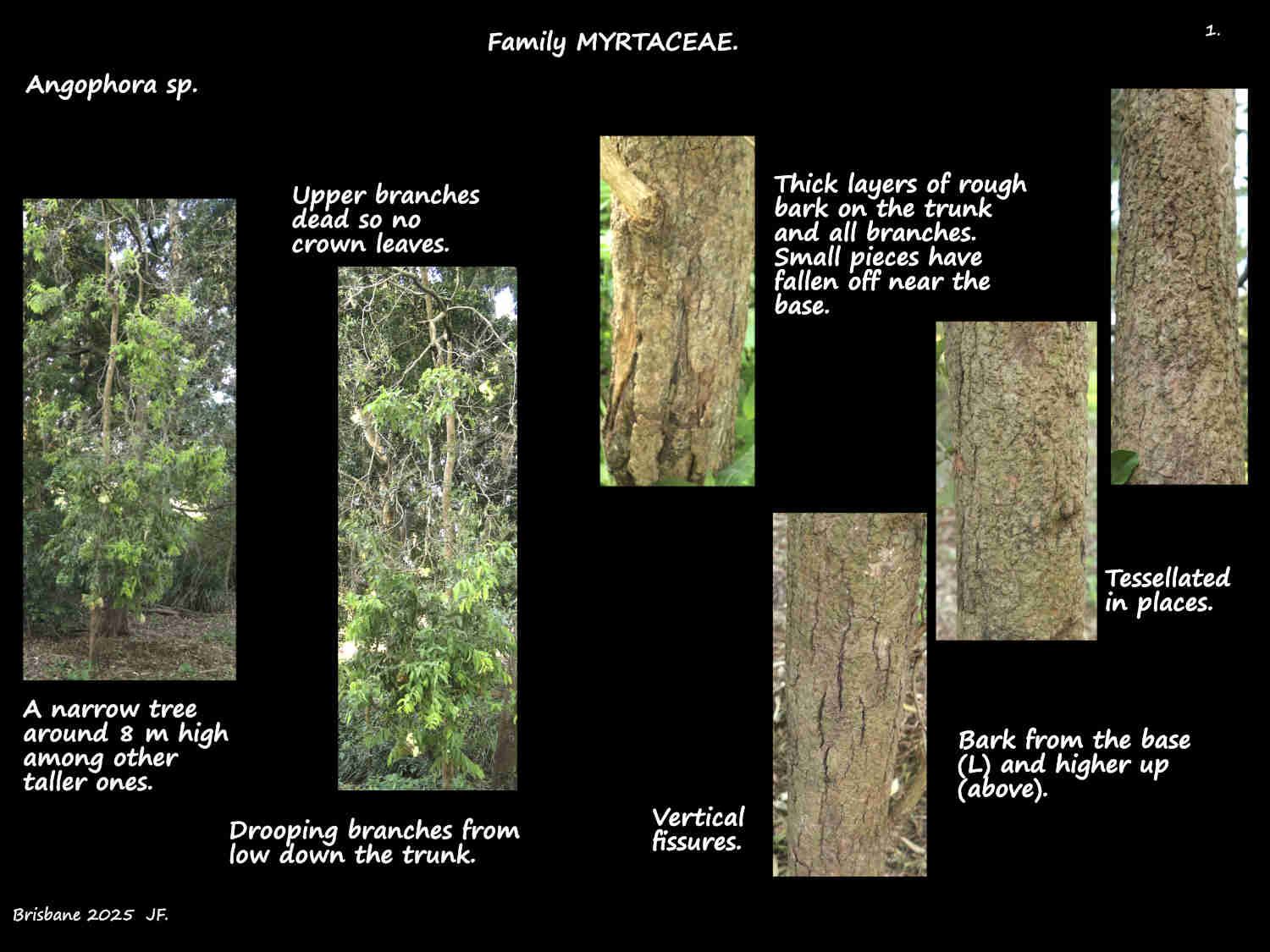
All have persistent rough fibrous bark except A. costata and its subspecies.
(Some consider the smooth barked subspecies leiocarpa to be another species named A. leiocarpa.)
The persistent bark is brown, pale to dark grey or grey-brown and may be fissured or flaky.
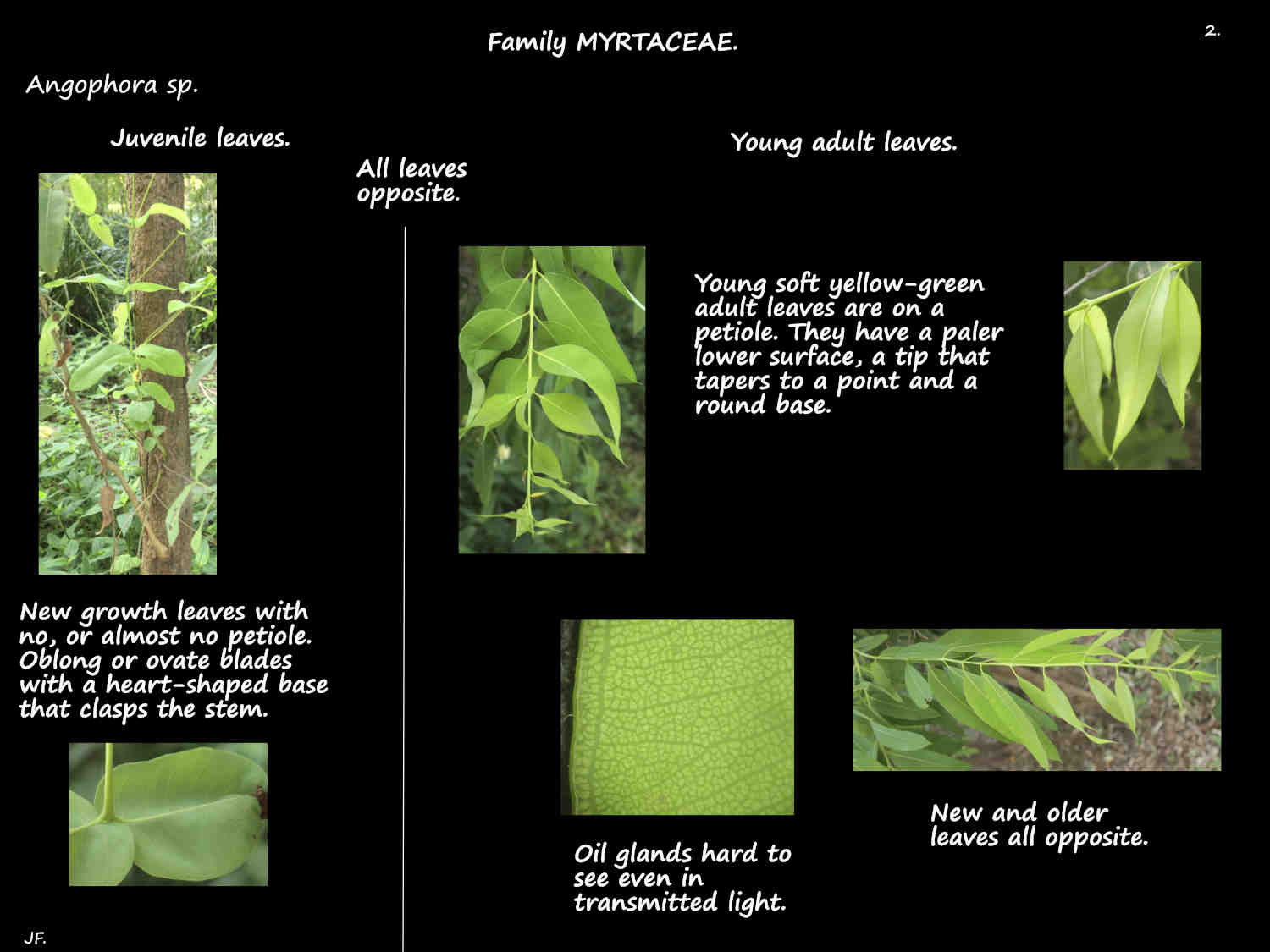
All leaves are opposite and there are different juvenile and adult leaves (dimorphic).
Juvenile leaves, with no petiole (or a very short one) have a heart-shaped base that clasps the stem.
They can be ovate, oblong or lance-shaped with a paler lower surface.
Leaves range from around 5 to 12 cm long and from under 1.5 cm to over 6 cm wide.
The oil glands are prominent and there may be small stiff hairs.
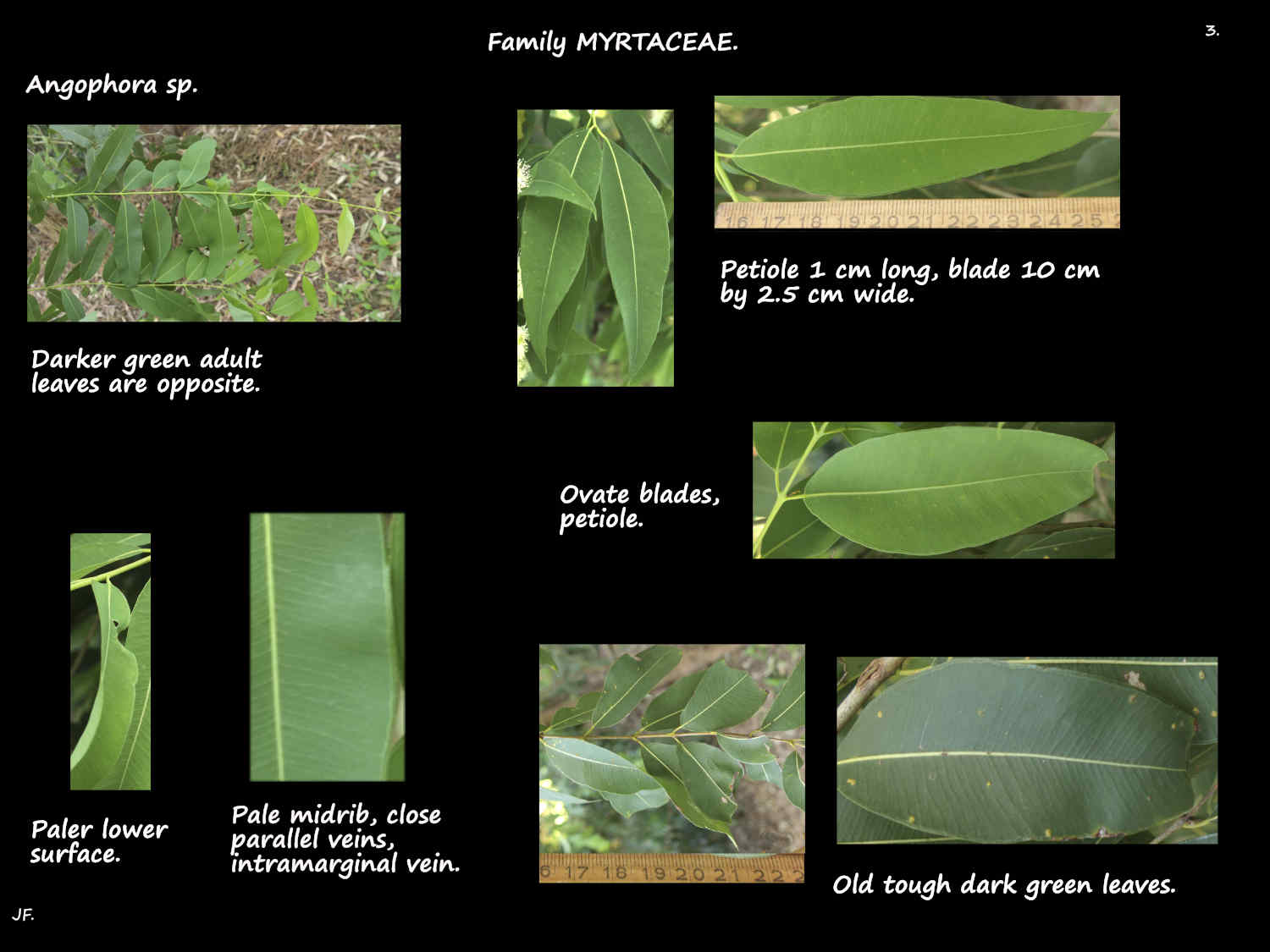
Opposite adult leaves are on a round, angled or flattened petiole up to 2 or 2.5 cm long.
Blades are mostly a narrow lance or sickle-shape with a pointed tip and tapering base.
They are up to 20 cm long and 5 (7) cm wide.
The leathery or thin papery blades usually have a smooth edge.
Most have no hairs but there may be a few small bristly ones.
The dull or shiny upper surface can be green, dark green, grey-green or blue-grey and the lower is always paler.
The fine lateral veins are closely spaced and there is a dense reticular network between them.
There is an intramarginal vein and the oil glands are small and hard to see.
The crown of mature trees can have different types of leaves.
- true adult leaves on a petiole and with a tapering base.
- juvenile leaves with no petiole and a heart-shaped base clasping the stem.
- a mix of adult and juvenile leaves.
Crown leaves of mature trees are usually juvenile with only a few species having adult leaves.
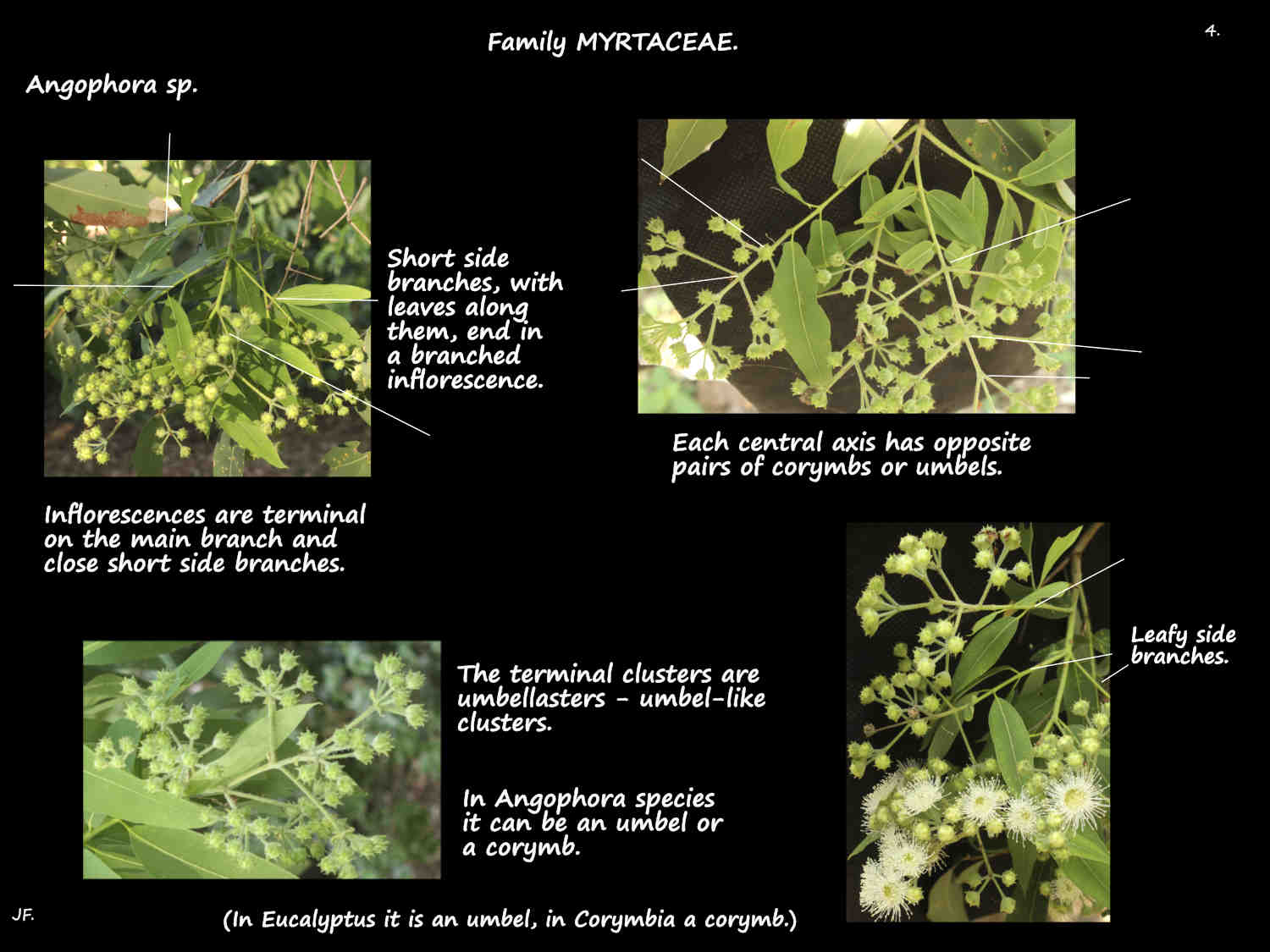
Branched inflorescences are terminal on the main and short side branches.
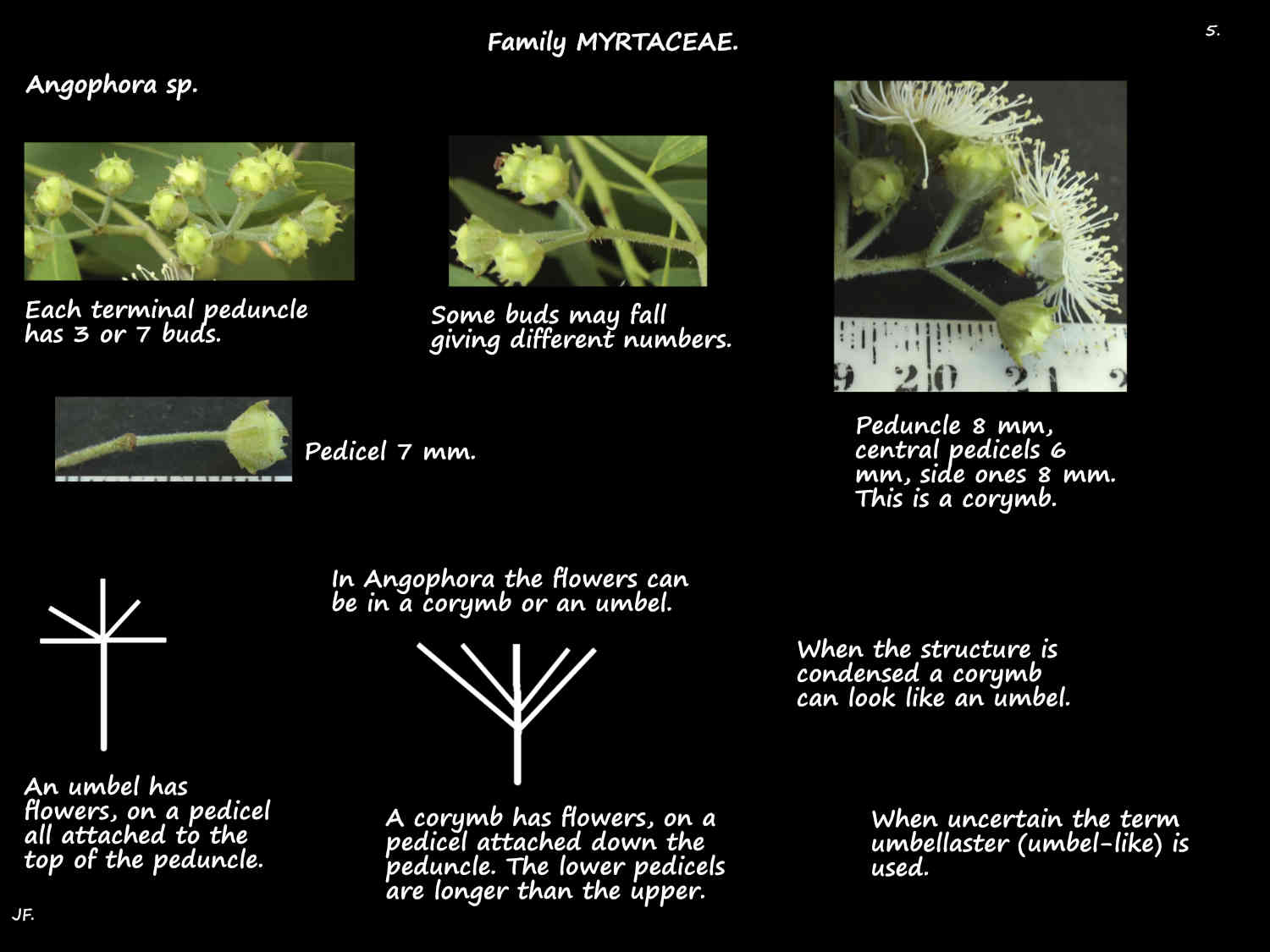
The terminal peduncles have 3 or 7 flowers on pedicels 3 to 25 mm long.
(Eucalyptus species have flowers in umbels and Corymbia have corymbs (see illustration below).
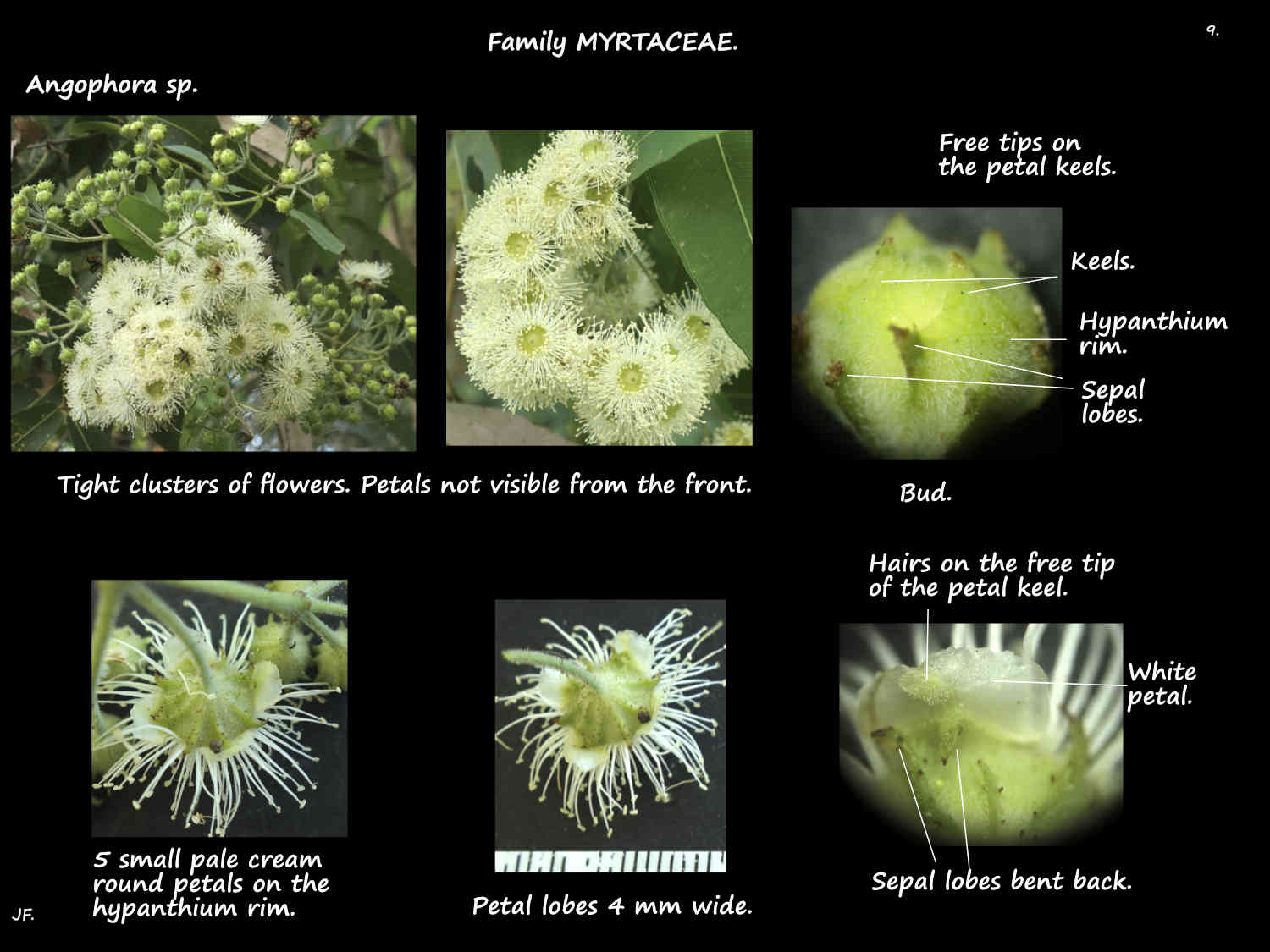
Those in Angophora can be either umbels or corymbs and where uncertain they are called umbellasters.
With three there is a central flower with one on each side.
If the 2 side flowers have one on each side that makes a cluster of 7.
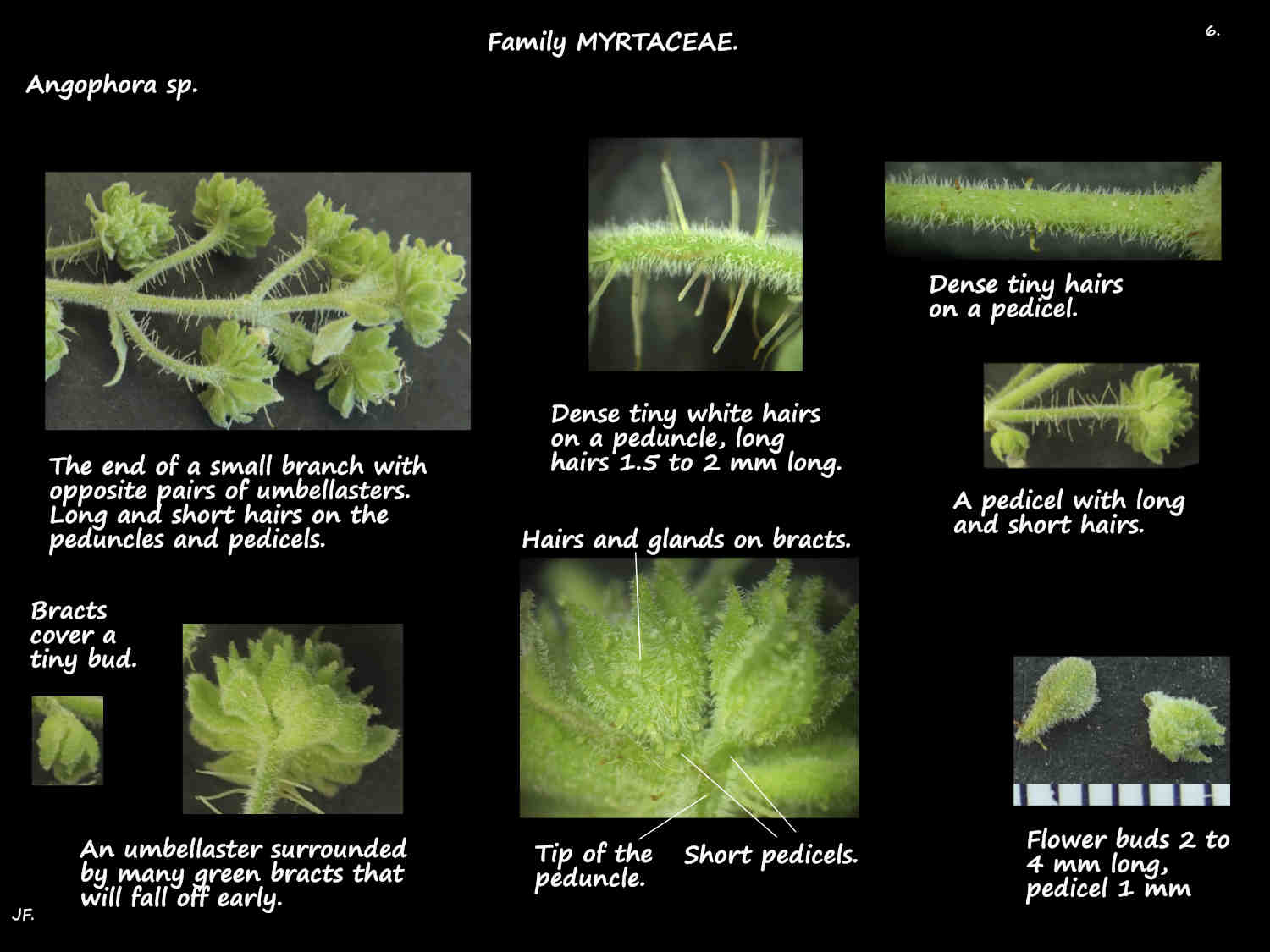
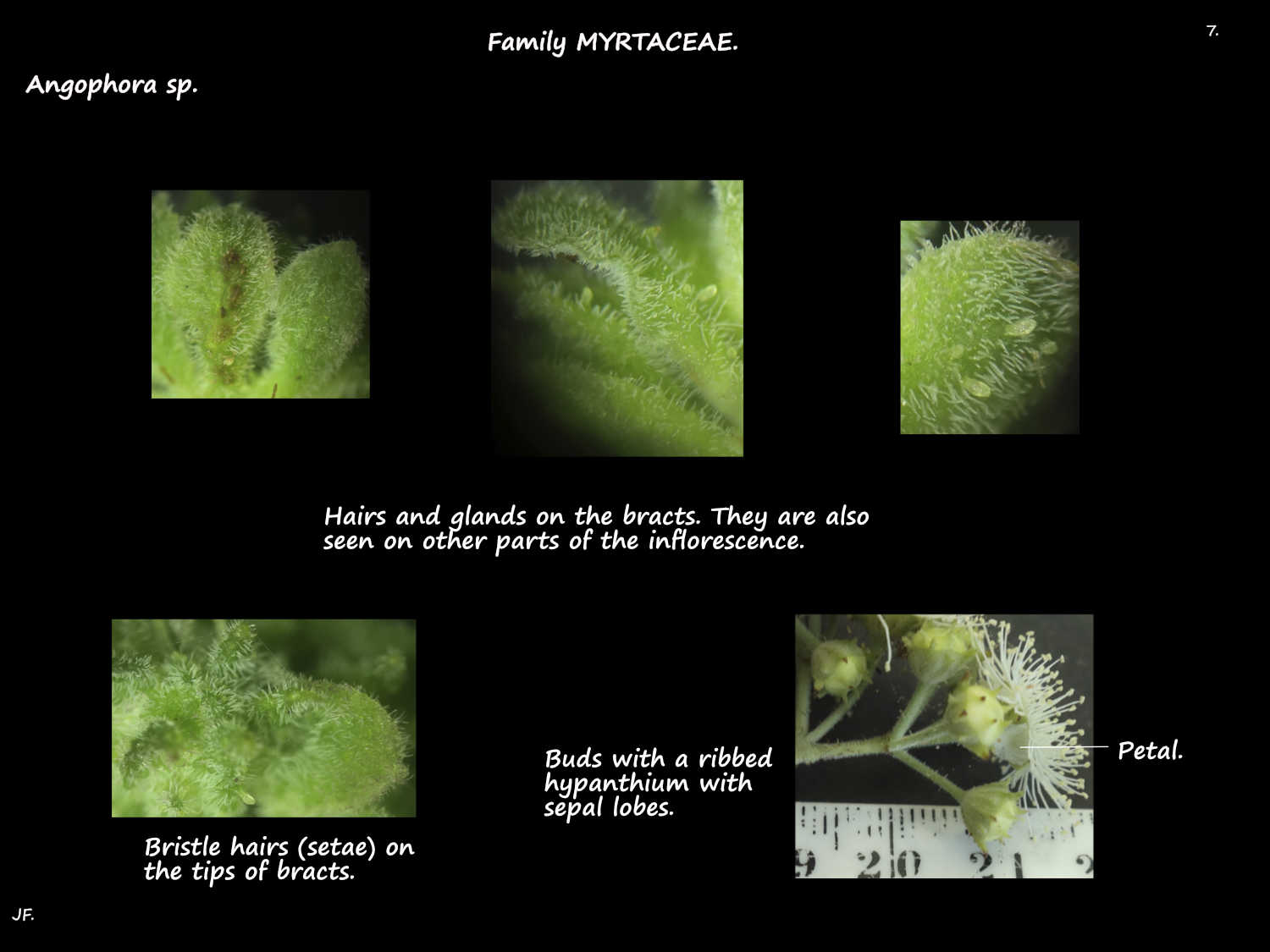
The peduncle, pedicels, bracts and other parts of the inflorescence often have tiny hairs and glands.
The buds are protected by many small green bracts that fall very early.
Bracts are covered in tiny white hairs and prominent oil glands.
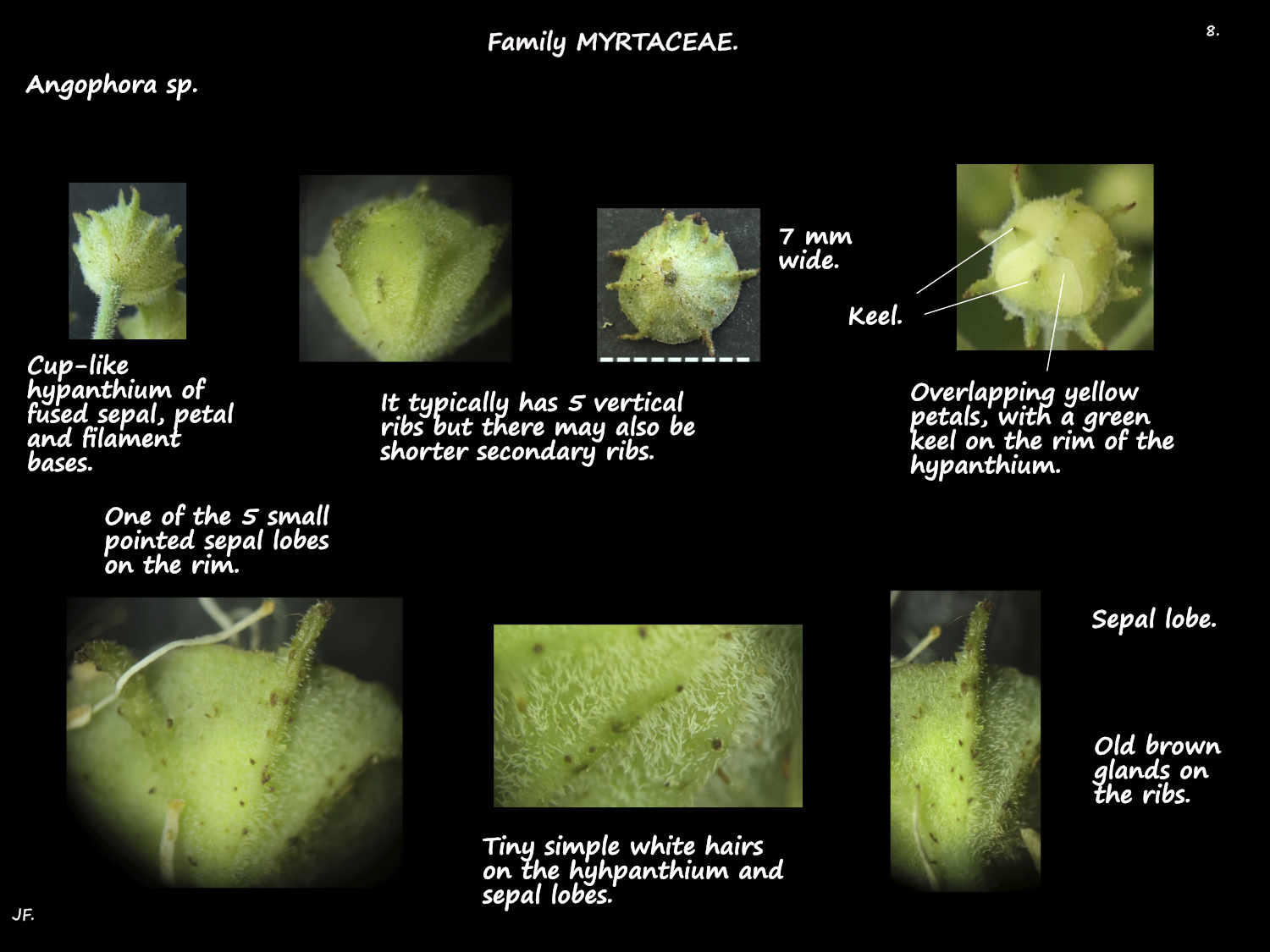
Mature spherical buds are 4 to 5 mm long and 6 to 7 wide.
The base is the hypanthium of fused sepal, petal and filament bases.
The hypanthium can be cup-like or an inverted cone.
It has vertical ribs and is usually covered with small hairs.
On the rim of the hypanthium are the 4 or 5 sepal and petal lobes, the stamens and the disc.
The outer whorl has the 1 to 3 mm long pointed green sepal lobes that persist on the fruit.
Inside the sepals are the round, 2 to 4 mm cream to white petal lobes with a pale green keel.
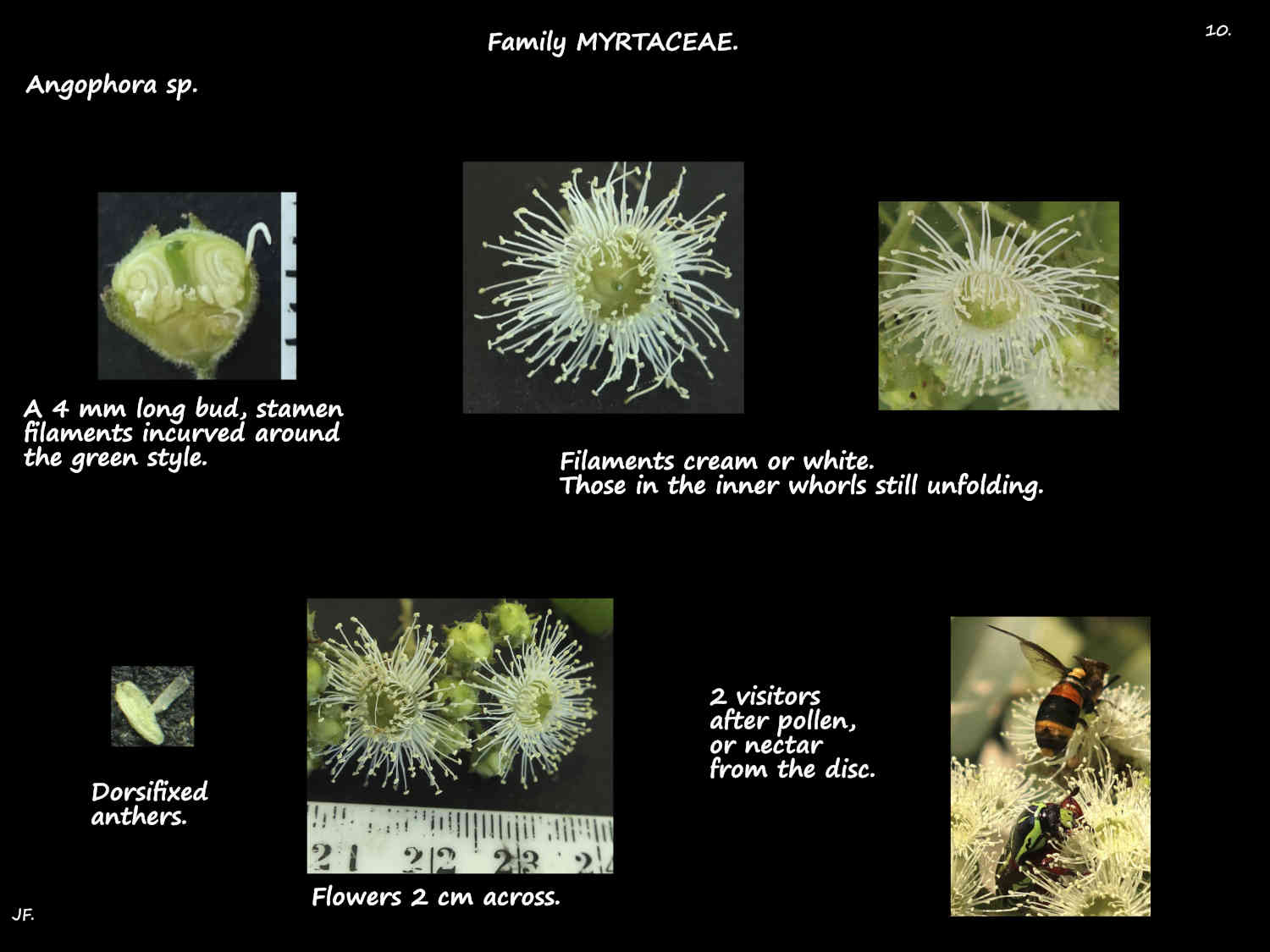
Inside the petals are whorls of free stamen filaments.
The cream to white filaments are up to around 1 cm long.
In the bud they are curved inwards.
The oblong dorsifixed anthers open through longitudinal slits.
The gland at the tip, between the pollen sacs can be indistinct or prominent.
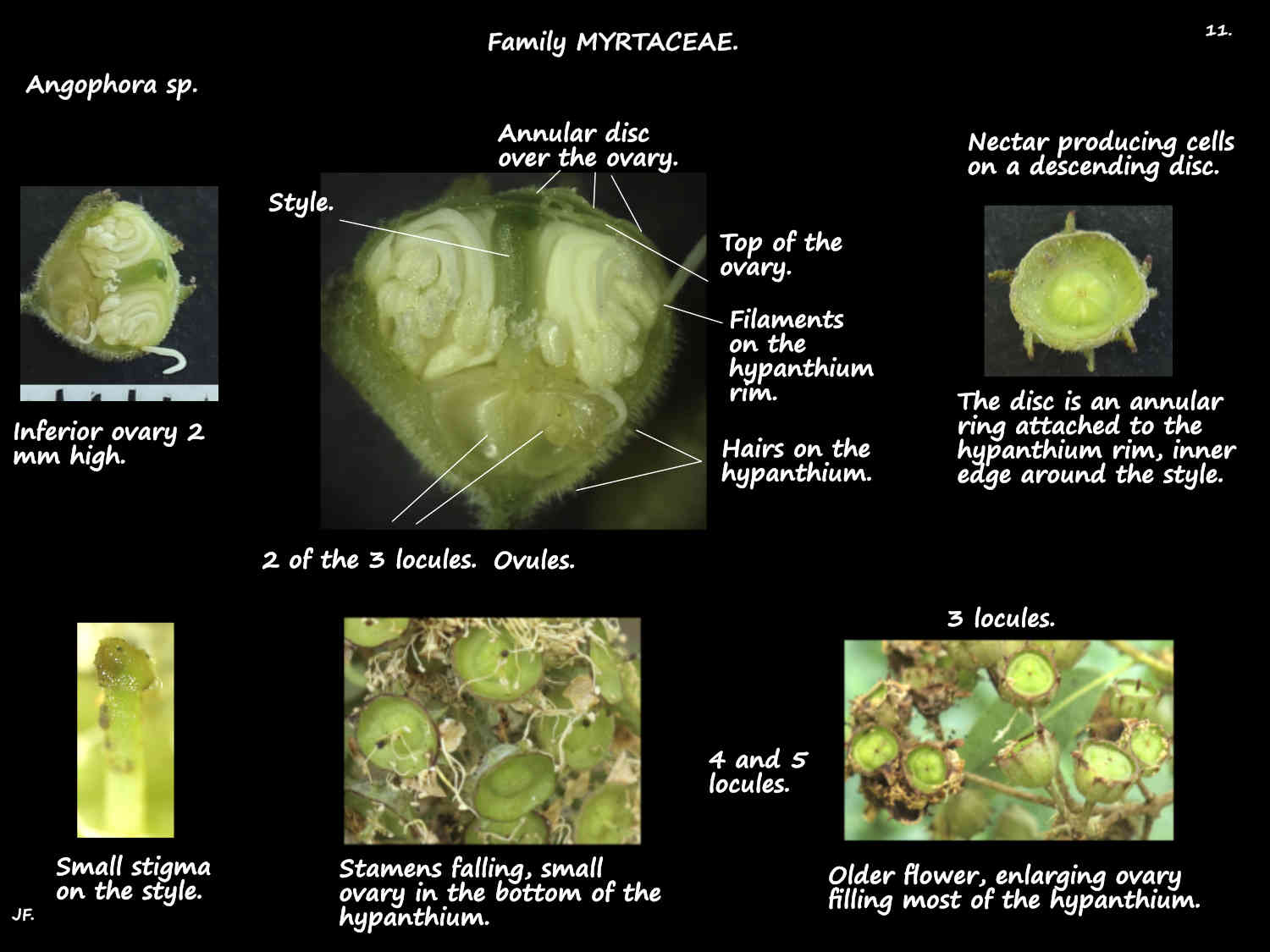
The mostly inferior ovary has 3 (4) locules with vertical rows of ovules and the style has a small flat stigma.
The narrow annular disc, attached to the rim of the hypanthium inside the filaments lies over the top of the ovary.
Cells on the disc secrete nectar.
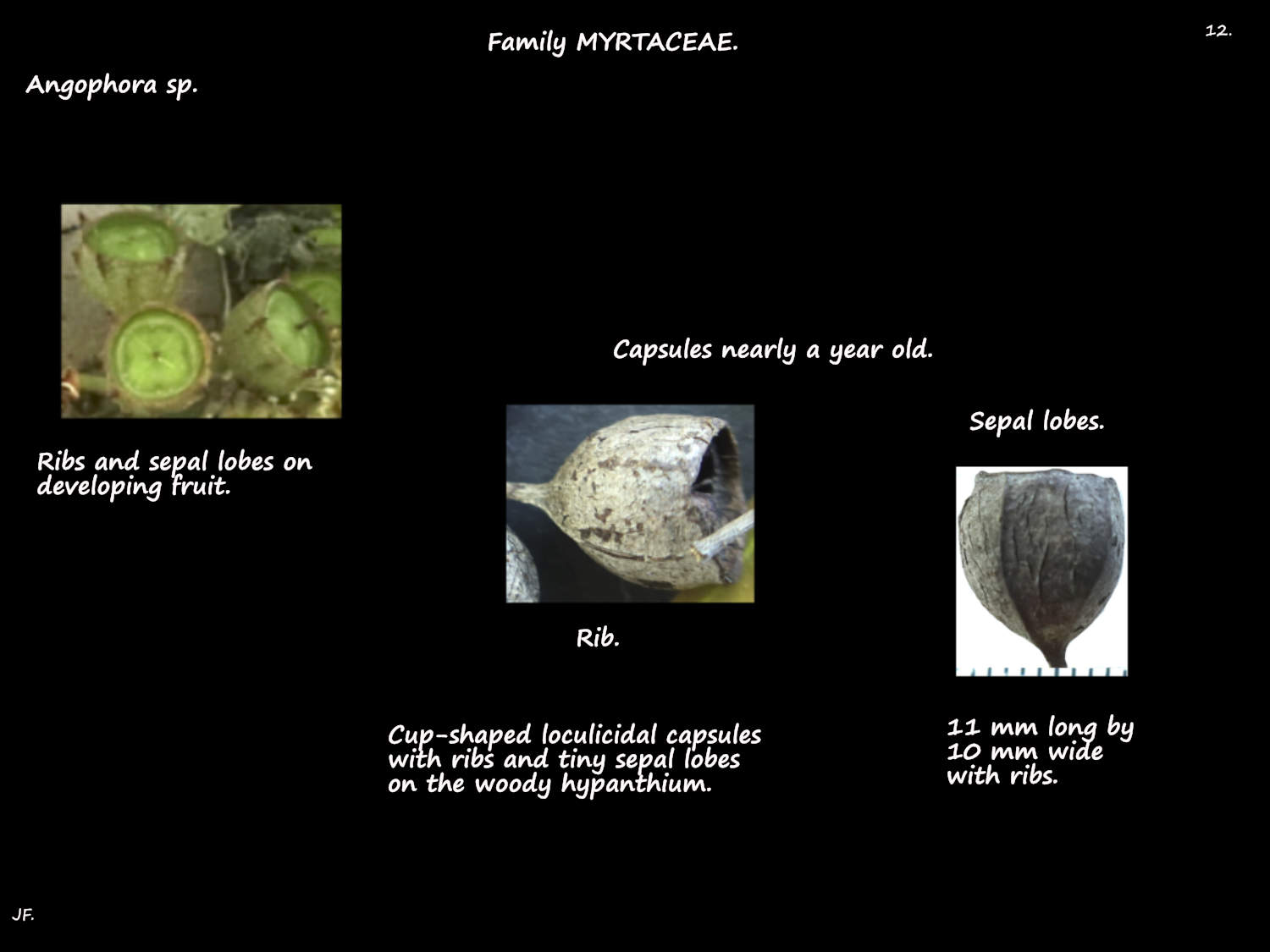
Fruit are a woody loculicidal capsule almost always with ribs and the tiny sepal lobes.
Most are ovoid or spherical, some cup or bell-shaped.
The firm or hard woody fruit are 7 to 14 mm long by 7 to 12 mm wide.
The brown, black or grey capsules can be smooth or have some stiff hairs.
The disc can be level with the rim of the hypanthium, ascend above or descend below it.
Vertical slits into each chamber allow the seeds to escape.
Walls between adjacent chambers become the valves which can be above or below the hypanthium rim.
The flattened seeds have the hilum (placental attachment) in the centre of the upper surface.
A number of species are native to the area around Brisbane especially A. costata subsp. leiocarpa.
Angophora costata subsp. leiocarpa is sold in Brisbane as A. leiocarpa.
This recently suggested elevation to species level is not accepted by all.
Also sold locally are A. costata, A. subvelutina and the very similar A. floribunda and A. woodsiana.
J.F.