

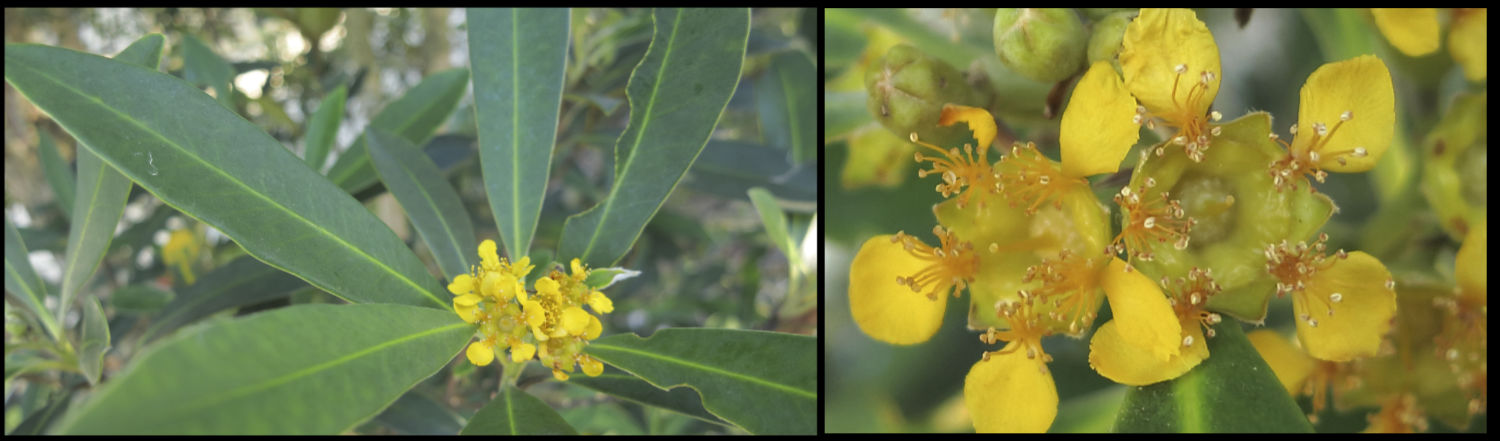
Family Myrtaceae > Subfamily Myrtoideae.
Plants of the World Online (Kew) recognises 43 species and Mabberley 40.
They are native to New Caledonia, New Guinea and areas around S. E. Asia.
Australia has 3 native species T. collina, T. exiliflora and T. laurina.
These 3 are all found along the S. E. coast of Queensland.
There are shrubs a few metres high and trees up to 30 or 35 m.
Trunks can be cylindrical, irregular or gnarled on very old trees.
When damaged some can grow new shoots from near the base of the trunk.
Old bark peels off in long strips leaving a smooth pale surface that gradually darkens.
Alternate leaves, on a short petiole have a simple blade.
The often elliptic or oblanceolate leaves can be up to 14 cm long.
The lower surface is paler and has short hairs as do the small twigs.
The midrib is prominent and there are oil glands.
Axillary inflorescences are cymes with 2 or 3 flowers on a short pedicel.
The hypanthium holds the 5 free green sepals and 5 yellow, cream or white petals.
The numerous stamens are fused into 5 bundles.
They are inserted on the hypanthium rim opposite the petals.
The inferior or part ovary usually has 3 locules and one style and stigma.
Fruit are a loculicidal capsule with the sepals attached.
The top of the capsule lies above the hypanthium.
Each chamber has seeds attached to the top of the central axis.
Seeds may have a wing.
Australian species.
1a Seeds with no wings …….. Tristaniopsis exiliflora.
1b Seeds with wings ….. Go to 2.
2a Hairs on the lower leaf surface … T. laurina
2b No hairs on the lower leaf surface … T. collinia
J.F.

