Family Myrtaceae > Subfamily Myrtoideae.
Native to Australia they are found along the S. E. coast of Queensland and coastal N.S.W and Victoria.
Previously known as Tristania laurina it is commonly known here as the Water Gum.
It is a fairly common cultivated species seen in gardens, streets and parks.
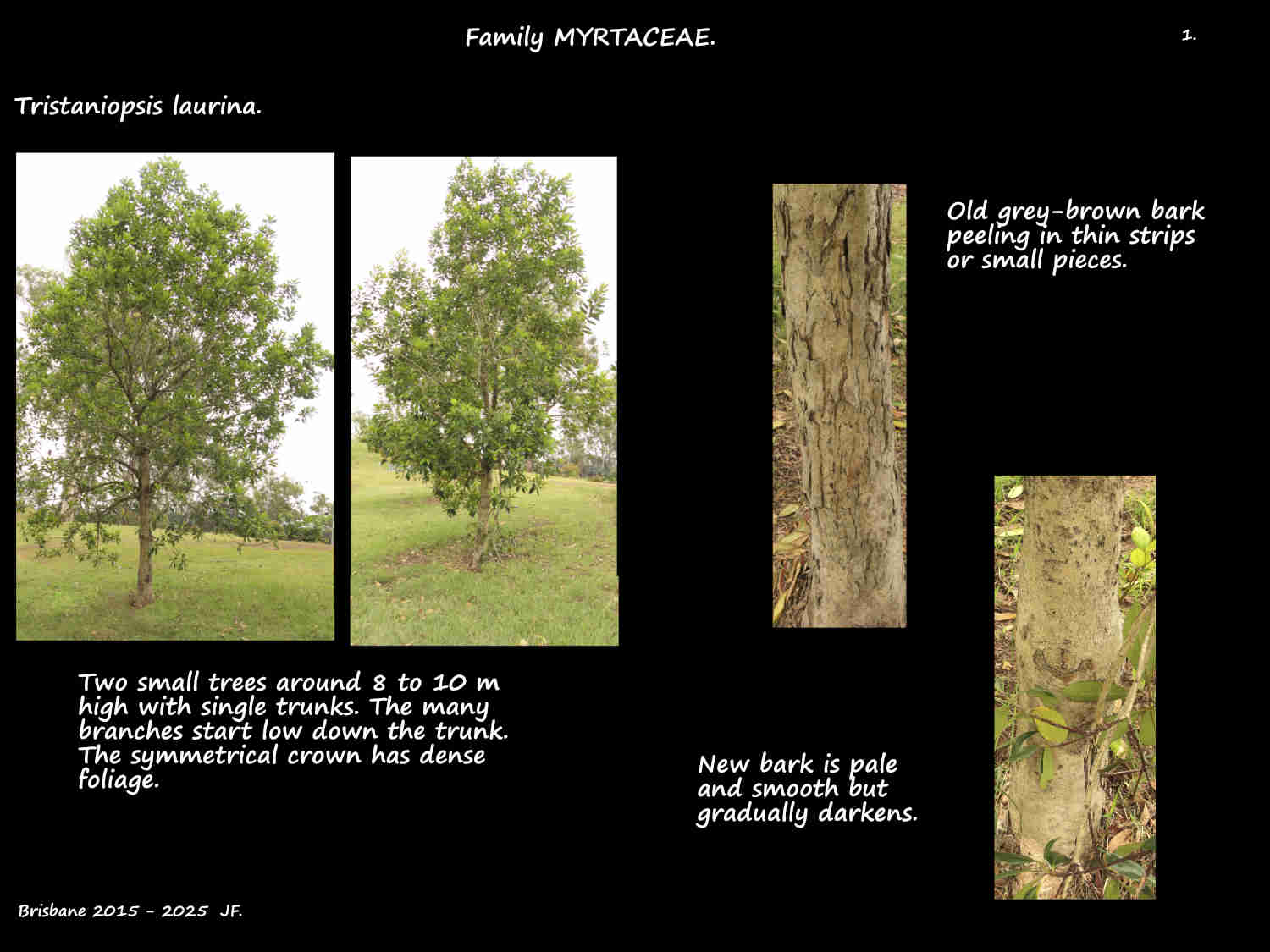
They are usually seen here as a shrub or small tree.
From 5 to 10 m high in cultivation they can be over 30 m in the wild.
With a single or multiple trunks they are well branched and have a compact crown.
Old bark peels off in long strips or smaller pieces leaving a smooth pale surface.
As it ages the bark becomes darker and is mottled in pale grey to brown.
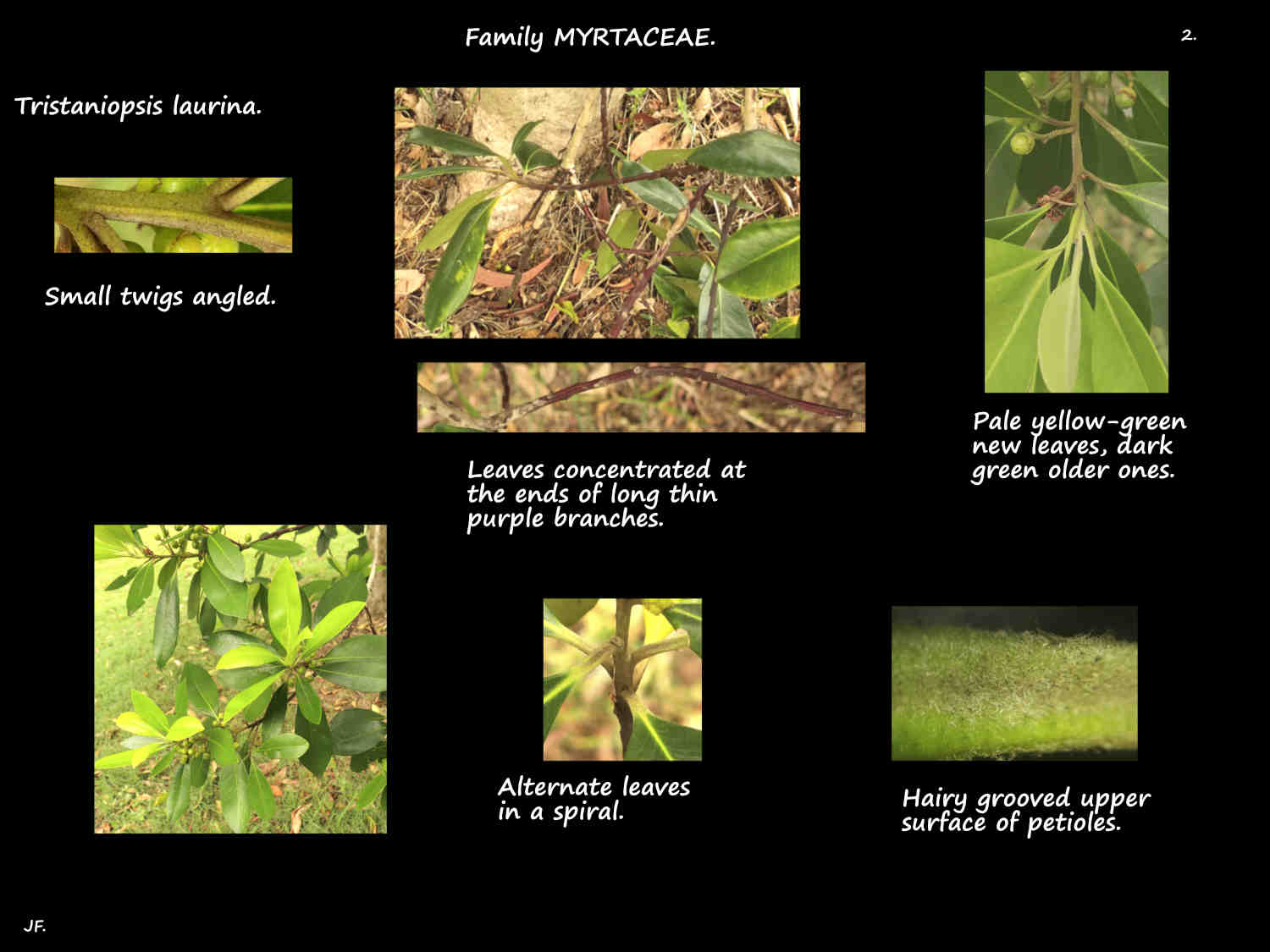
Small branches can be round or angled and green, brown or purple.
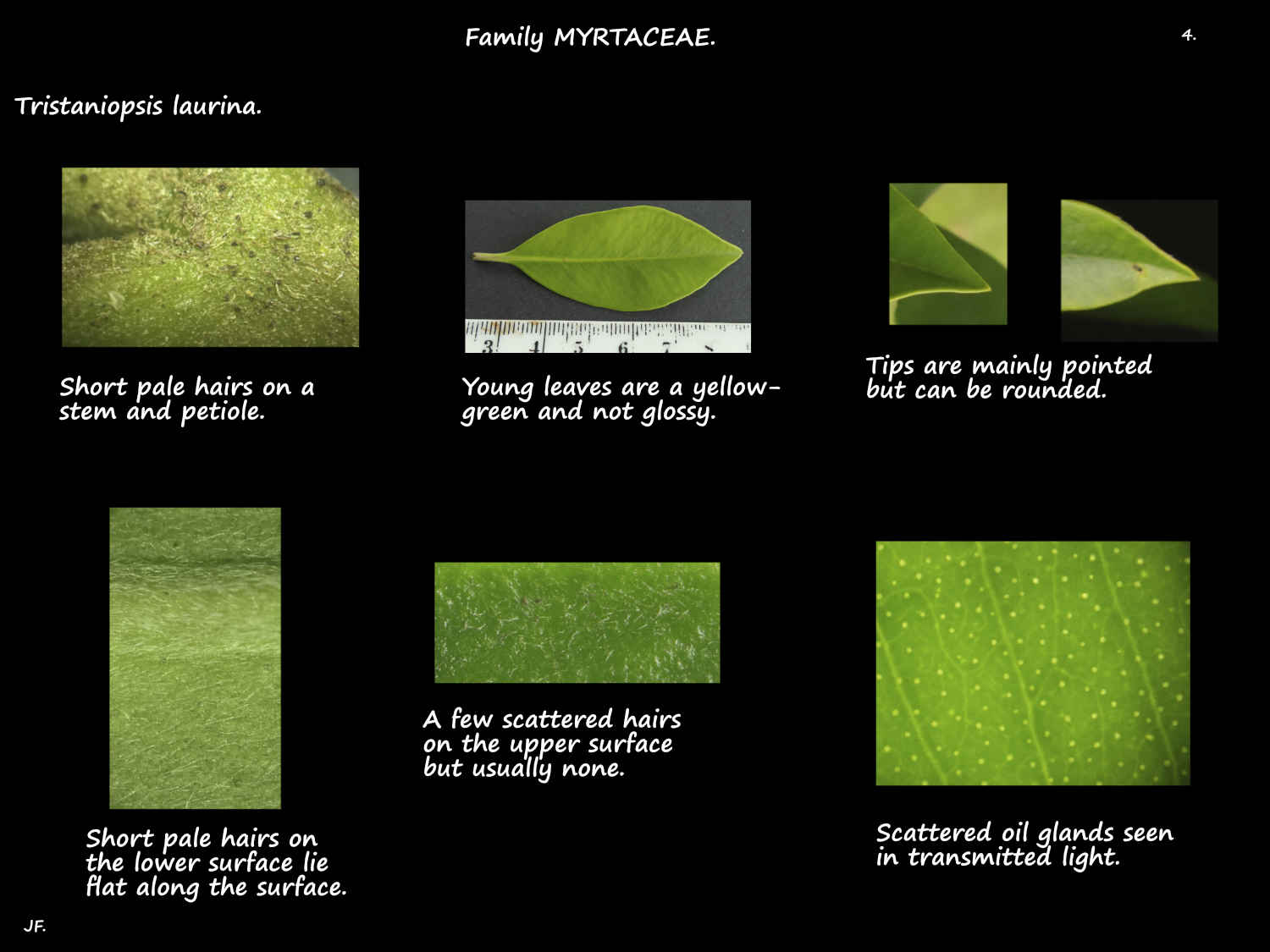
There are short simple hairs on the smaller branches.
The alternate leaves tend to be concentrated near the branch ends.
The short petiole, under 1 cm long has a shallow groove on the upper surface.
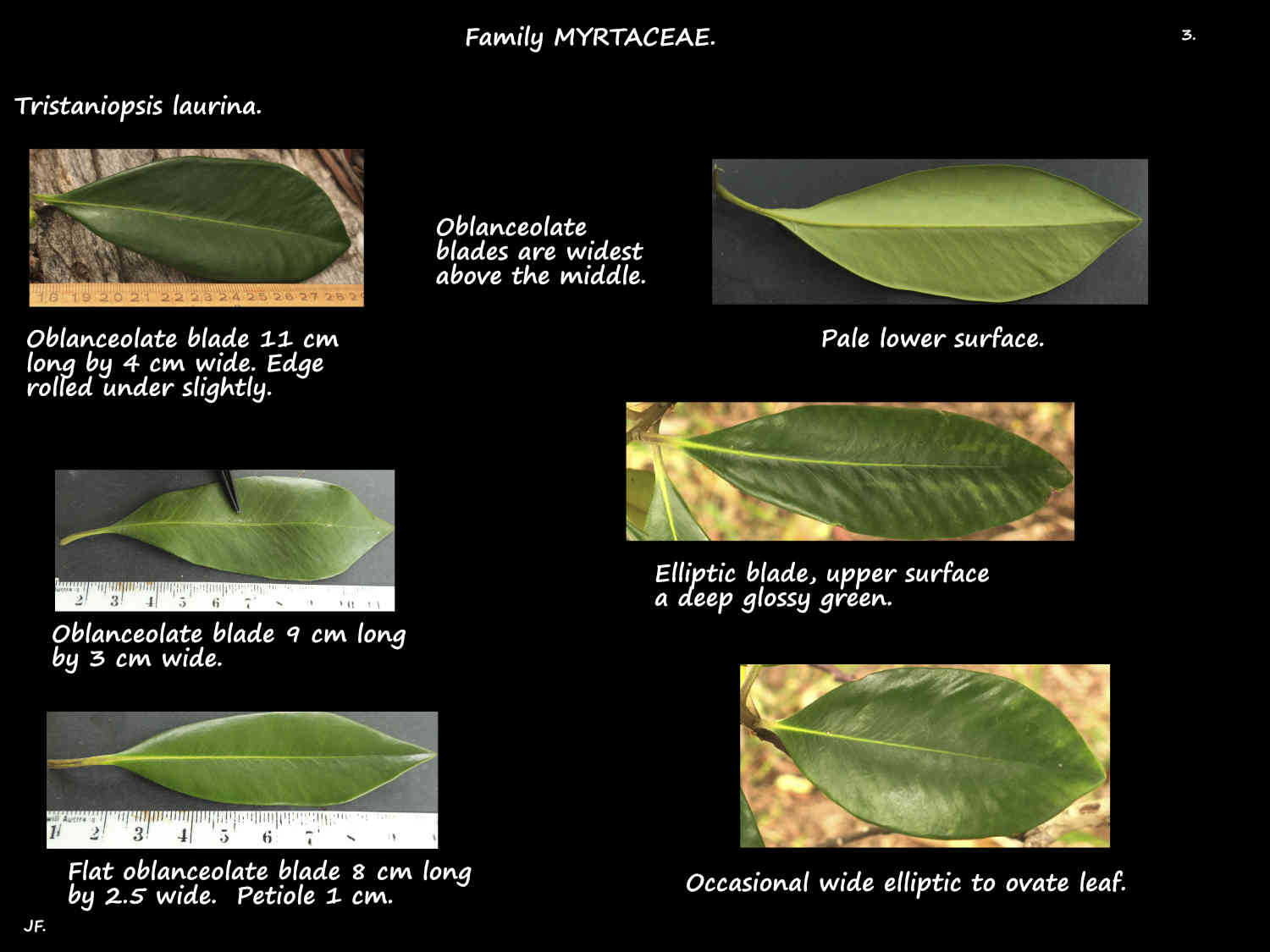
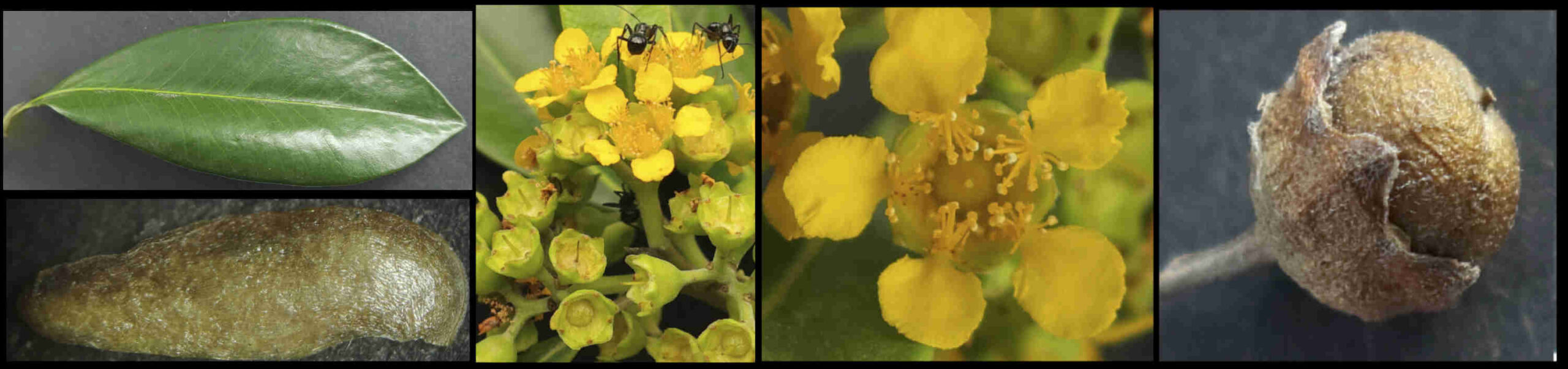
Blades, up to 14 cm long and 1 to 3 cm wide have a blunt or pointed tip.
They are narrowly elliptic to oblanceolate.
The upper surface is a shiny deep green with no (or a few) hairs.
The lower is a pale whitish-green and has small hairs that lie along the surface.
New leaves may be a shiny deep red.
Scattered oil glands are best seen in young leaves.
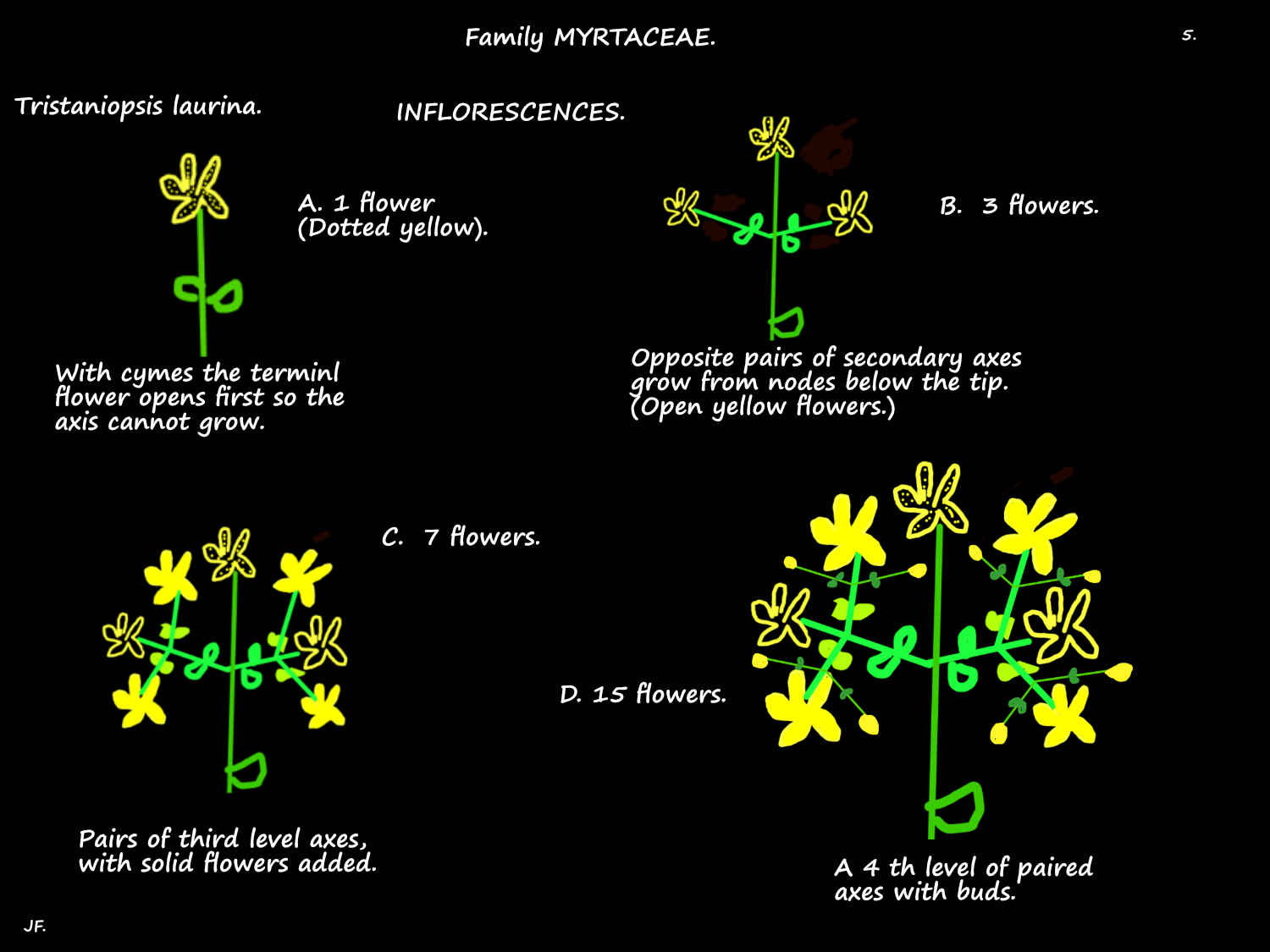
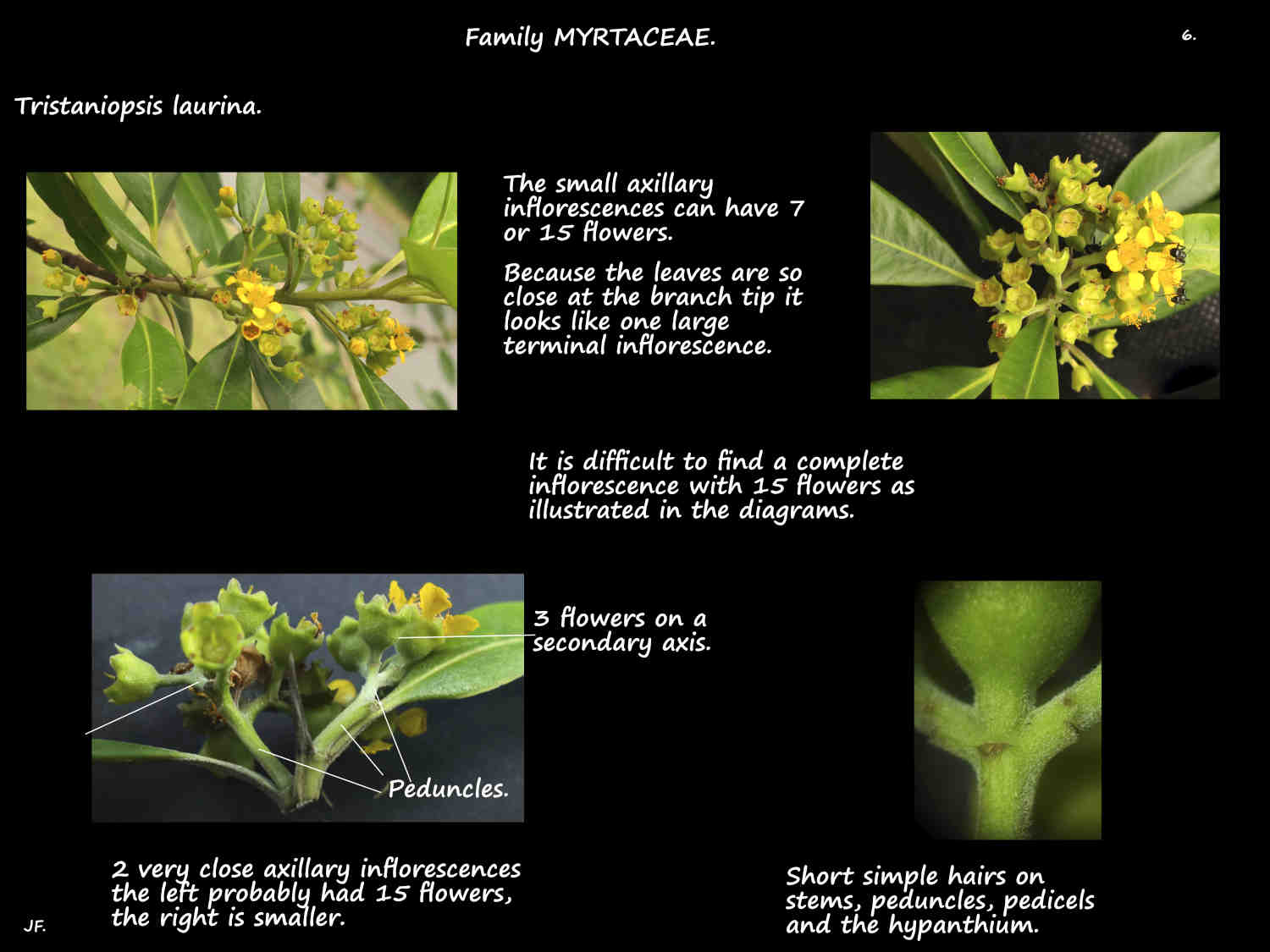
Axillary inflorescences are short clusters of up to 15 flowers.
They are cymose with a flower on the tip of the axes.
They increase in size by branching from nodes below the tip.
At each node, opposite pairs of flowering stems grow from the axils of bracteoles.
Each pair of new stems ends in a flower but can repeat the branching pattern.
If all the flowers survived this inflorescence would have 7 or 15.
Each flower is on a short hairy pedicel with tiny bracteoles that fall early.
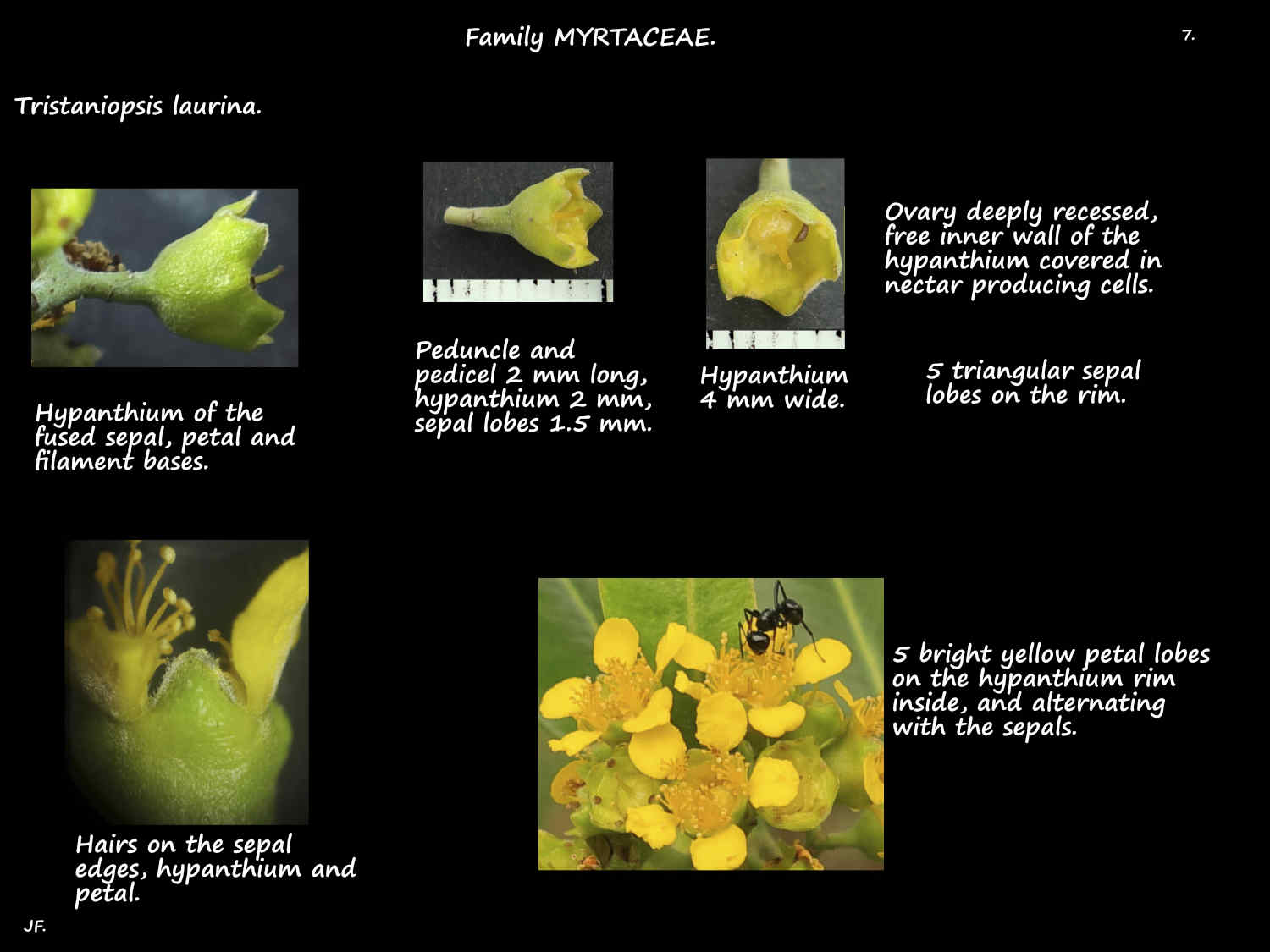
Flowers have a hypanthium of fused sepal, petal and filament bases.
Only a few mms long it has small pale hairs that lie along the surface.
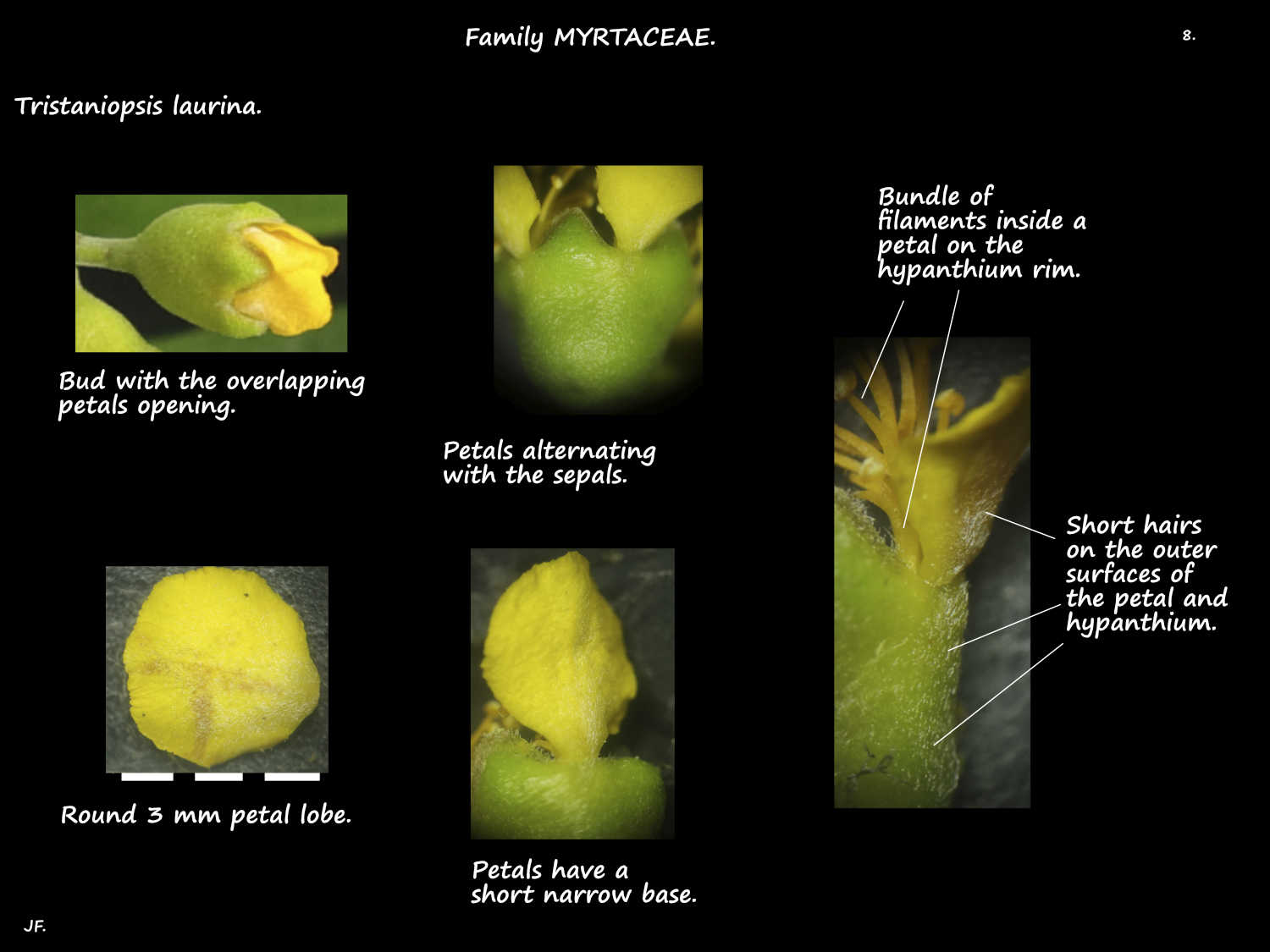
On the rim are 5 green sepal lobes outside, and alternating with 5 petal lobes.
The triangular green sepal lobes have dense short hairs on the edges.
Most of the outer, and all the inner surface is smooth.
The bright yellow petals are oblanceolate or circular with a short narrow base.
They are around 3 to 4 mm across.
When fully open the petals form a flat corolla around 1 cm wide.
There are small hairs on the lower/posterior surface of the petals.
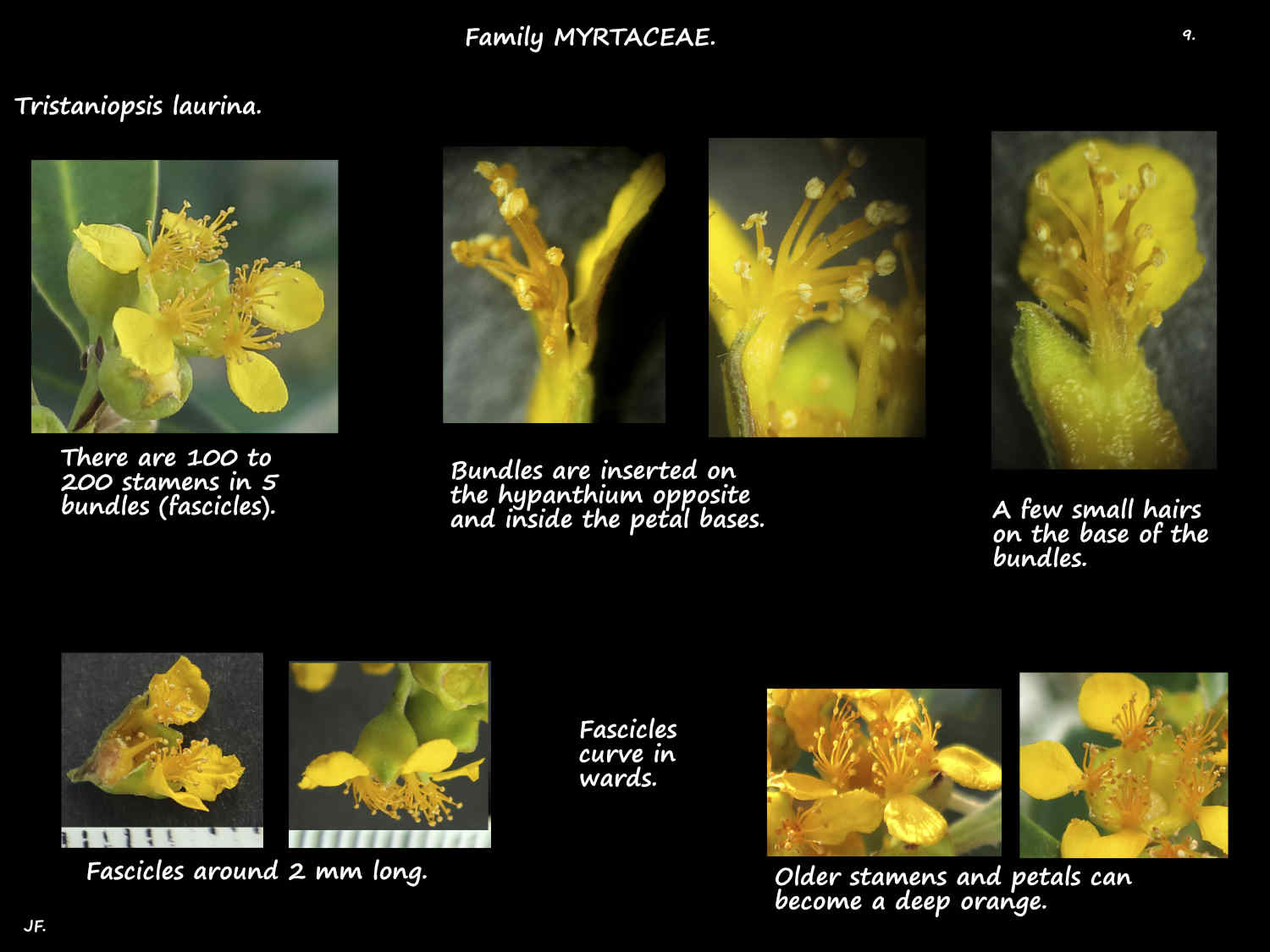
The stamens are inserted on the hypanthium inside and opposite the petals.
There are 100 to 200 divided into 5 bundles or fascicles.
The filament bases are fused into a flat triangular column.
The rest of the filaments, of unequal lengths are attached to the sides of the column.
The fascicles are bright yellow then deepen to orange in older flowers.
They bend inwards over the stigma.
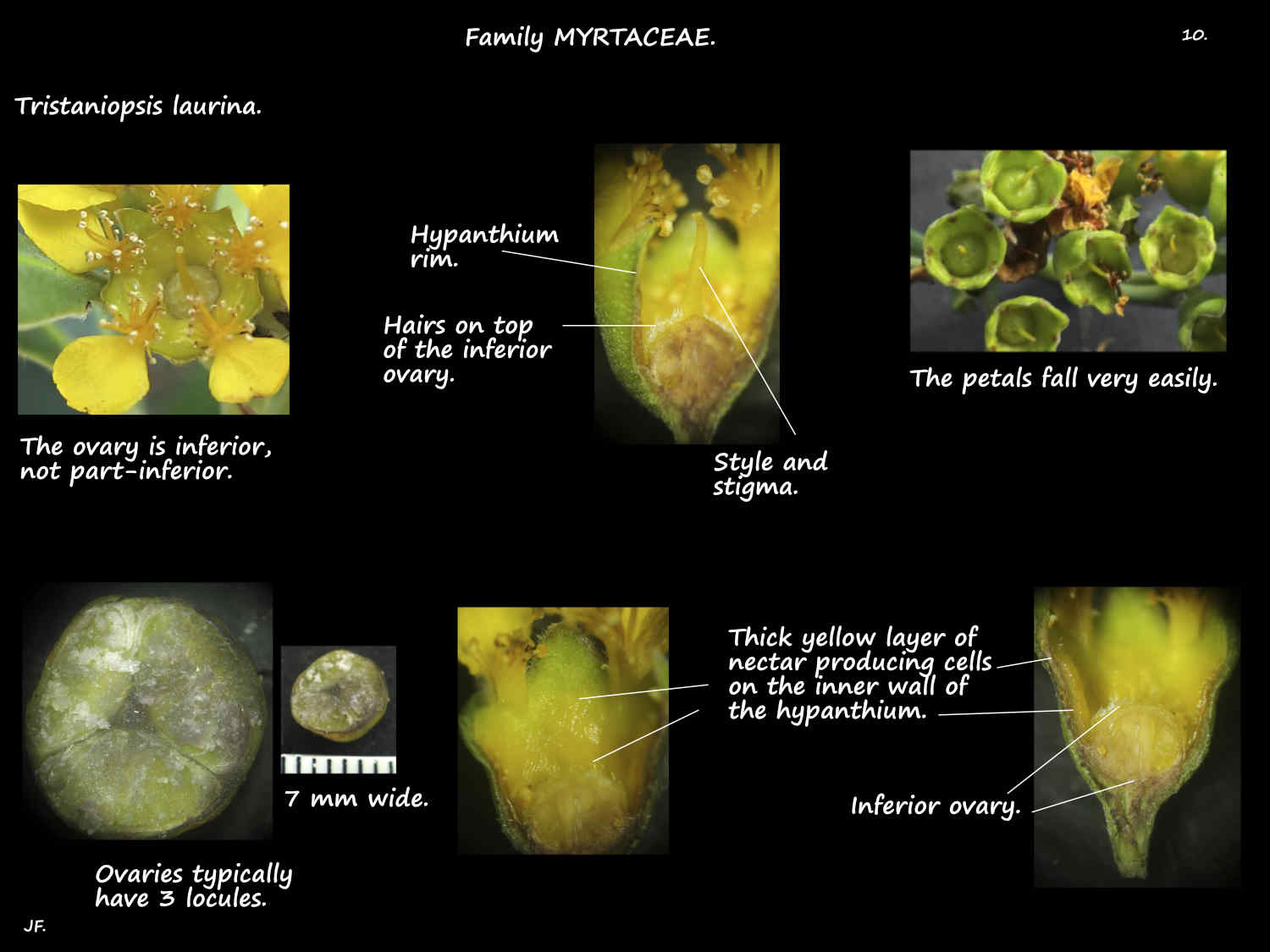
The ovary is inferior.
(It is the capsules that extend above the hypanthium.)
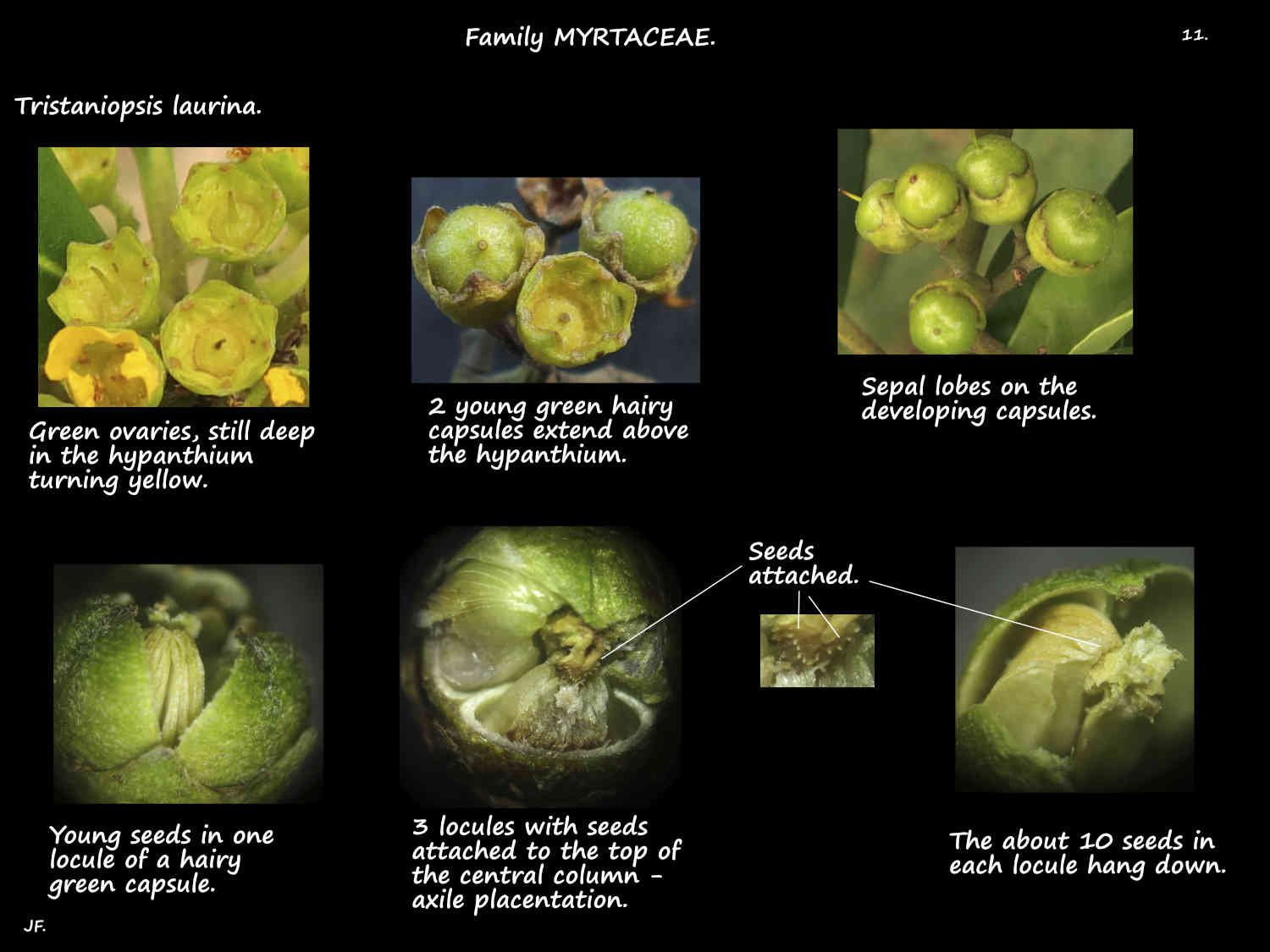
The typically 3 locules have numerous ovules.
Ovules are attached to the top of the central column (axile placentation).
There is a single style with a small stigma.
Flowers produce a lot of nectar from cells lining the free inner wall of the hypanthium.
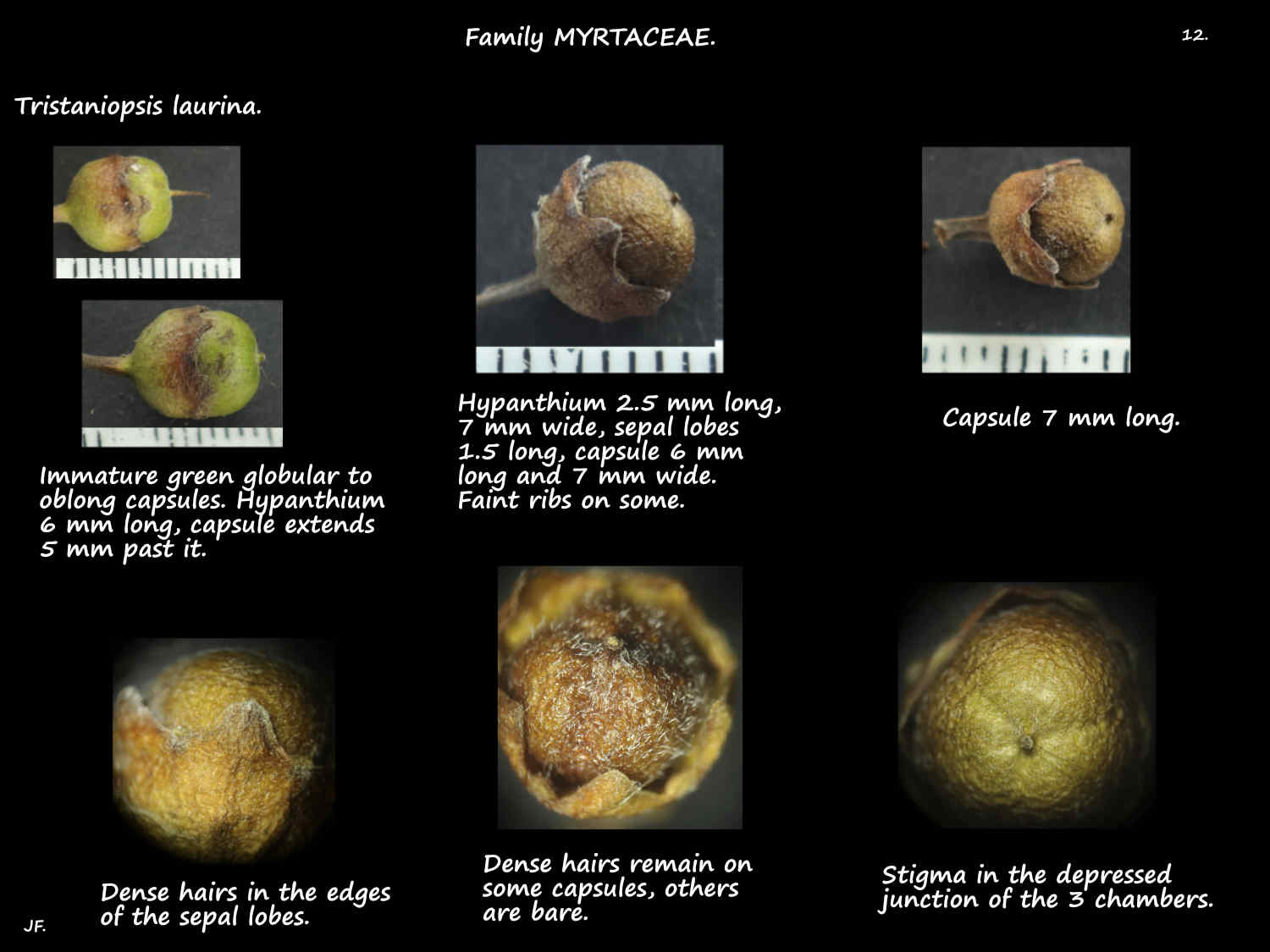
Fruit are a woody loculicidal capsule up to 1 cm long and 0.5 cm wide.
They are globular to oblong with the 5 sepal lobes are still attached.
Mature capsules extend well above the rim of the hypanthium.
They mature from green to dry and brown and open into the 3 chambers.
The splits only extend from the tip to the top of the hypanthium.
The outer surface has some small hairs.
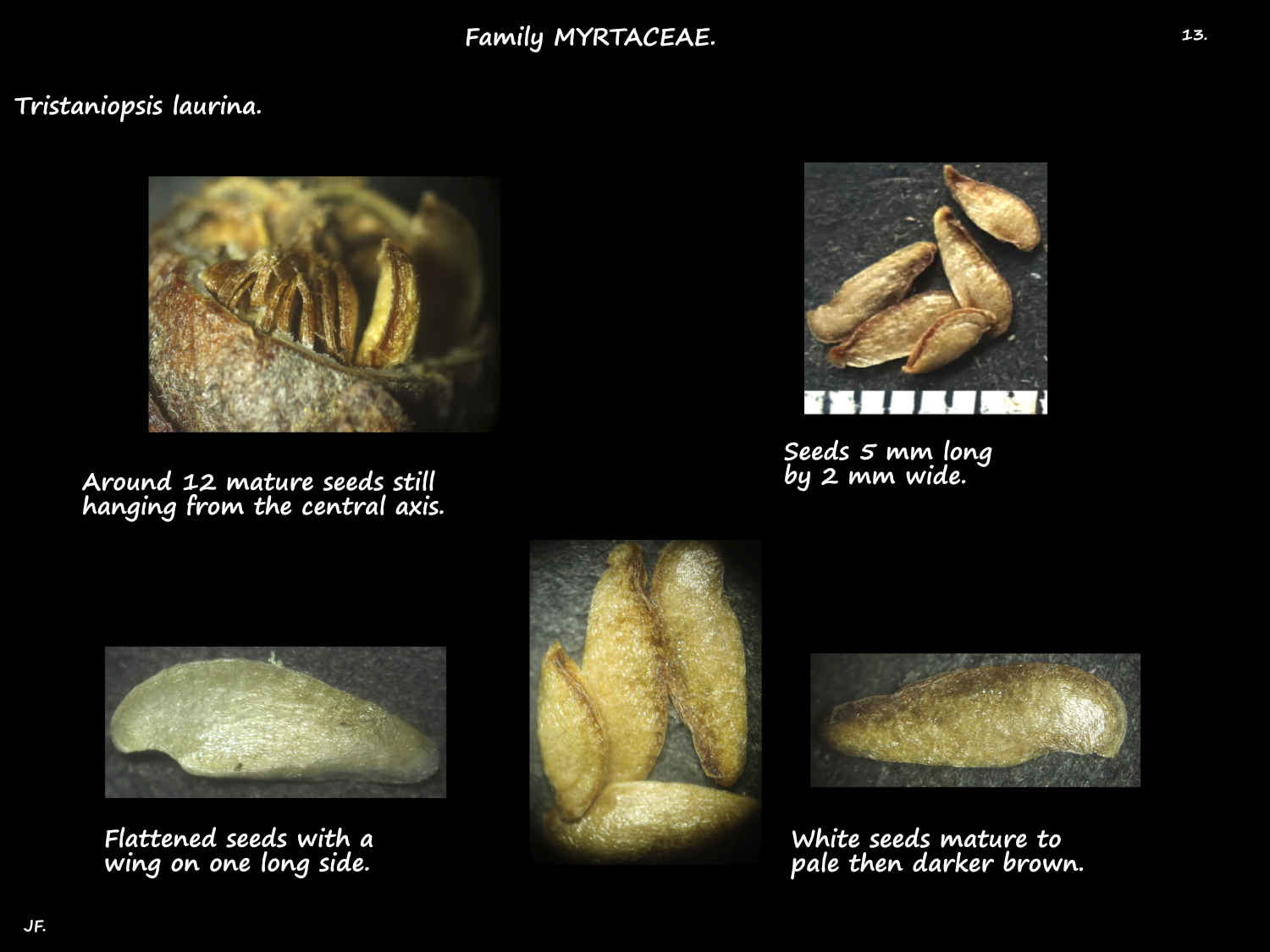
The numerous seeds are flattened and have a long wing.
Around 5 mm long and 2 mm wide they are a pale brown.
( Illustrations below are from tagged trees.)
J.F.