

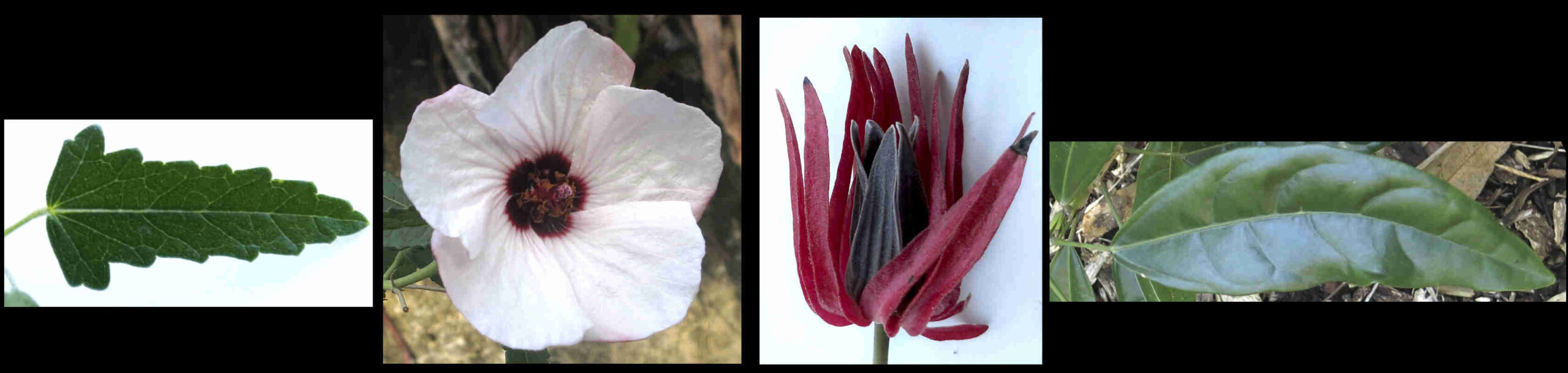
In Family Malvaceae, Plants of the World Online accepts 291 species.
Queensland has 1 naturalised species – Pavonia hastata.
Most are annual to perennial herbs or small to large shrubs.
They can be prostrate or scrambling with most being erect.
There are a few small trees.
Many parts have hairs that are mostly stellate but there are some simple hairs.
There may also be some glandular hairs.
Alternately arranged leaves can be in a spiral or 2 ranks (distichous).
They are on a petiole but this can be very short.
Narrow stipules at the petiole base usually do not fall.
Blades are very variable and can be elliptic, ovate, obovate, triangular or lance-shaped.
The wedge or heart-shaped base is sometimes asymmetric.
Occasionally smooth the edge almost always has small sharp teeth or blunt lobes.
There may be larger lobes at the base that point down (sagittate) or outwards (hastate).
Deep divisions can make blades palmately divided.
Inflorescences are commonly 1 or 2 flowers in the leaf axils.
Others are terminal clusters of variously arranged flowers (heads, spikes etc.).
Flowers are usually on a stalk (pedicel) but it may be very short.
There are hairs on many parts.
At the base of the flower is an epicalyx or involucre of 5 to 24 bracts.
They are in 1 or more whorls and may be fused at the base.
They may also be fused to the base of the calyx.
The leaf-like bracts are ovate, spatula-shaped or linear.
They are usually green but some are pink or red.
Above the epicalyx is the saucer to bell-shaped calyx with 5 (to 16) sepals.
Sepals are fused for up to half their length with the lobes being ovate.
The star-shaped or tubular corolla has 5 petals that are longer than the sepals.
The wide obovate petals may have a narrow claw base or basal lobes.
As well as white, petals can be pink, red, yellow, purple or mauve.
Petal bases, fused to the base of the staminal column may be a dark colour.
Most of the length of the stamen filaments are fused into a staminal column.
The top of the column can be level or have 5 teeth or lobes.
Most of the short free filament ends are attached near the top of the column.
The column can be shorter or longer than the petals.
The superior ovary, of 5 free carpels has 5 locules with 1 ovule in each.
The carpels are inserted around a small conical extension of the receptacle.
The 10 styles, 2 from each carpel, are fused at the base and into the staminal column.
The 10 free ends of the styles each has a small flat or rounded stigma.
Fruit are a slightly flattened spherical schizocarp.
These are a dry fruit that splits into 5 sections (mericarps) each from one of the carpels.
The mericarps can be smooth, ridged, winged, spiny, hairy or have 3 long barbs.
Most open along the suture (septicidal) rather than into the mericarp (loculicidal).
Each section has one kidney-shaped seed that is smooth or has a few hairs.
(Pavonia have 10 stigmas while the similar Hibiscus species have 5.
Occasionally however Pavonias only have 5 styles and stigmas.
The first flowers each season are smaller, have petals shorter than the calyx and can set seed without opening.
They also only have 5 stamens.)
J.F.

