They are a small tree up to 8 or 12 m high.
The first branches are a whorl of 3 to 5 with later branches being alternate.
The alternate leaves on the whorled stems are variously arranged.
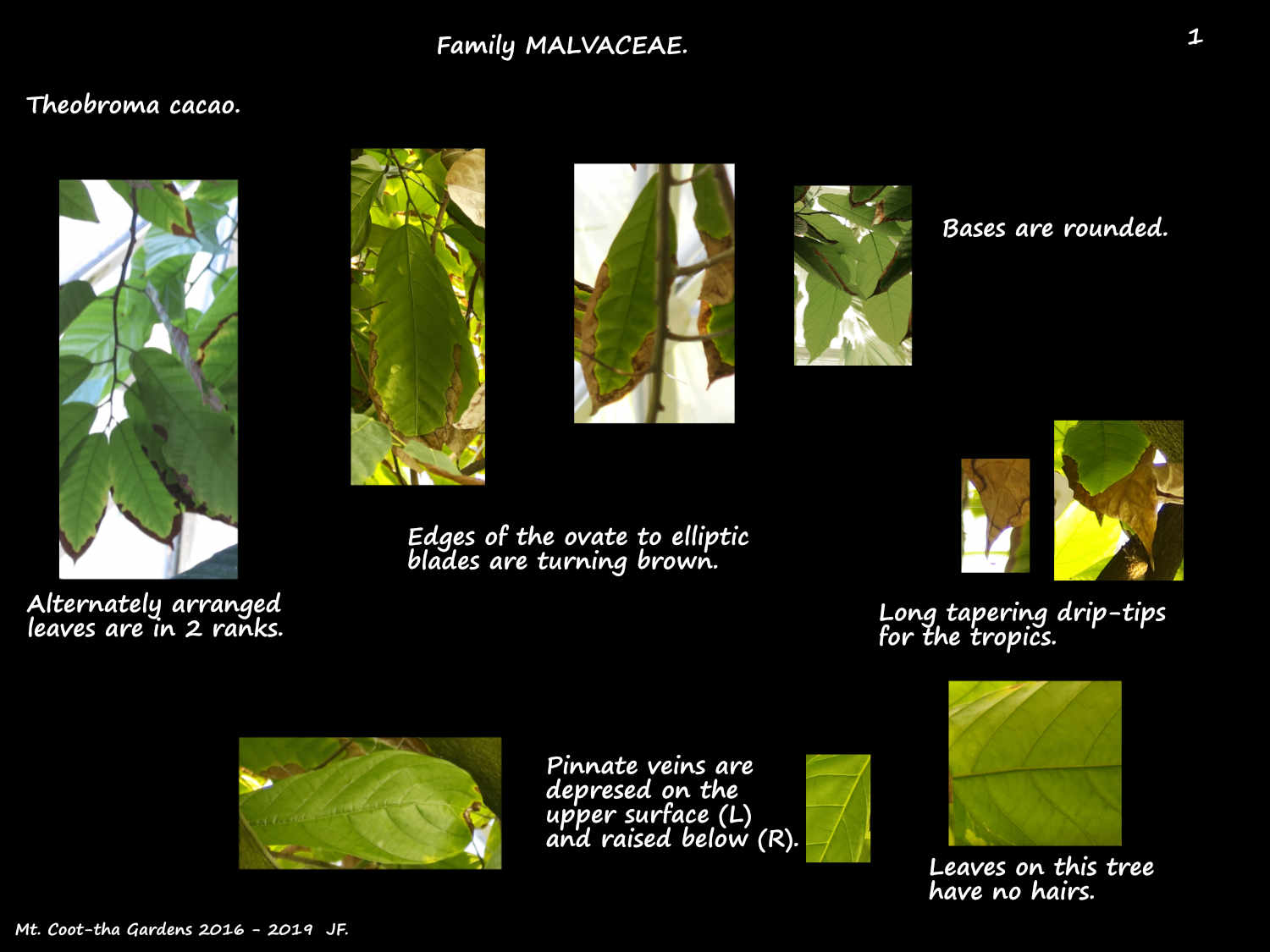
Those on the later stems are alternate and in 2 ranks (distichous).
The simple evergreen leaves are on a short petiole.
Shiny leaves are around 40 cm long and up to 10 cm wide.
Blades are ovate to elliptic with a heart-shaped or round base.
They have a long tapering drip-tip and pinnate veins that are raised on the lower surface.
Leaves may have no hairs or occasional simple hairs with glands.
More common are scattered multi-cellular stellate hairs.
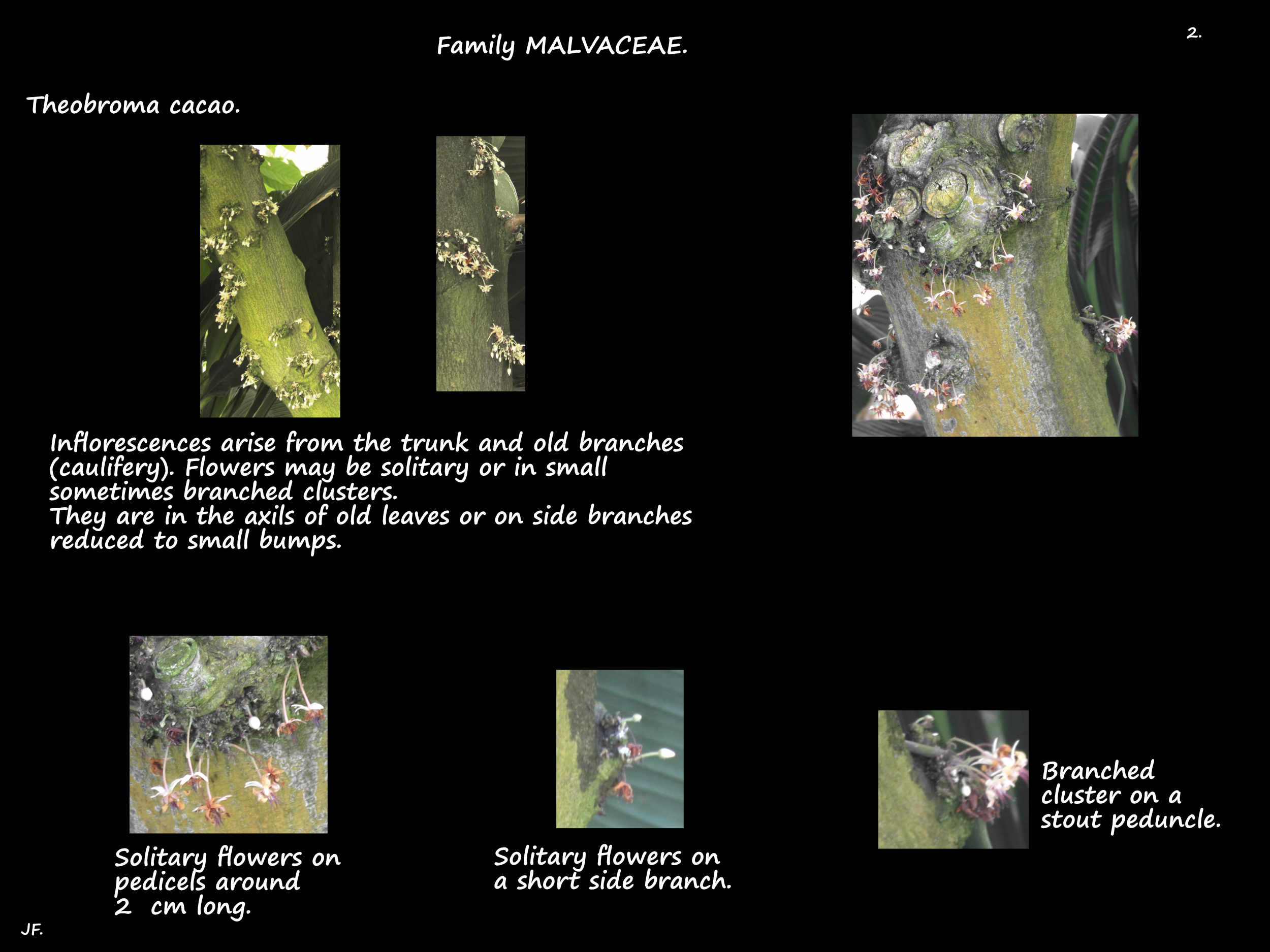
Inflorescences are a solitary flower or a small branched cluster with the terminal flowers opening first.
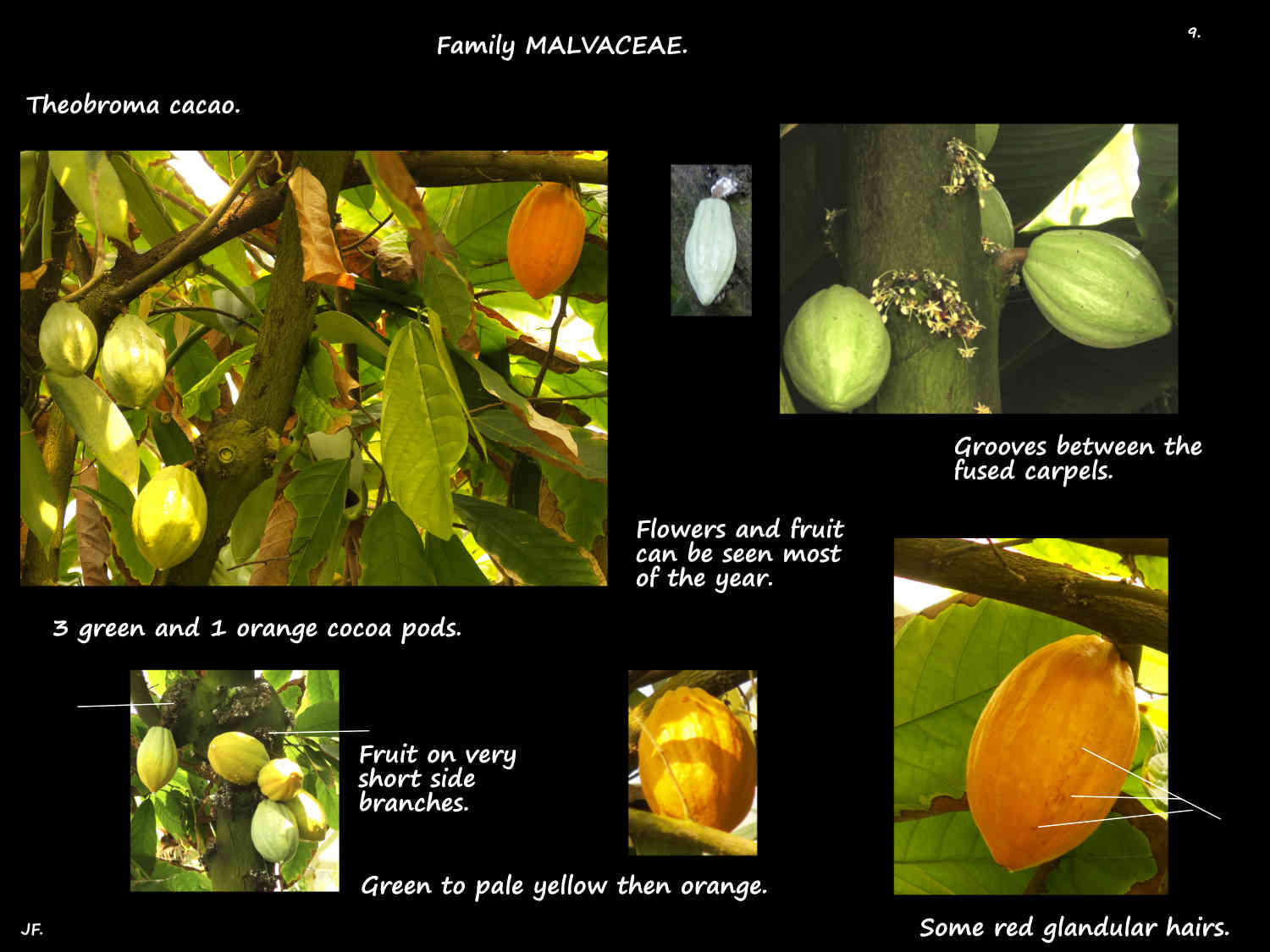
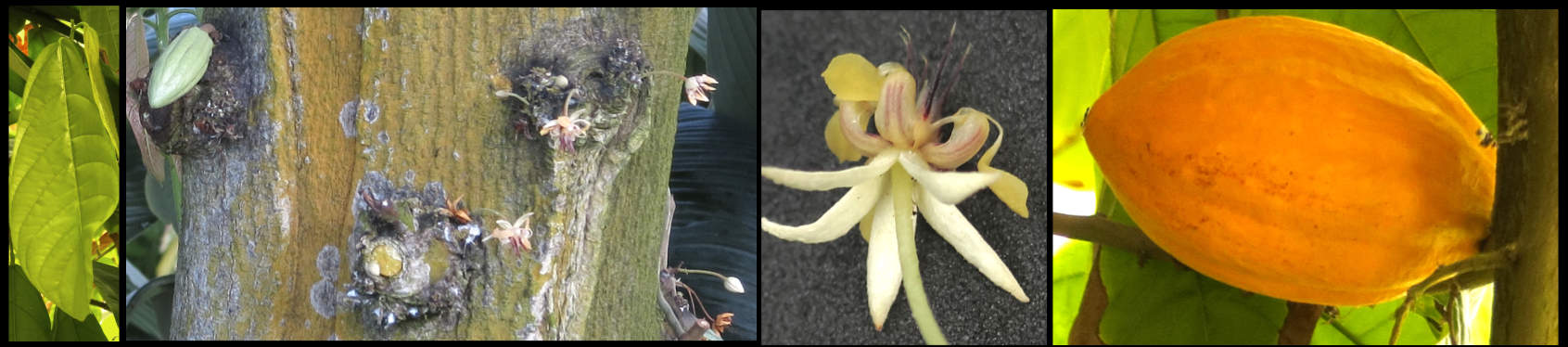
All arise from old wood on the trunk and large branches (caulifery).
They arise from the axils of fallen leaves or on very short nodule-like side branches.
Flowers, up to 2 cm across are seen on the trees all year.
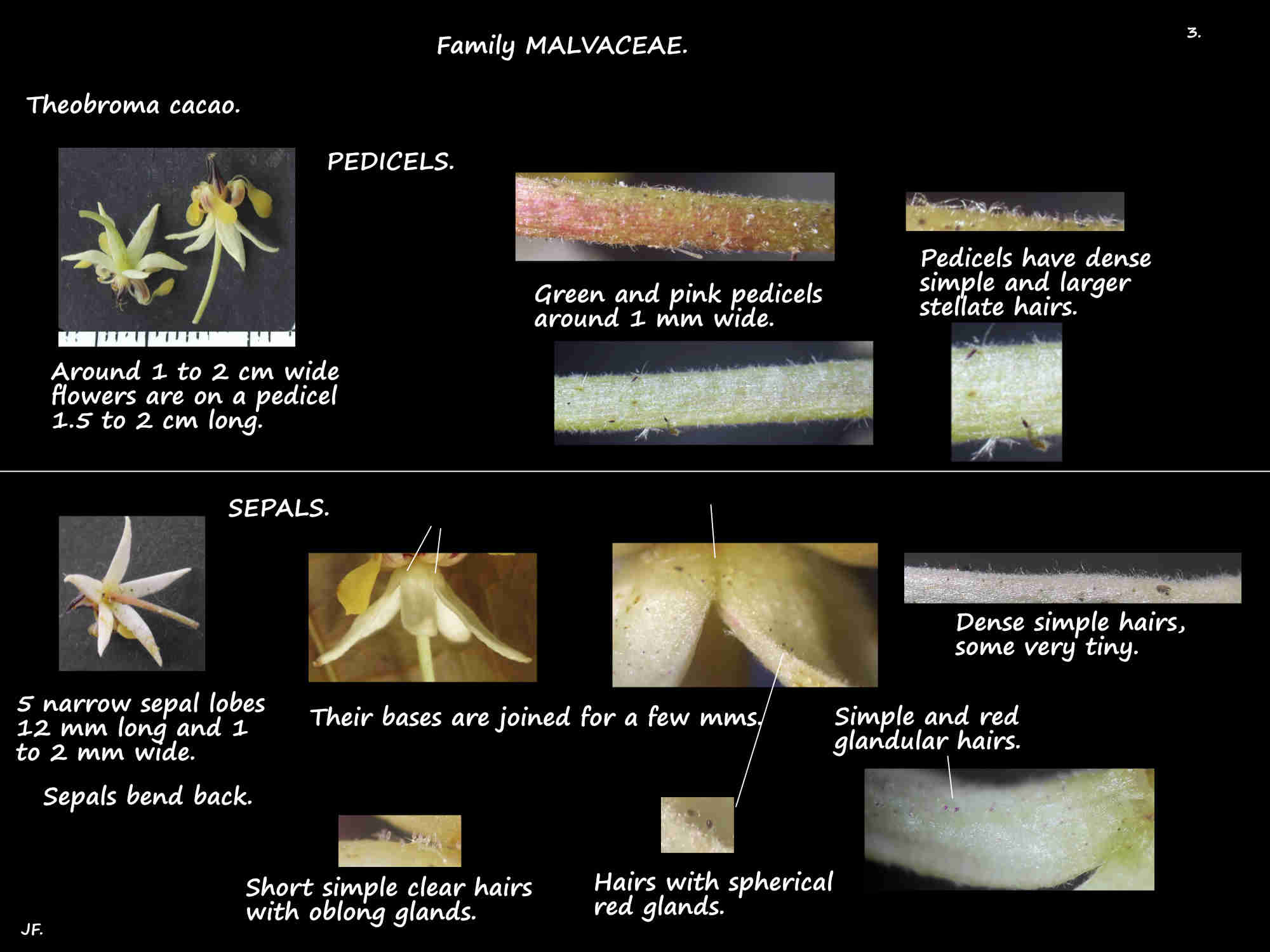
The around 2 cm long pedicel has a lot of simple hairs and some larger stellate ones.
The pink to white sepals are joined for a few mms at the base.
The 5 narrow triangular lobes have a lot of small simple hairs and a few stellate ones.
Some of the simple hairs have red glands at the tip.
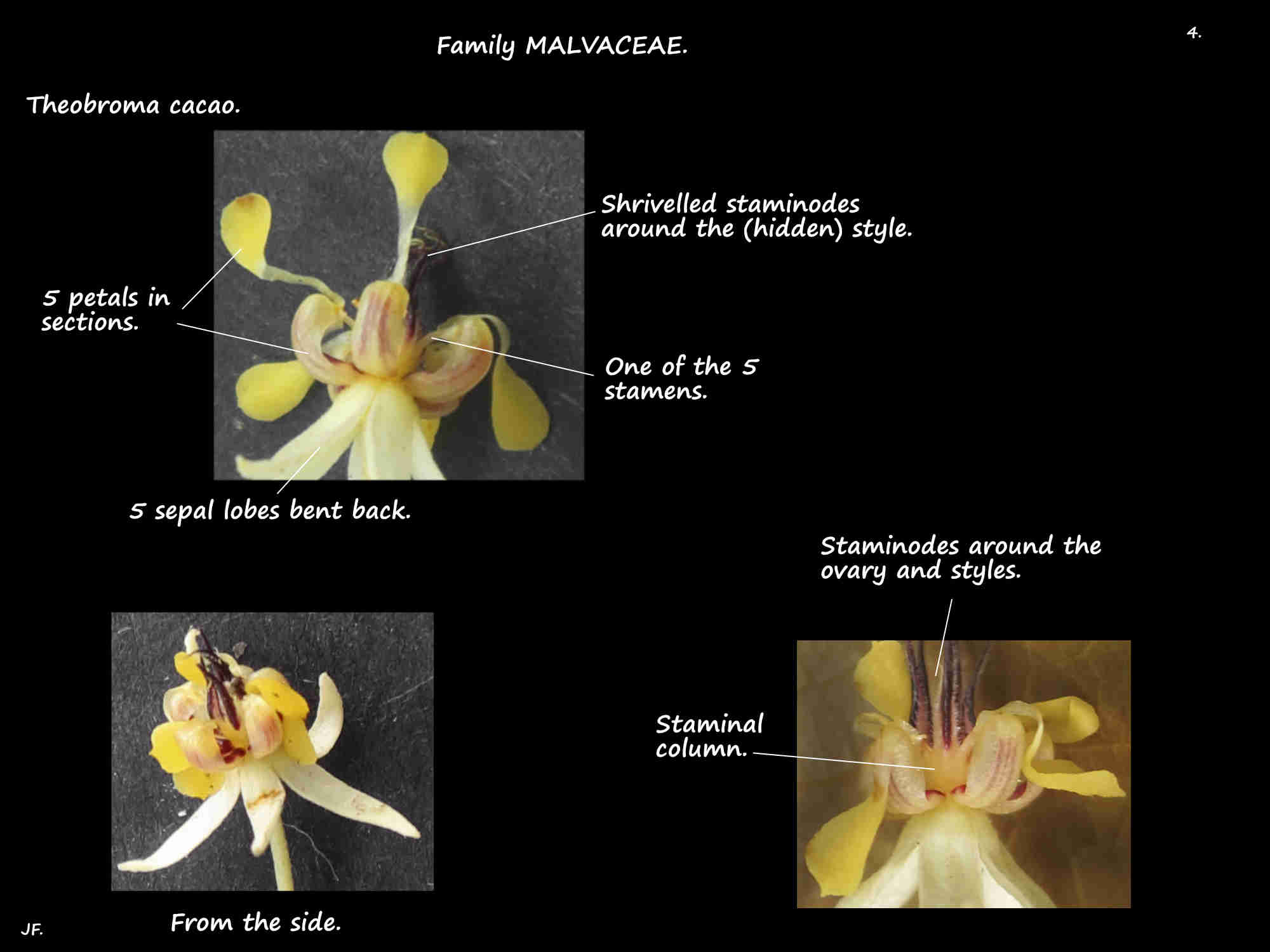
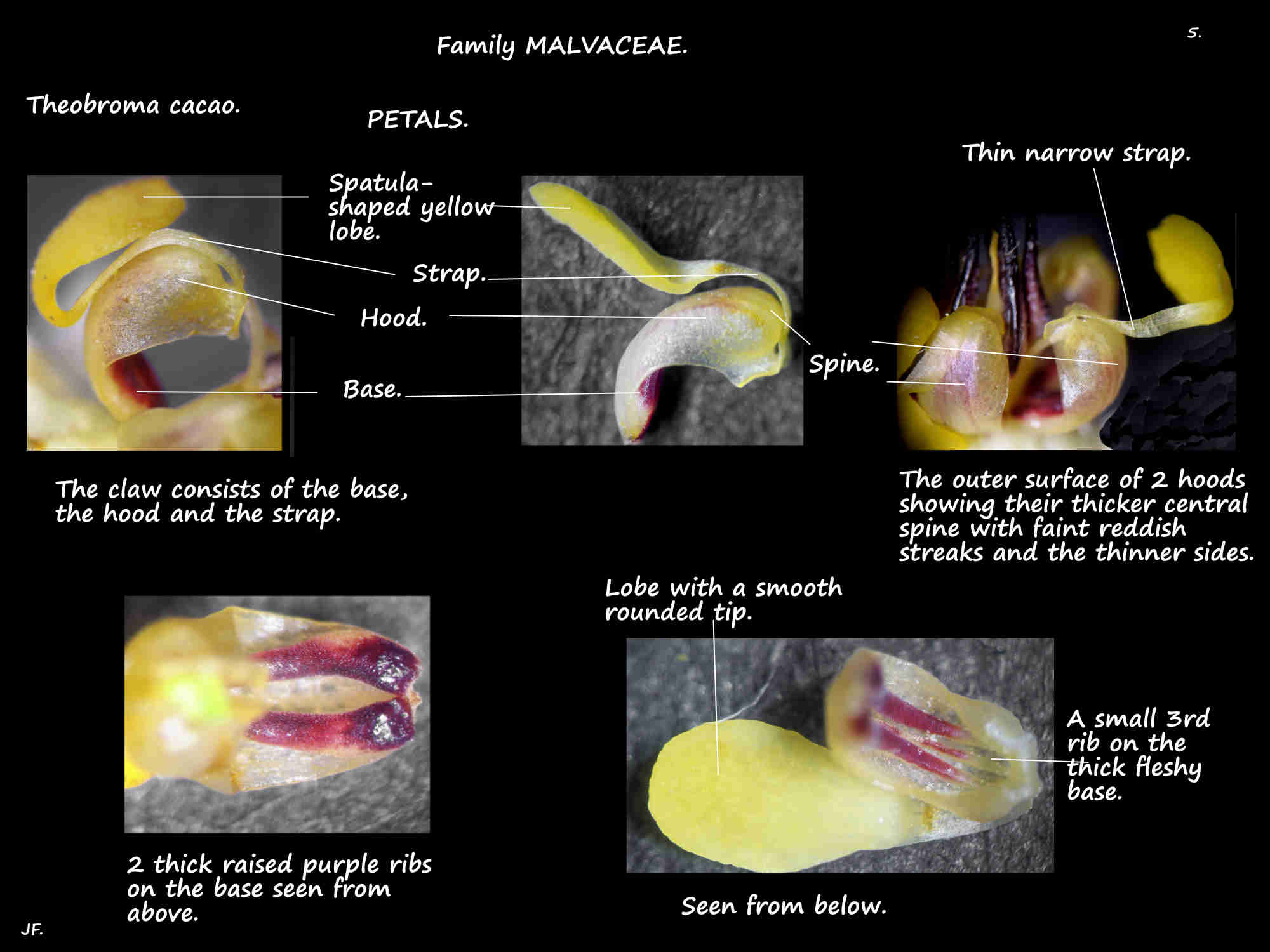
The 5 petals, free of each other and with no hairs are in 2 sections.
i.) the claw base is divided into a hood with a narrow strap-like section at the top.
The deeply concave, membranous, almost colourless hood opens inwards.
It has a thicker yellow spine running between the fleshy base and the strap.
ii.) a flat spatula-shaped bright yellow lobe which may have a small point at the tip.
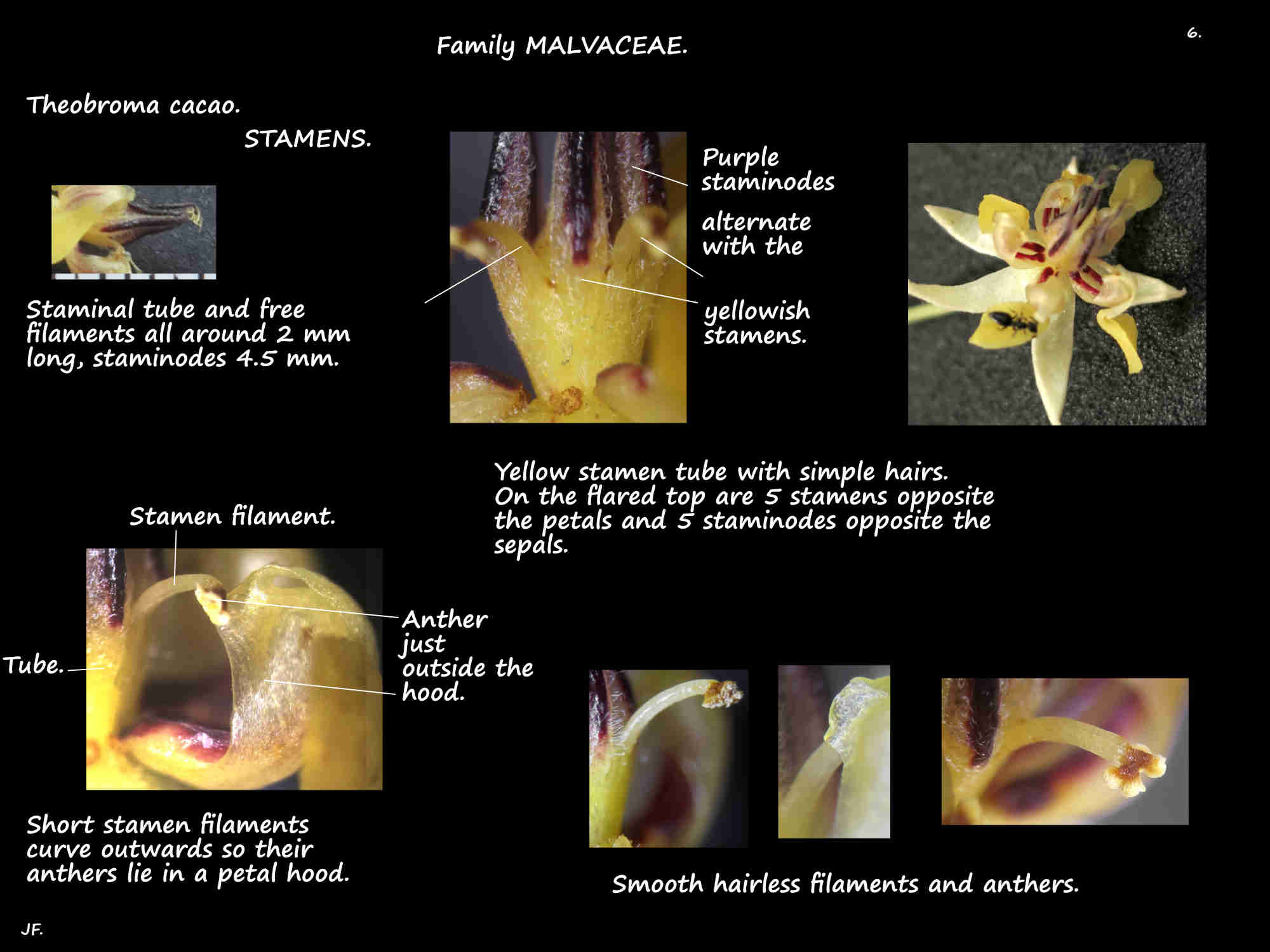
There are 5 short fertile stamens and 5 long sterile staminodes.
Their fused bases form a pale yellow staminal tube around 1.5 to 2 mm long.
The tube is slightly wider at the top and has simple hairs outside.
Each short free stamen filament curves outwards into a petal hood.
The anthers, mostly hidden in the hoods have 2 pollen sacs.
The sacs open through longitudinal slits.
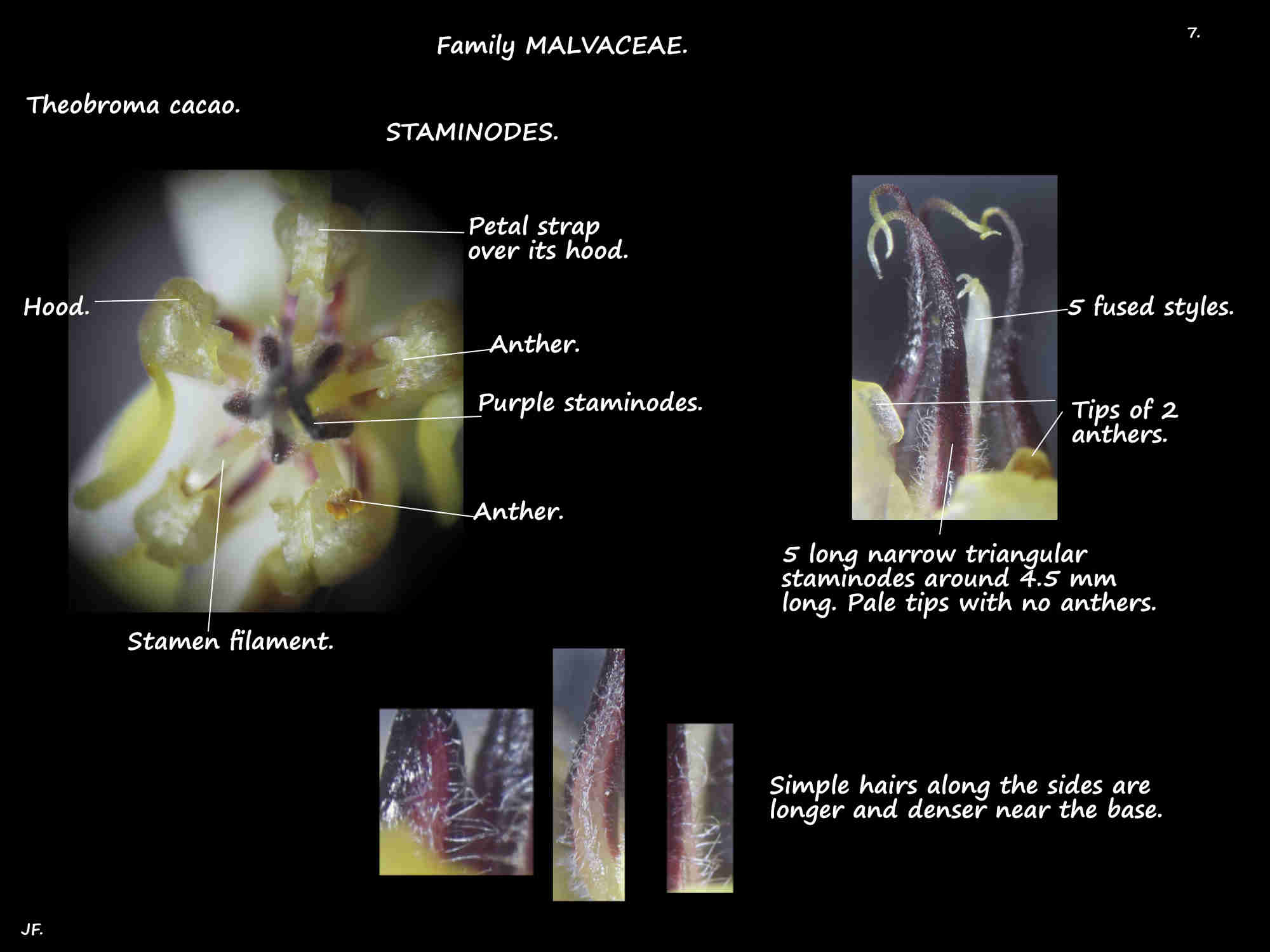
The 5 long staminodes, opposite the sepals alternate with the fertile stamens.
They can be linear or have a petal-like (petaloid) sterile anther.
There are simple hairs along the edges of the staminodes.
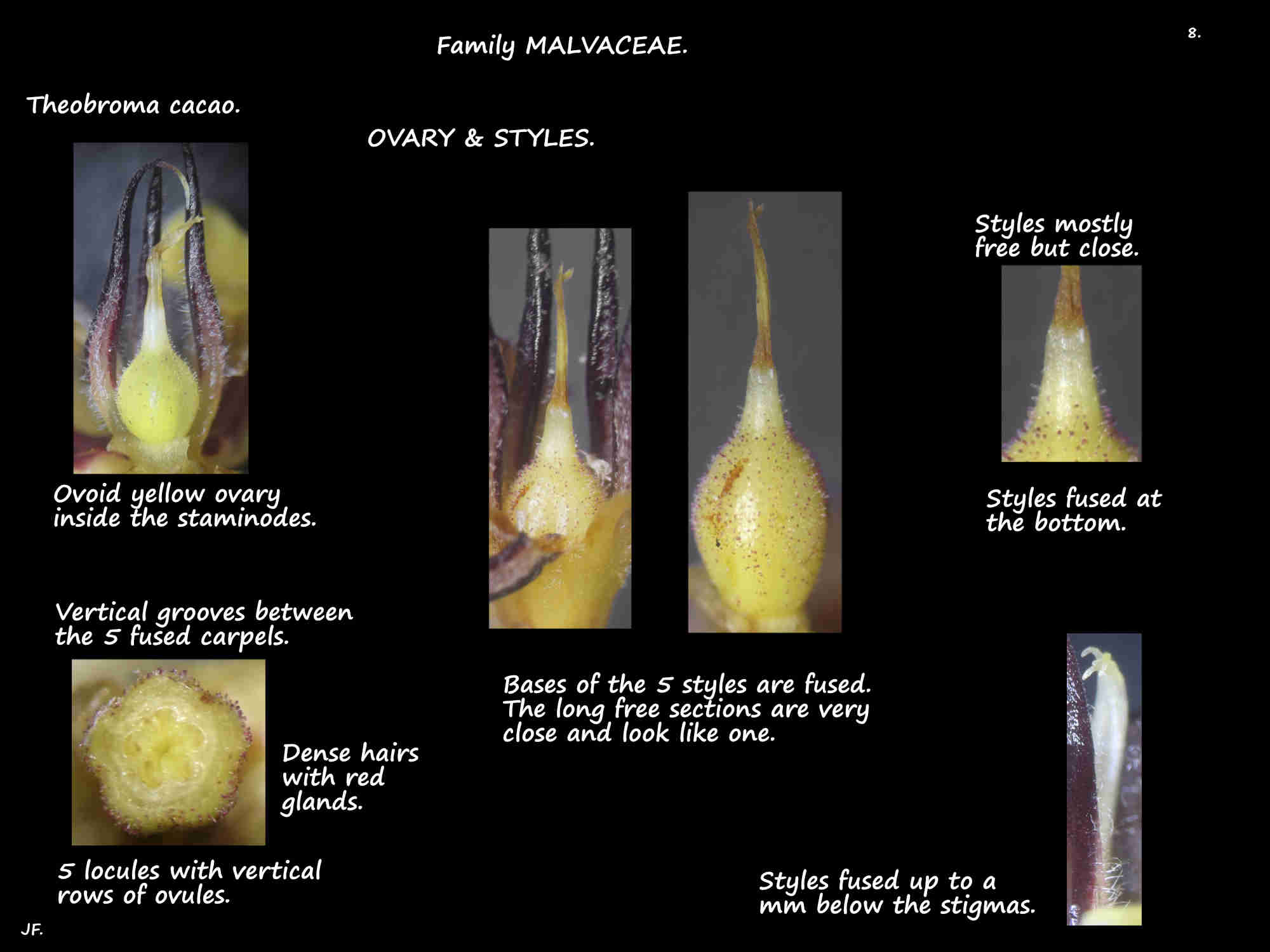
The superior ovary of 5 fused carpels has 5 locules.
Rows of ovules are attached to a central placenta – axile placentation.
The yellow ovoid ovary is densely covered in red glandular hairs.
There are 5 linear styles each with a small stigma.
The styles can be free to fully fused.
Fruit, known as ‘cocoa pods’ are described as ‘drupe-like’ or ‘berry-like’.
They are not ‘pods’ which are the fruit of the Fabaceae or bean family.
They are not drupes as they contain many seeds.
‘Berry-like’ or baccate is a nonspecific term for an indehiscent fruit with numerous seeds in a fleshy pulp.
The ovoid pods can be up to 30 cm long and 10 cm wide.
The 5 vertical grooves between the fused carpels are visible as are the red glandular hairs.
Fruit mature from green to yellow then red or orange.
Up to around 50 seeds, in vertical rows are surrounded by a white pulp.
J.F.