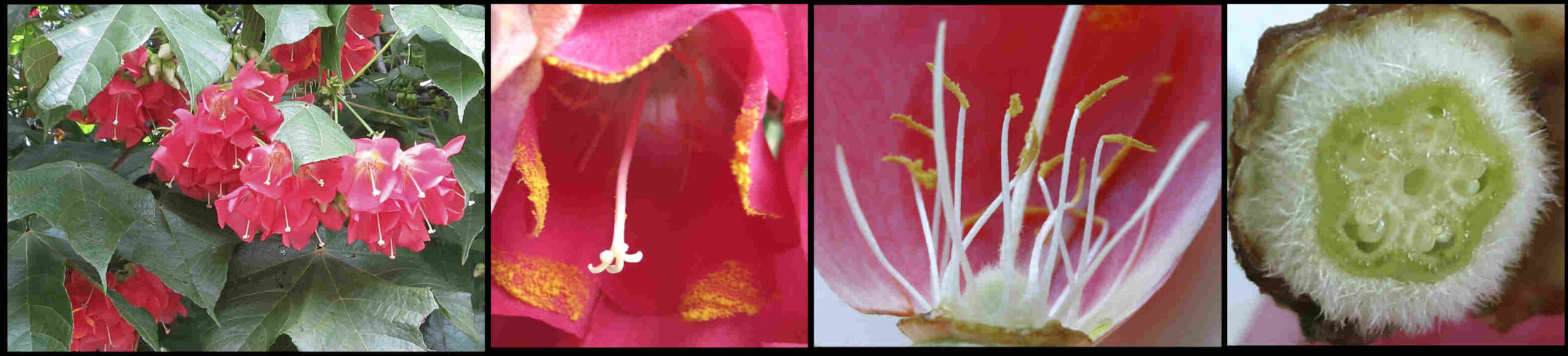
The Pink Dombeya is from Madagascar.
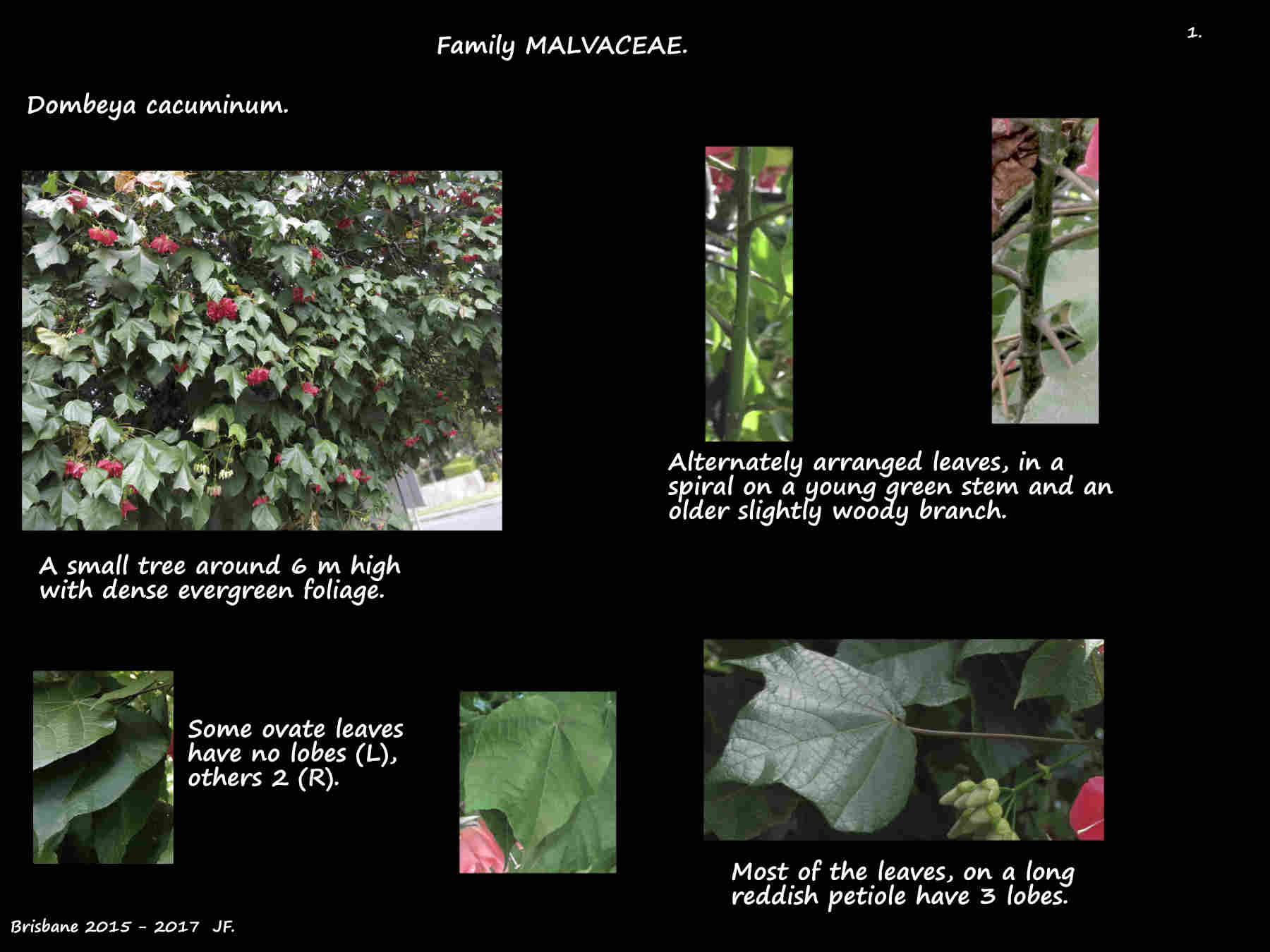
The small evergreen trees are usually seen around 10 high.
They can reach 15 m with a 6 m wide crown.
Alternately arranged leaves, on a petiole can be up to 30 cm long.
The long reddish petiole has a shallow groove on the upper surface.
Stipules at the petiole base fall early.
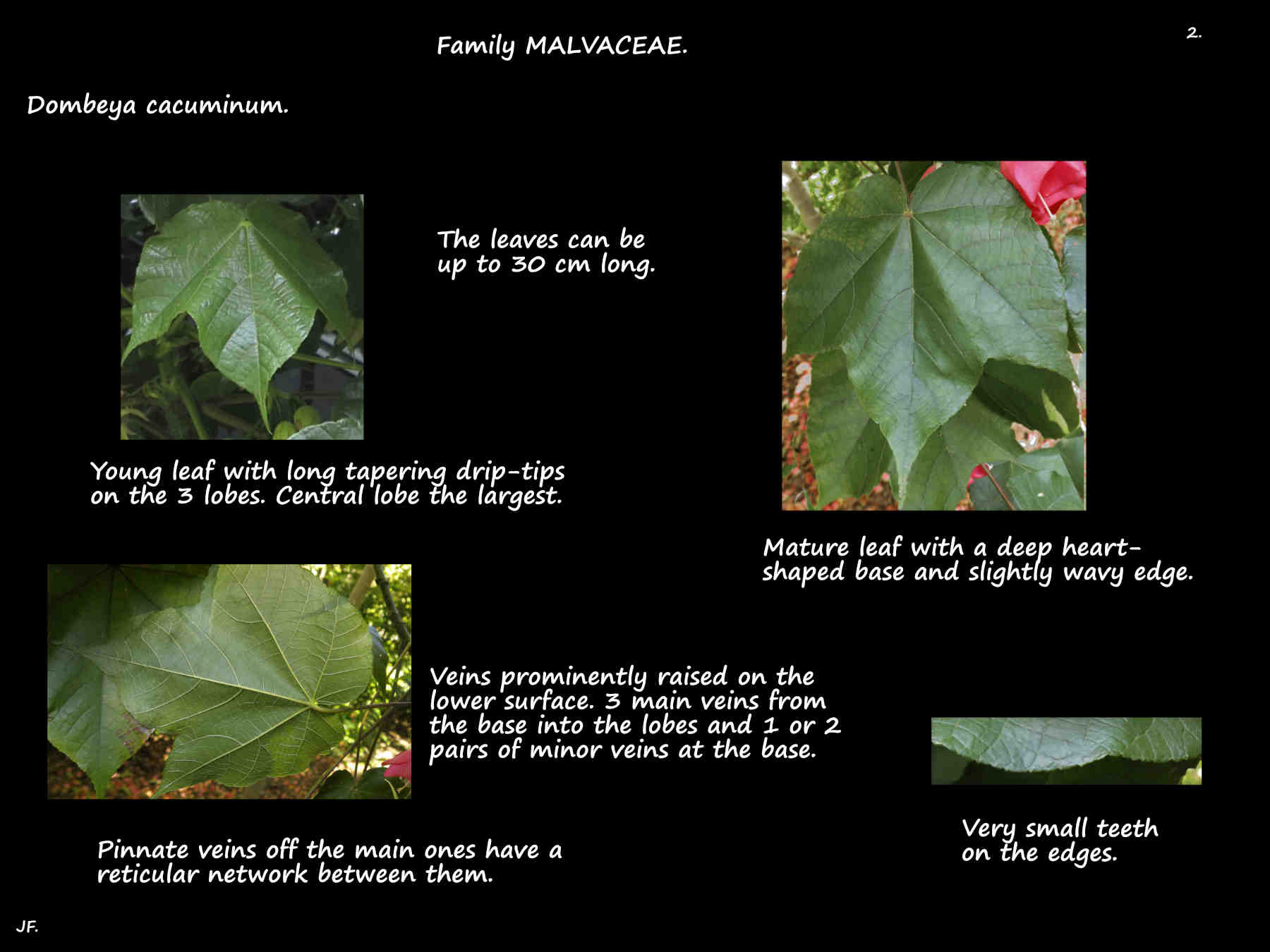
Most of the ovate blades have 3 lobes with the terminal being the longest and widest.
Divisions usually extend less than half way to the midrib.
The base is a deep heart-shape (cordate) and the tip a long tapering point.
The 3 main veins run from the base into the lobes.
There may be 1 or 2 smaller pairs of veins at the base.
Secondary pinnate veins run from the main veins to the leaf edges.
There is a reticular network between them.
Veins are slightly sunken on the upper surface and prominently raised on the lower.
The wavy edge has small or very small teeth at the ends of the veins.
Adult leaves have no hairs on the dark green upper surface.
The paler lower surface has simple hairs along the base of the main veins.
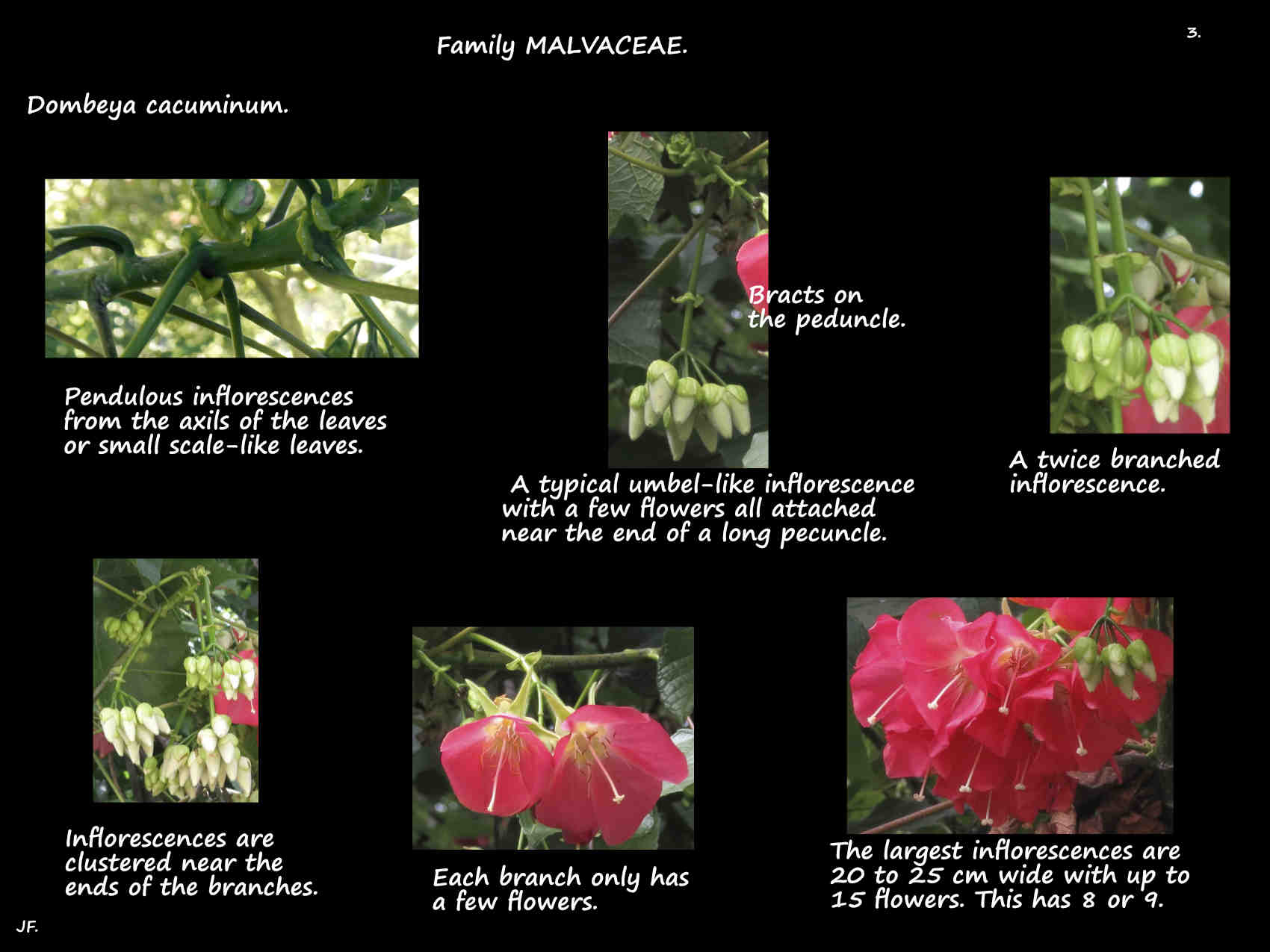
Drooping axillary inflorescences are concentrated at the branch ends.
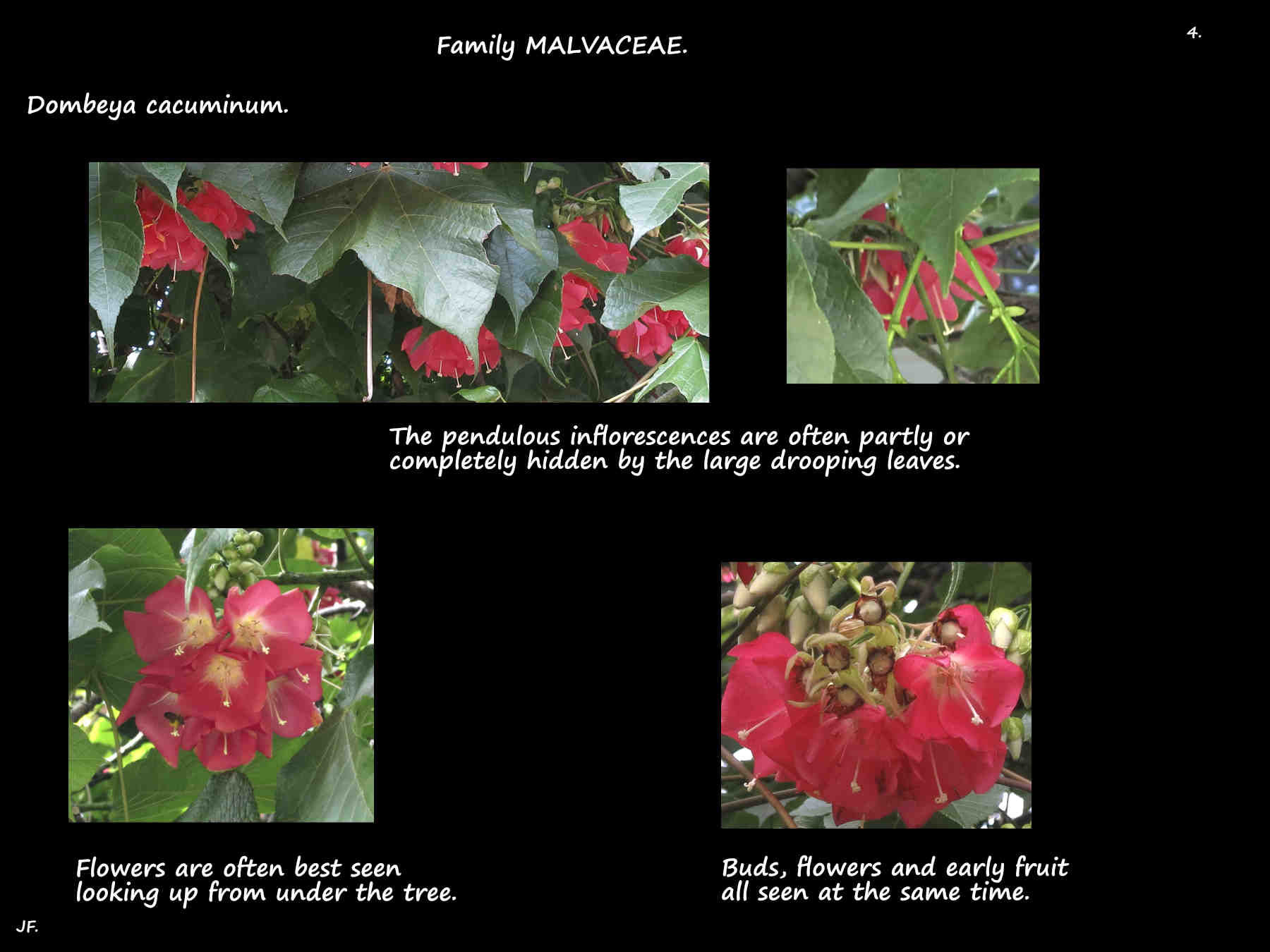
Despite being on a long peduncle many are partly hidden by the large leaves.
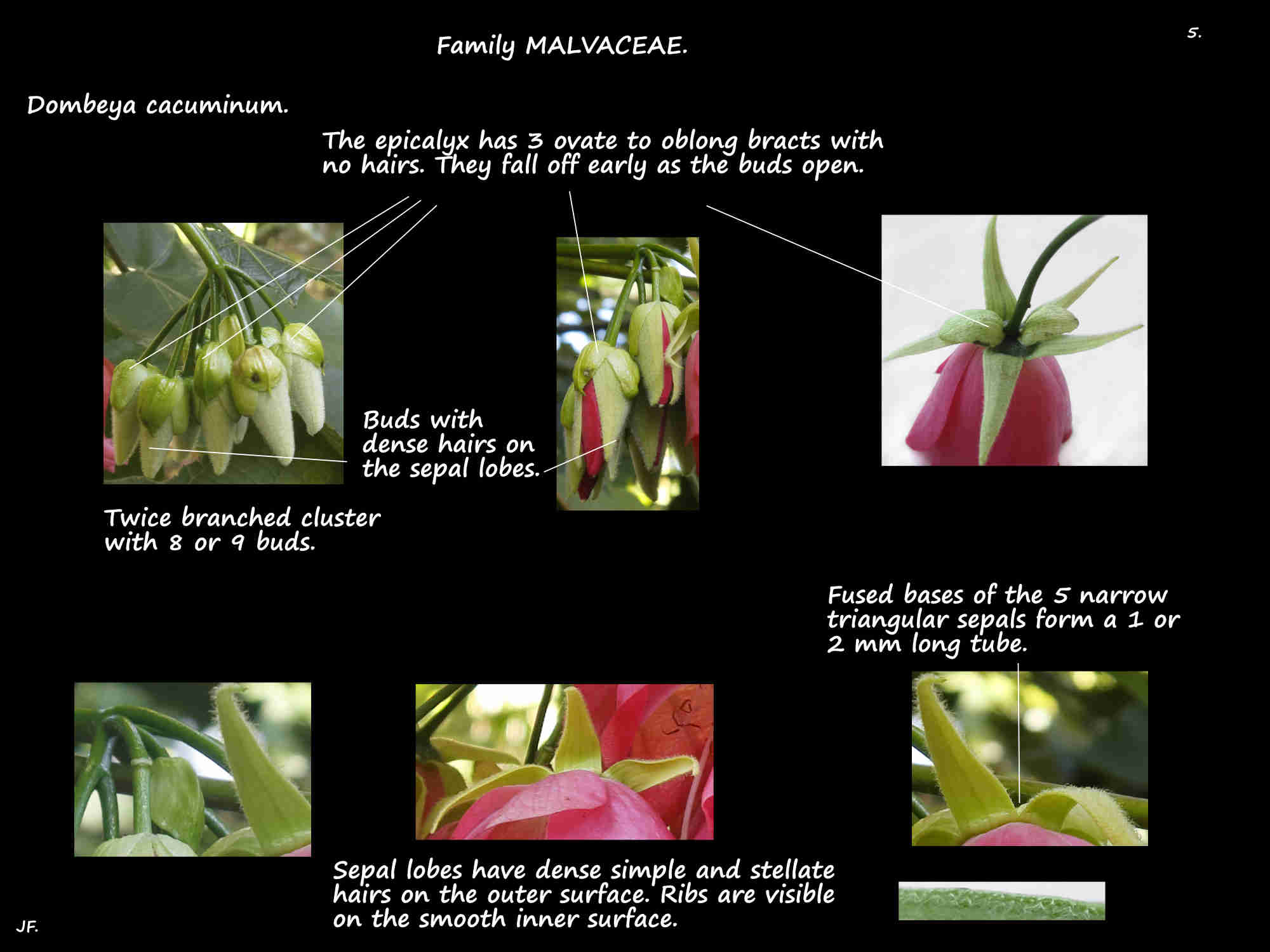
Inflorescences are umbel-like with flowers, on a pedicel attached near the tip of the peduncle.
The peduncle can branch once or twice but each branch only holds 2 or 3 pendant flowers.
The largest clusters, around 20 (25) cm wide have around 15 flowers.
There are small leafy bracts and bracteoles that fall.
Just below the calyx is the epicalyx or involucre of 3 bracts.
The mid-green ovate to oblong bracts may have a small point at the tip.
They have ribs, no hairs and fall as the buds begin to open.
The 5 pale green sepals are joined for a mm or so at the base.
The narrow triangular lobes have dense hairs on the outer surface.
The 3 or 5 ribs on each are visible on the smooth inner surface.
Lobes spread out sideways.
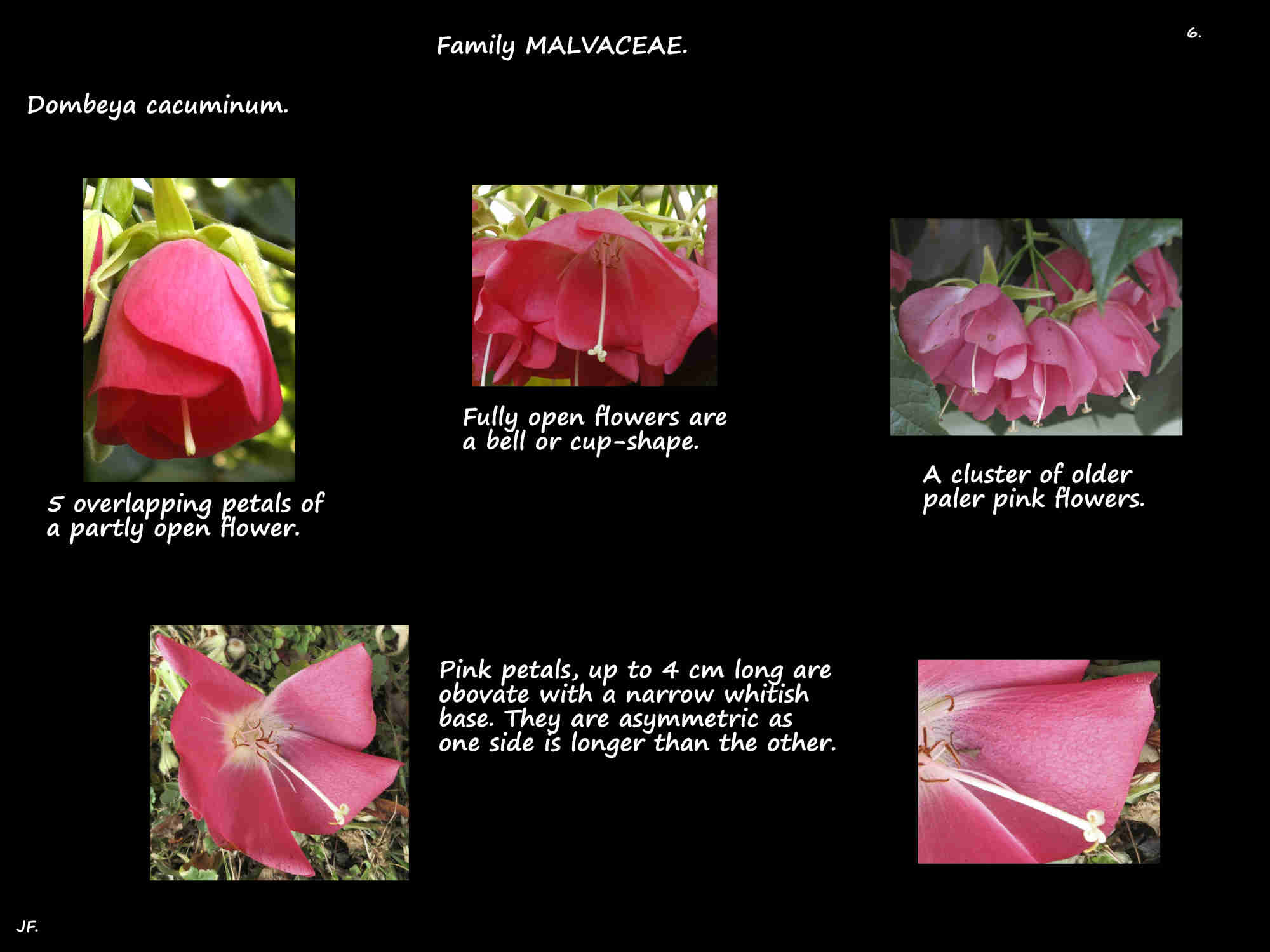
The 5 overlapping obovate petals are up to 4 cm long.
The asymmetric petals have a narrow base and wide tip.
Together they form a bell to cup-shaped corolla up to 6 or 7 cm across.
The pale pink petals have a whitish base with thick veins.
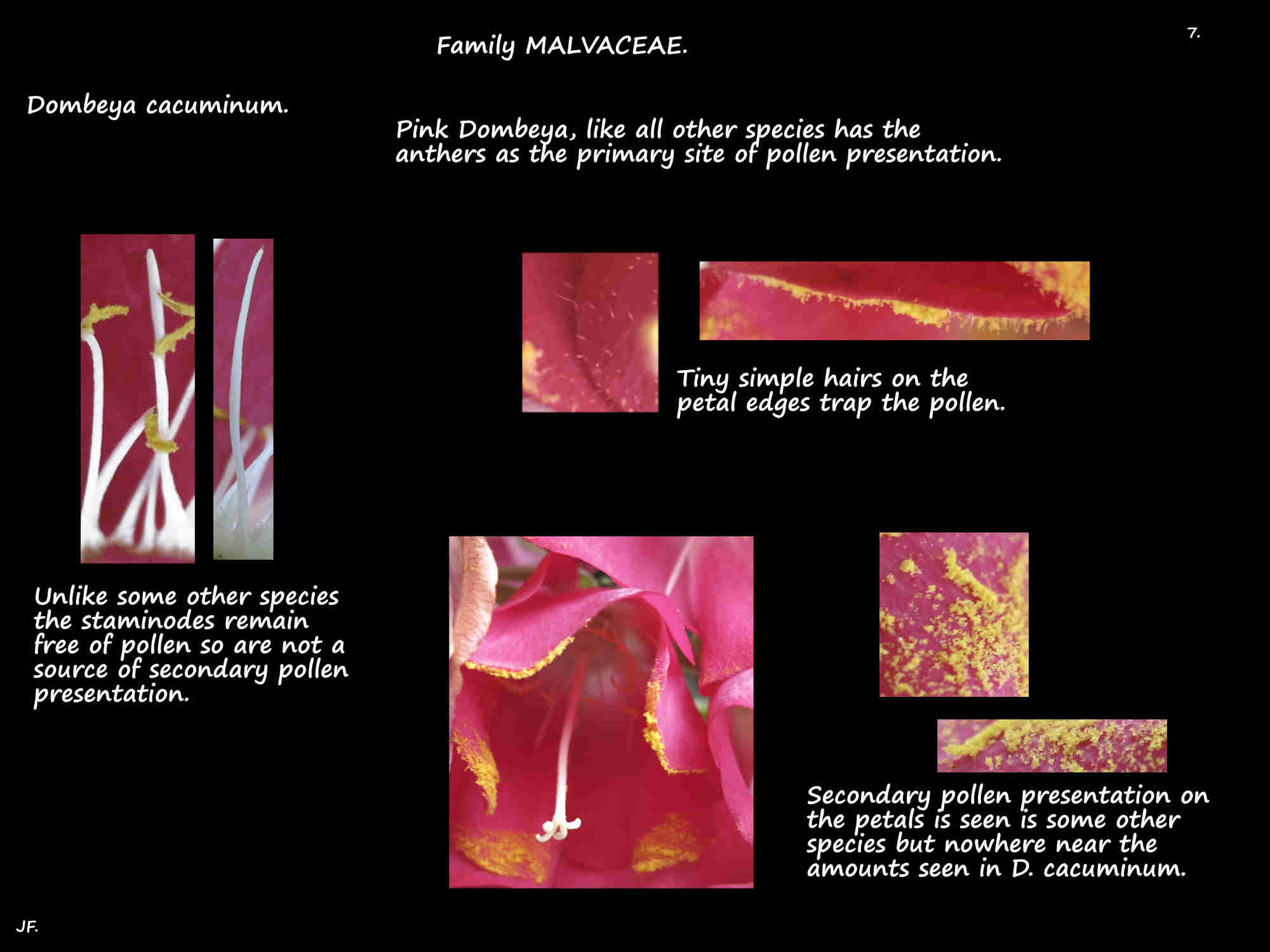
There are small simple hairs around the edges especially at the tip.
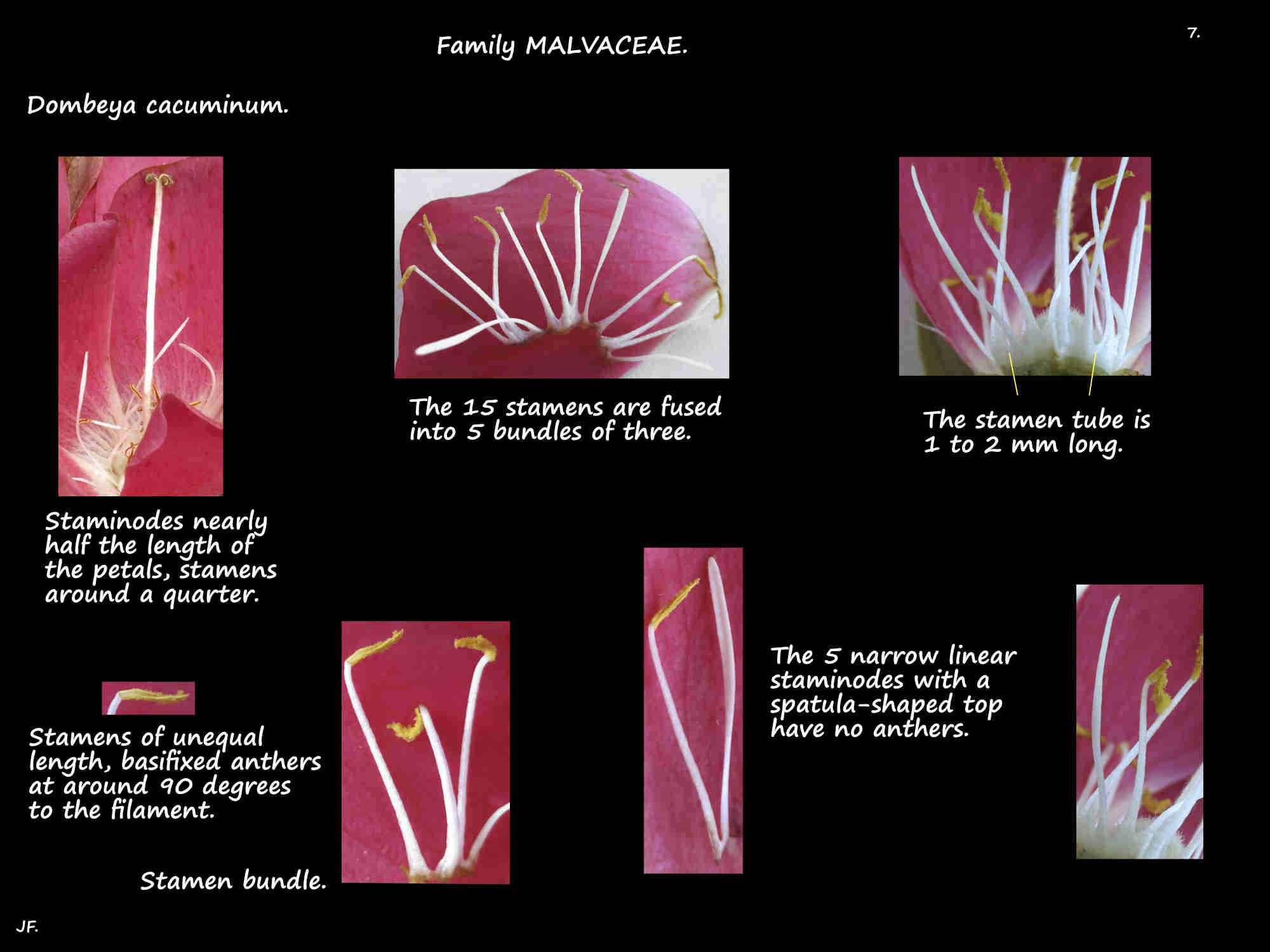
Fused bases of the stamens and staminodes form a 1 to 2 mm long staminal tube.
Bases of the 15 stamen filament are fused into 5 groups of three.
Stamens, with their anthers are less than half the length of the petals.
Long basifixed anthers are at an angle of up to 90 degrees to the filaments.
Anthers open through longitudinal slits releasing yellow pollen.
Alternating with the stamen bundles are 5 infertile staminodes.
The longer white spatula-shaped staminodes have no anthers.
The staminodes remain free of pollen all the time unlike some species.
Replacing this secondary pollen presentation is pollen on the petals.
Pollen, released in the bud is caught among the tiny hairs on the petal edges.
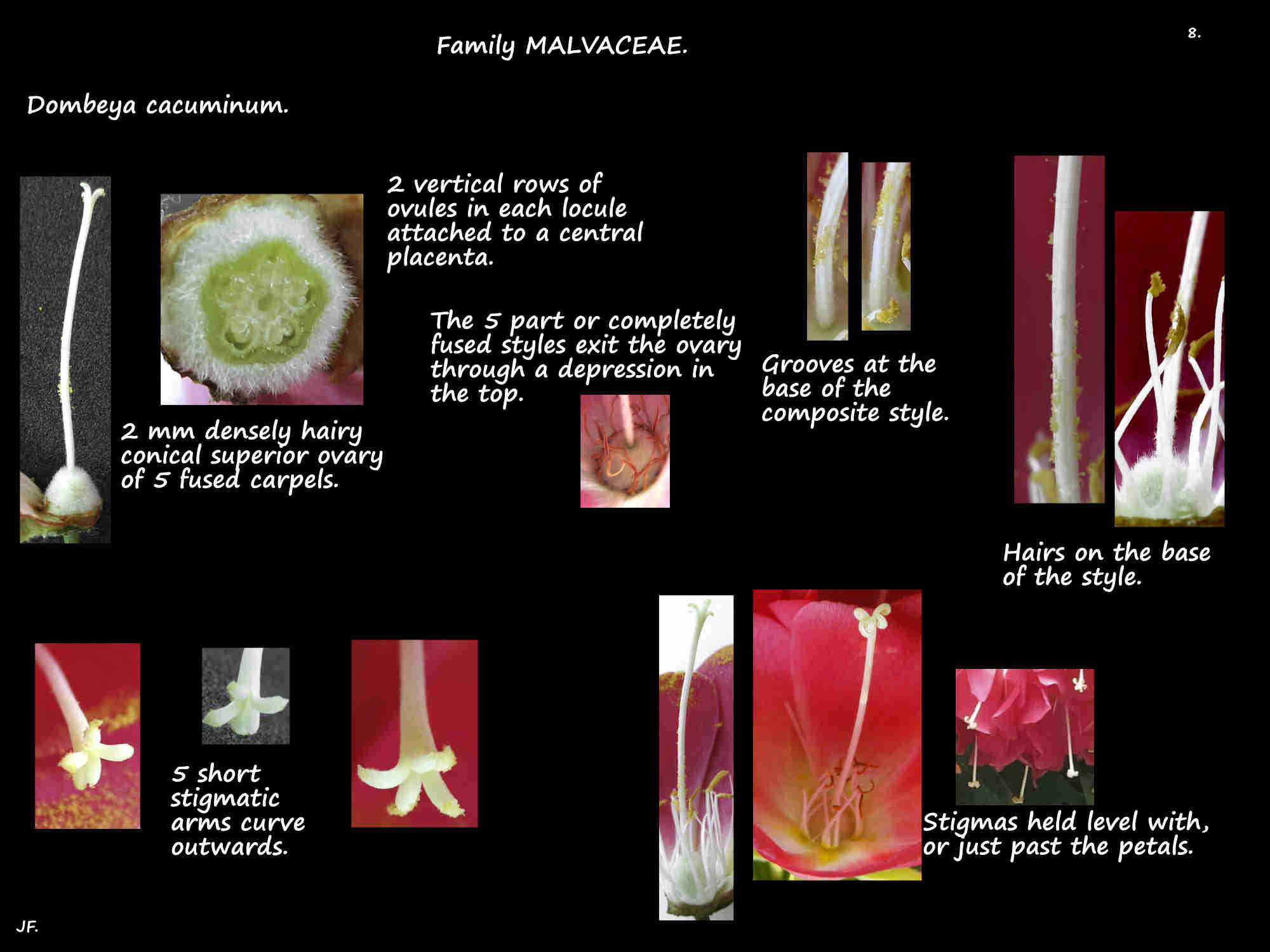
By maturity the stamens have withered and the stigmas lie just past the petals.
Of all the Dombeya species this secondary pollen presentation is most marked in D. cacuminum.
The superior ovary, of 5 fused carpels has 5 locules each with a few ovules.
The outer surface has very dense white simple and stellate hairs.
The single style from each carpel quickly fuse into one which extends to, or just past the petals.
Here it splits into 5 short arms each with a small stigma.
Hairs on the ovary continue onto the base of the white or pink style.
Fruit are small ovoid loculicidal capsules around 13 mm long.
The hairy capsules have wedge-shaped seeds.
J.F.