

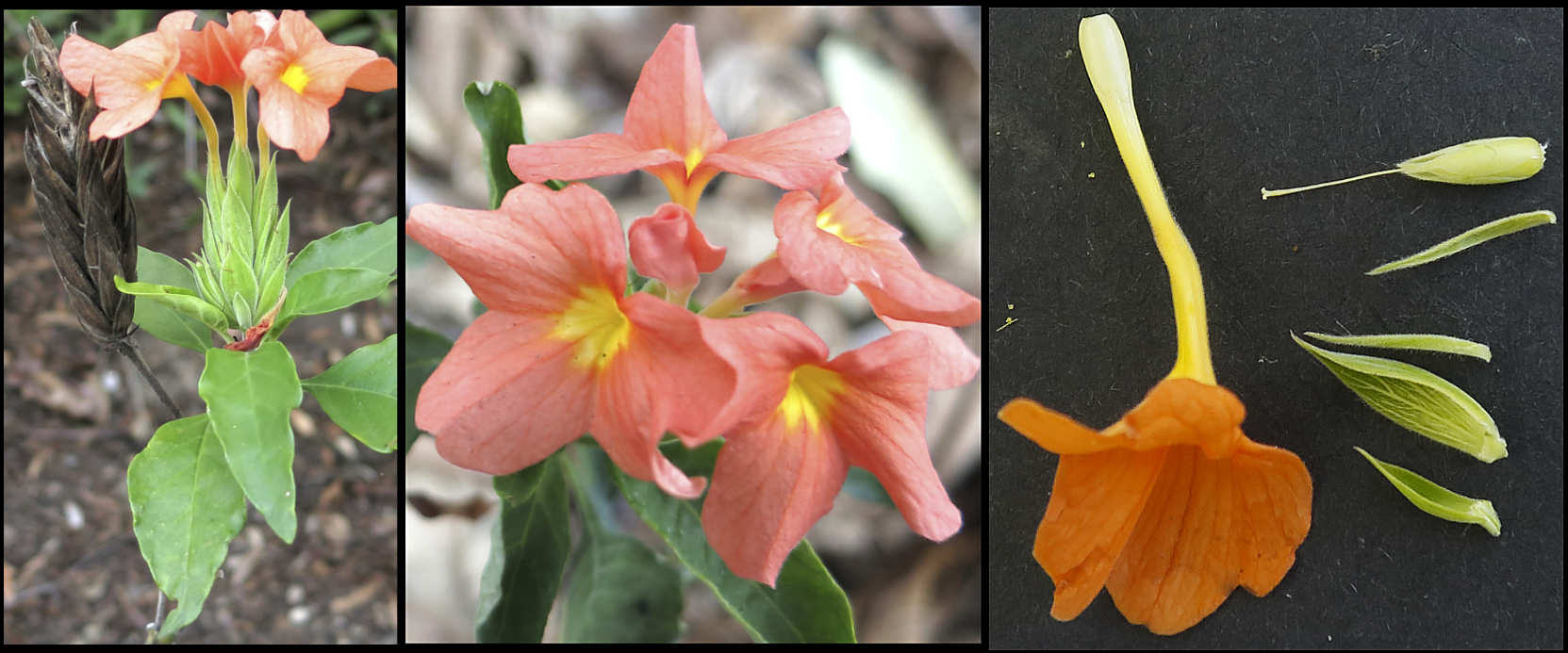
Family Acanthaceae > Subfamily Acanthoideae> Tribe Acantheae.
The 54 species are from Africa, Arabia and India.
Crossandra infundibuliformis, or mainly its cultivars are widely cultivated.
Australia has a few areas of naturalised plants that are probably from cultivars.
Plants can be small evergreen perennial herbs 30 to 50 cm high with green stems.
There are also shrubs up to 1.5 or 2 m high and wide with a woody base.
Stems arise from the base or occasionally a short trunk only a few cms long.
Young stems can be smooth or have a few to dense tiny soft hairs that are erect or lie along the surface.
Leaves are basically opposite and in 4 ranks (decussate).
They are often crowded near the branch ends making them appear to be in whorls of 4.
Sometimes there is a basal rosette of leaves.
The blade can be directly attached or on a petiole a few mms up to 4 or 5 cm long.
Leaves are from 2 to 22 cm long by 1 to 8 (20) cm wide.
Blades can be ovate, elliptic, lance-shaped or obovate.
The glossy often dark green leaves can have a rounded or pointed tip.
The base tapers and may run onto any petiole as wings.
Edges can be flat or wavy and there are sometimes shallow rounded lobes.
There may be no to dense tiny soft hairs that are erect or lie along the surface.
Sometimes they are confined to the veins especially underneath.
Terminal or occasionally axillary inflorescences are a dense spike.
Flowers are opposite and decussate making the spike markedly 4-angled.
Peduncles can be as short as 1 cm but many are up to around 24 cm.
Peduncles have sparse long or short soft hairs that are erect or flattened.
The densely packed unbranched spikes are 2 to 15cm long.
Flowers open from the base first.
The 4 rows of bracts below each flower are a mix of sterile and fertile ones.
The oppositely arranged bracts are mostly elliptic or ovate with some lance-shaped.
The longer outer ones can be up to 2 or 3 cm long.
The overlapping bracts have a thickened midrib or keel.
They also have 1 or 2 pairs of prominent lateral veins.
The tip tapers to a point or a small mucro or may have long teeth.
Some have teeth along the edges.
There are almost always short edge hairs (cilia) and sparse to dense surface hairs.
The long, short, matted or silky hairs can be erect or lie along the surface.
There are also glandular hairs.
The shorter narrower bracteoles also have glandular hairs.
All species have a calyx of 5 sepals that differ in shape and size.
They are typically free but occasionally slightly fused at the base.
Sepals can be narrow to widely ovate, elliptic, oblong or lance-shaped.
There is one upper sepal (dorsal), and paired lateral and lower (ventral) ones.
Lengths range from 4 mm to 17 mm and the widths vary.
The ends may be toothed or notched.
The outer surface can have no hairs or sparse to dense glandular ones.
Part or all of the edge can have short fine cilia.
The corolla has a basal tube up to 5 cm long that widens towards the top.
The tube does not twist but may be bent where the stamens insert.
The spreading obovate lobes, up to 3 cm long are variously divided.
There is no upper lip and the lower lip has 3 lobes.
The lateral pair may have a notched tip making the corolla look 5-lobed.
There are hairs on the outer surface and simple and glandular hairs inside the throat.
Flowers have a yellow tube and throat with the lobes typically orange.
Some have lobes that are white, cream or shades or pink to red.
The 4 stamens, in 2 slightly unequal pairs are inserted onto the middle of the corolla tube.
They have no filaments or ones only 1 mm long.
The dorsifixed anthers have 1 pollen sac with short fine hairs.
There is an annular nectary disc at the base of the ovary.
The roughly oblong ovary, up to 4 mm high has 2 locules each with 2 ovules.
It may have a few simple hairs at the top.
The style, up to 2 cm long has an oblique, slightly 2-lobed stigma with a fringed tip.
Fruit are an oblong green then brown capsule 1 to 1.5 cm long.
It can be smooth or have some hairs near the tip.
When it ruptures the up to 4 seeds are thrown out by their retinaculum.
The flattened round or ovate seeds are 3 to 4 mm across.
They are densely covered in scales that absorb water and expand when wet.
The tips are fringed or toothed.
(See Crossandra infundibuliformis for illustrations of some features.)
J.F.

