

Family Acanthaceae > Subfamily Acanthoideae > Tribe Ruellieae > Subtribe Trichantherinae.
The 45 species are native to the tropical areas of Central and South America.
Some species are cultivated as ornamentals, some are invasive weeds.
Most are shrubs with a few herbs and rarely small trees.
Shrubs are often around 2 m high but can be over 4 m.
Young stems are often red and are partly 4-angled.
The opposite leaves are in 4 ranks – decussate.
They are on a petiole up to 3 or 4 cm long with a grooved upper surface.
The wide ovate to elliptic blades can be around 35 cm long and 15 cm wide.
The base is rounded or wedge-shaped and may run onto the petiole a small wings.
The edge can be smooth, wavy or have small teeth and the tip is pointed.
Most species have no hairs on the leaves.
The up to around 16 pairs of lateral veins are prominent on both sides.
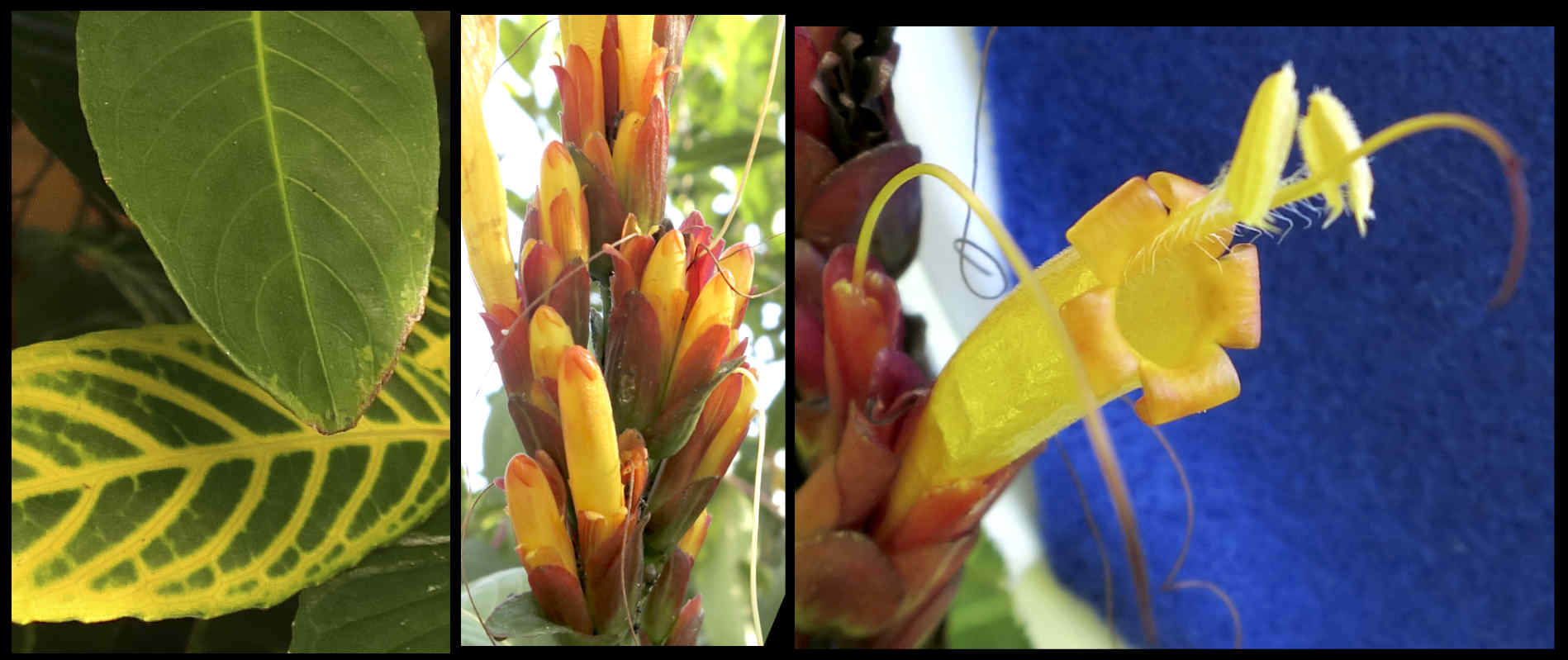
Green young leaves develop white then yellow areas along the veins.
There are small pale calcified nodules (cytstoliths) on both sides.
Terminal inflorescences up to 20 cm long are on a peduncle up to 5 cm long.
They can be a spike or rarely have a few branches (panicles).
Along the midrib are bracts (reduced leaves) arranged in 4 ranks (decussate).
In the axil of each bract is a solitary flower or a tight cluster of a few flowers (fascicles).
All bracts and flowers are directly attached to the midrib.
In the fascicles each developing bud has 2 protective bracts around it.
The often coloured, ovate bracts are up to 2 cm long.
The 5 oblong sepals, up to around 2.5 cm long have their bases fused.
There are minute soft hairs on both surfaces.
The 3 to 4 (5) cm long corolla tube has 5 short equal lobes.
The cylindrical tube is swollen on one side near the top.
The lobes have a rounded end that curls back.
Petals are yellow, orange, red or purple.
Dense hairs on the corolla are small to minute.
The 2 fertile stamens are inserted below the middle of the tube.
Stamens extend for varying distances past the corolla tube.
The flattened filaments usually have long simple hairs along the sides.
The anthers have 2 pollen sacs (thecae) with a spur or mucro at the base.
The anthers, opening through long slits have tiny hairs on the outsides.
Between the stamens is a pair of staminodes that have no anthers.
Up to 15 mm long they have a few simple hairs near the end.
There is a nectary disc around the base of the ovary.
The smooth ovary has 2 locules each with around 2 to 4 ovules in each.
The ovules have axile placentation.
The long slender style extends past the corolla tube.
Its 2 stigma lobes may be unequal.
Fruit are a capsule with 2 to around 8 flat seeds.
J.F.

