

Family Acanthaceae > Subfamily Acanthoideae > Tribe Ruellieae.
There are over 60 synonyms.
Around 250 species are recognised in Australia (PlantNet and Gardening Australia’s ‘Flora’).
Kew recognises 472 species.
They are native to a wide area of the tropics from India to China down to Queensland and the S. W. Pacific.
Strobilanthes anisophyllus is native to Australia which also has up to 5 naturalised species.
Many species are cultivated.
They are herbs or shrubs with soft stems that may become woody.
Stems are mostly 4-angled or ridged.
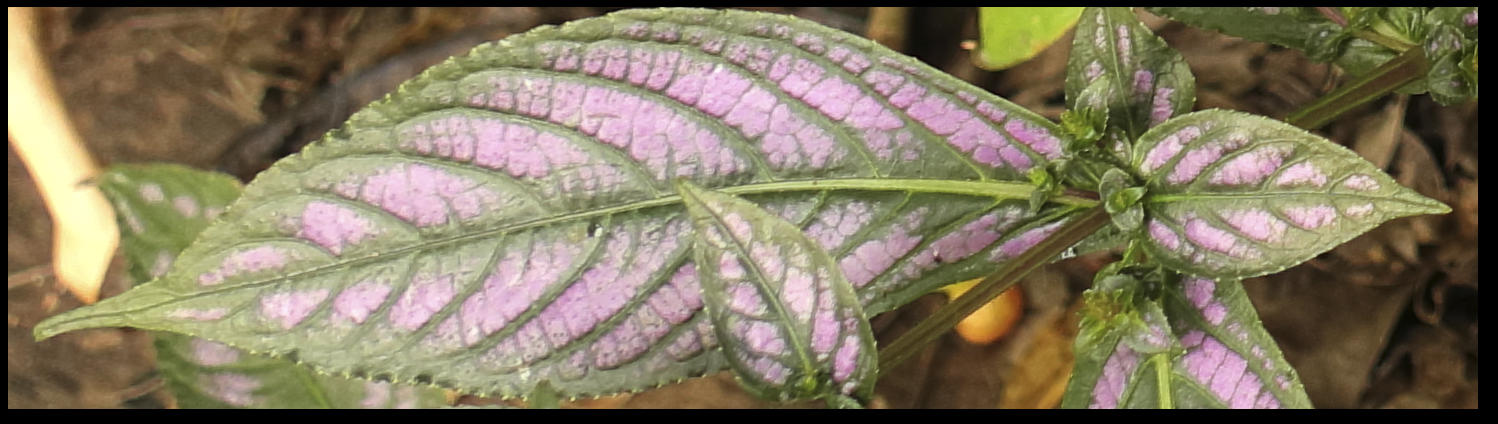
Leaves are opposite and in 4 ranks (decussate).
They may be on a petiole or directly attached to the stem (sessile).
In each pair one blade is markedly smaller than the other.
Leaves can be all green but often have coloured markings.
Leaf edges often have small teeth or lobes but they can be smooth.
There are usually cystoliths (small nodules of calcium) on the upper surface and sometimes the lower.
Terminal and/or axillary inflorescences can be a spike or a branched cluster (panicle).
There are sterile leaf-like bracts on the peduncle and smaller floral bracts under the flowers.
Flowers can be on a pedicel or directly attached and there may be 2 small bracteoles.
The 5 sepals can be free or have their bases fused into groups of 2 and 3.
The middle lobe may be longer than the others.
The bracts and sepals have simple and glandular hairs on the outer surface.
The corolla tube may be funnel-shaped or cylindrical with a wider throat.
The tube may be twisted longitudinally.
The 5 spreading ovate lobes often curve back.
The lobes may all be the same size or unequal.
When unequal there are 2 lobes in the upper lip and 3 in the lower.
Inside the tube is a clump of long hairs that hold the style in place.
Petals are mostly shades of blue or purple.
They may have darker markings or areas of white, pink or yellow.
The 4 stamens are in 2 pairs of different lengths.
They are inserted onto the middle of the corolla tube.
The anthers lie inside the tube.
The 2 oblong to almost round pollen sacs (thecae) lie beside each other.
Rarely there is a staminode.
The superior ovary has 2 locules each with 2 (to 6) ovules.
The slender style is held in place by the long hairs in the middle of the corolla tube.
The stigma has 2 unequal lobes.
Fruit are a capsule with the seeds attached to a retinaculum which forcibly ejects them when mature.
J.F.

