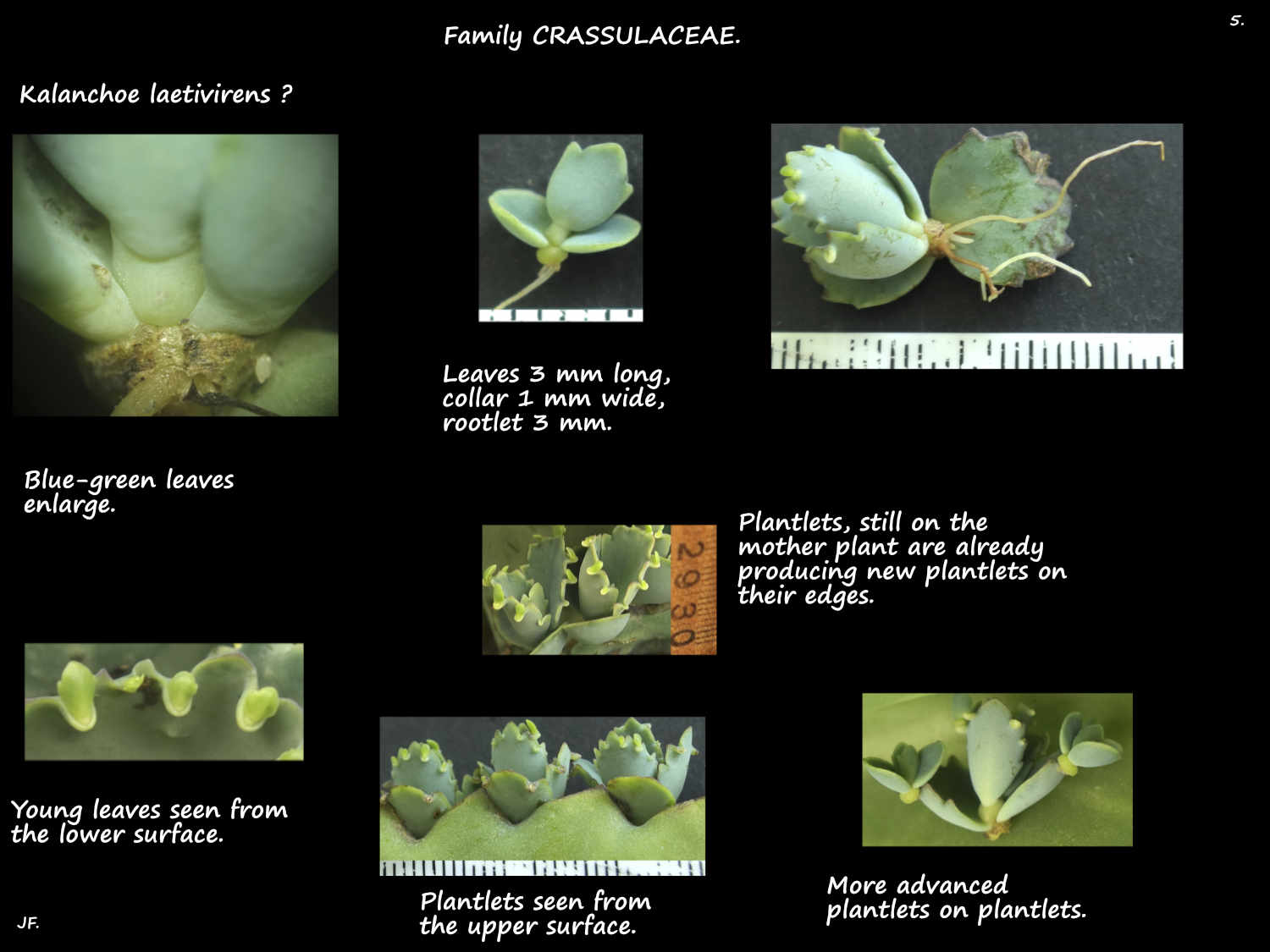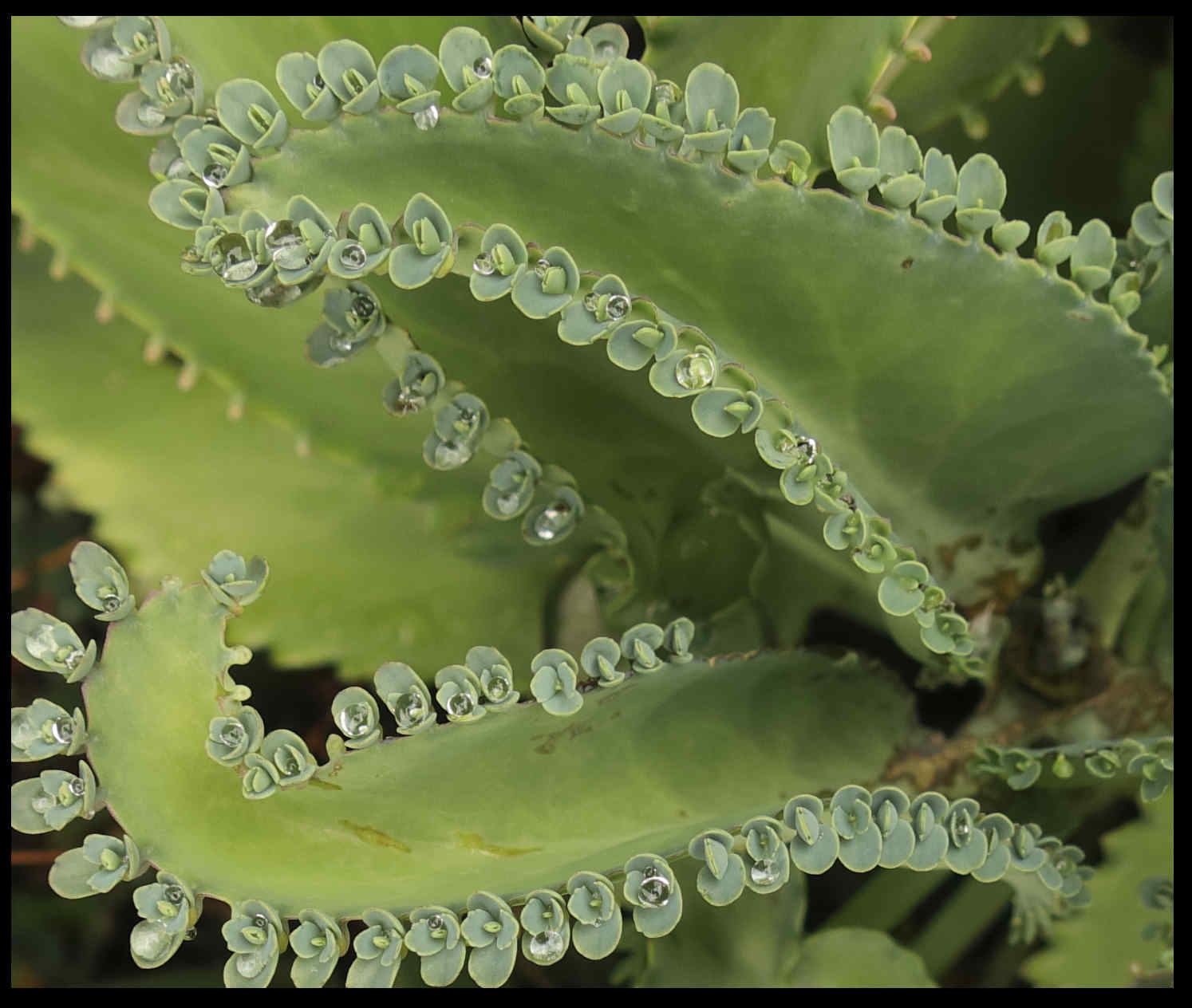
Officially known as Kalanchoe they are still seen under the old Bryophyllum name in Brisbane.
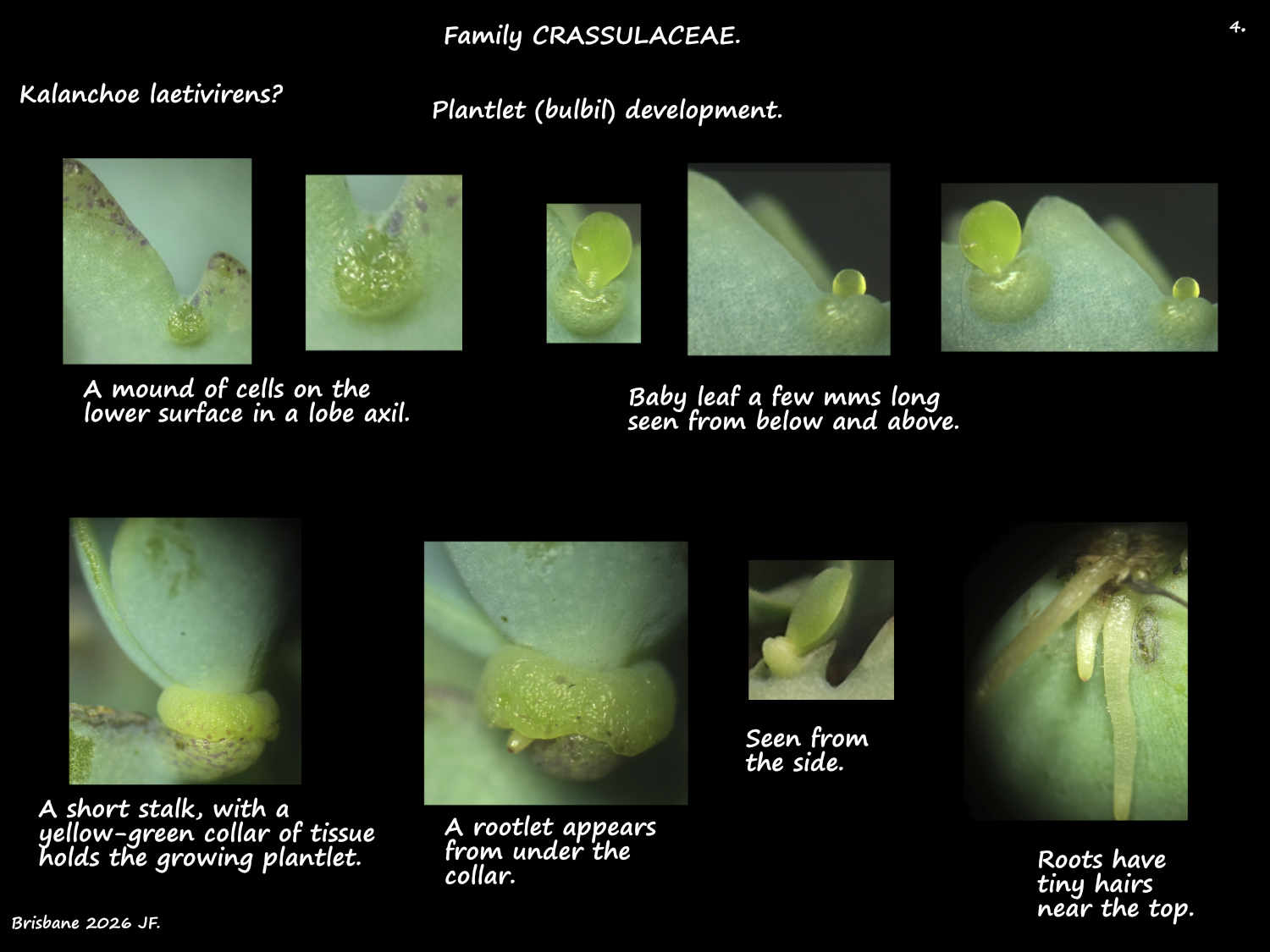
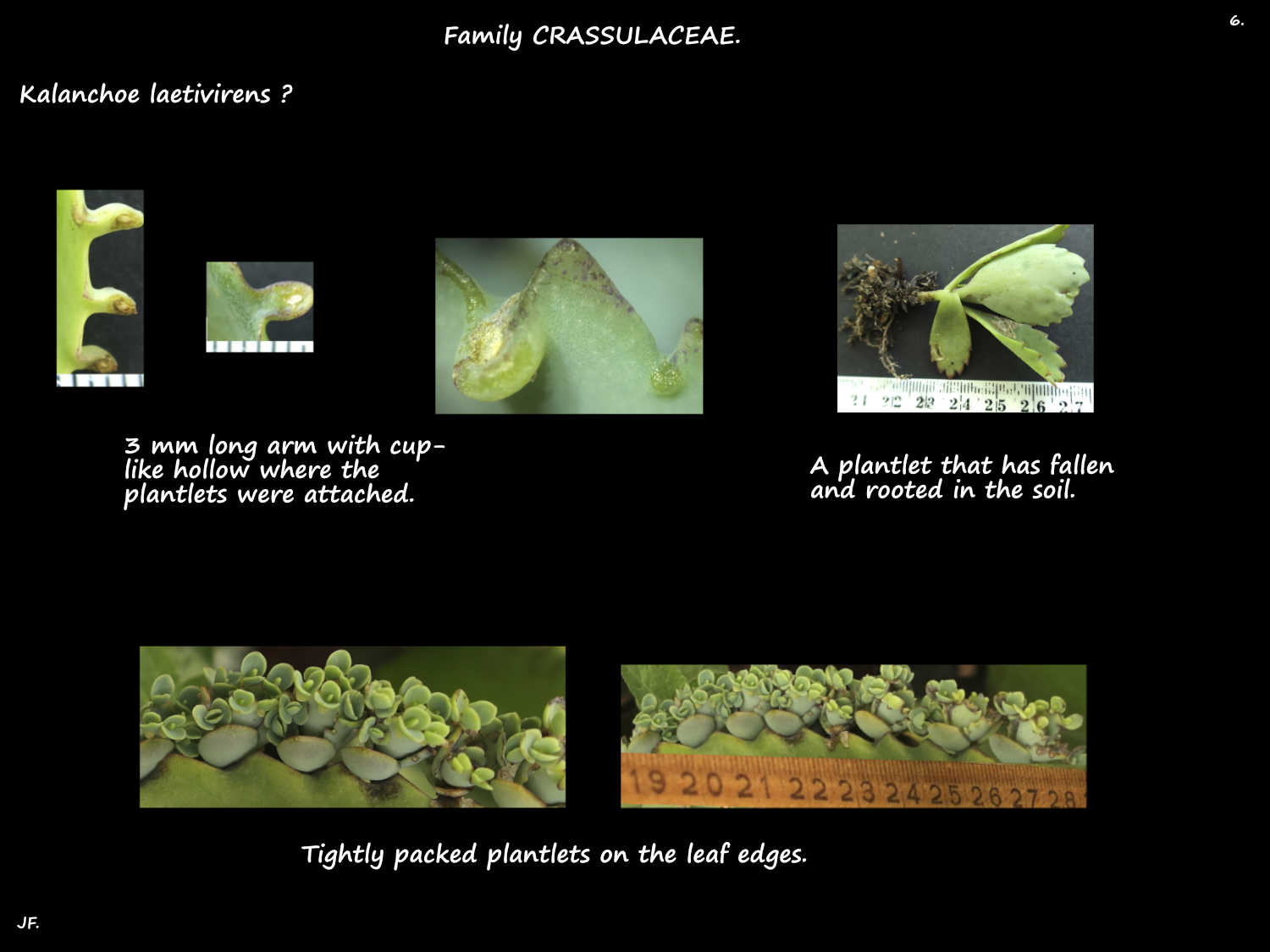
There are a number of Kalanchoe species that reproduce partly or completely by producing plantlets or bulbils on the leaf edges.
Seen in Australia are Kalanchoe daigremontianum, K. delagoense and K. x houghtonii.
Others seen overseas include K. laetivirens, K. rosei var. variifolia and K. sanctula.
The common names Mother of Thousands and Mother of Millions are seen applied to numerous plants.
1. Kalanchoe delagoense has cylindrical leaves with bulbils only on the tips.
2. Kalanchoe × houghtonii (a hybrid of K. daigremontianum and K. delagoense) has boat-shaped leaves that often have plantlets along the whole edge.
Its leaves have dark mottling and they can reproduce by seed.
Leaves are under 10 cm long and 2 cm wide.
3. K. daigremontianum has stems that branch.
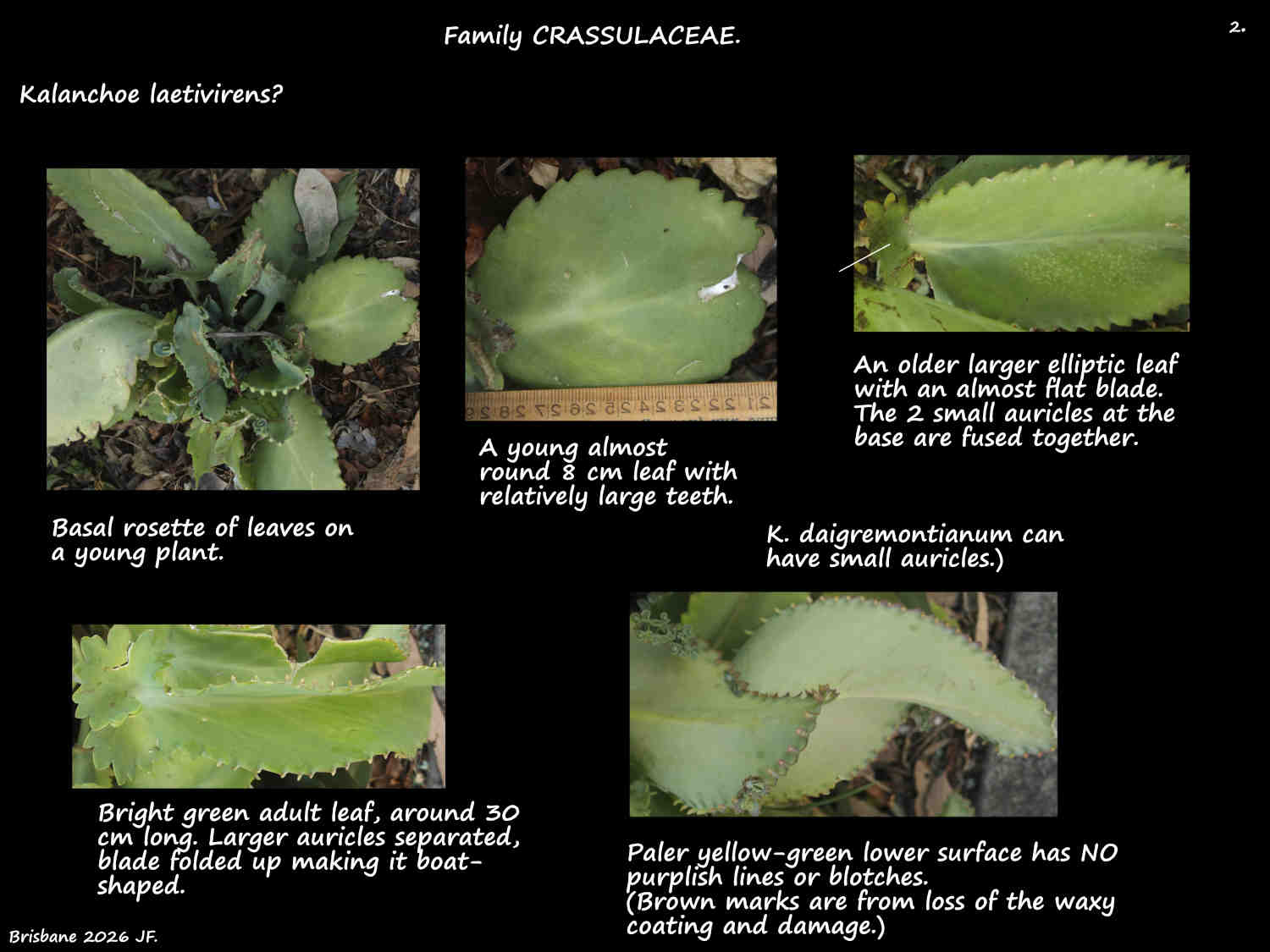
Folded leaves are nearly 30 cm long and around 5 cm wide at the base.
Leaves are always mottled with purplish lines and blotches on the lower surface.
These three are common in S. E. Queensland.
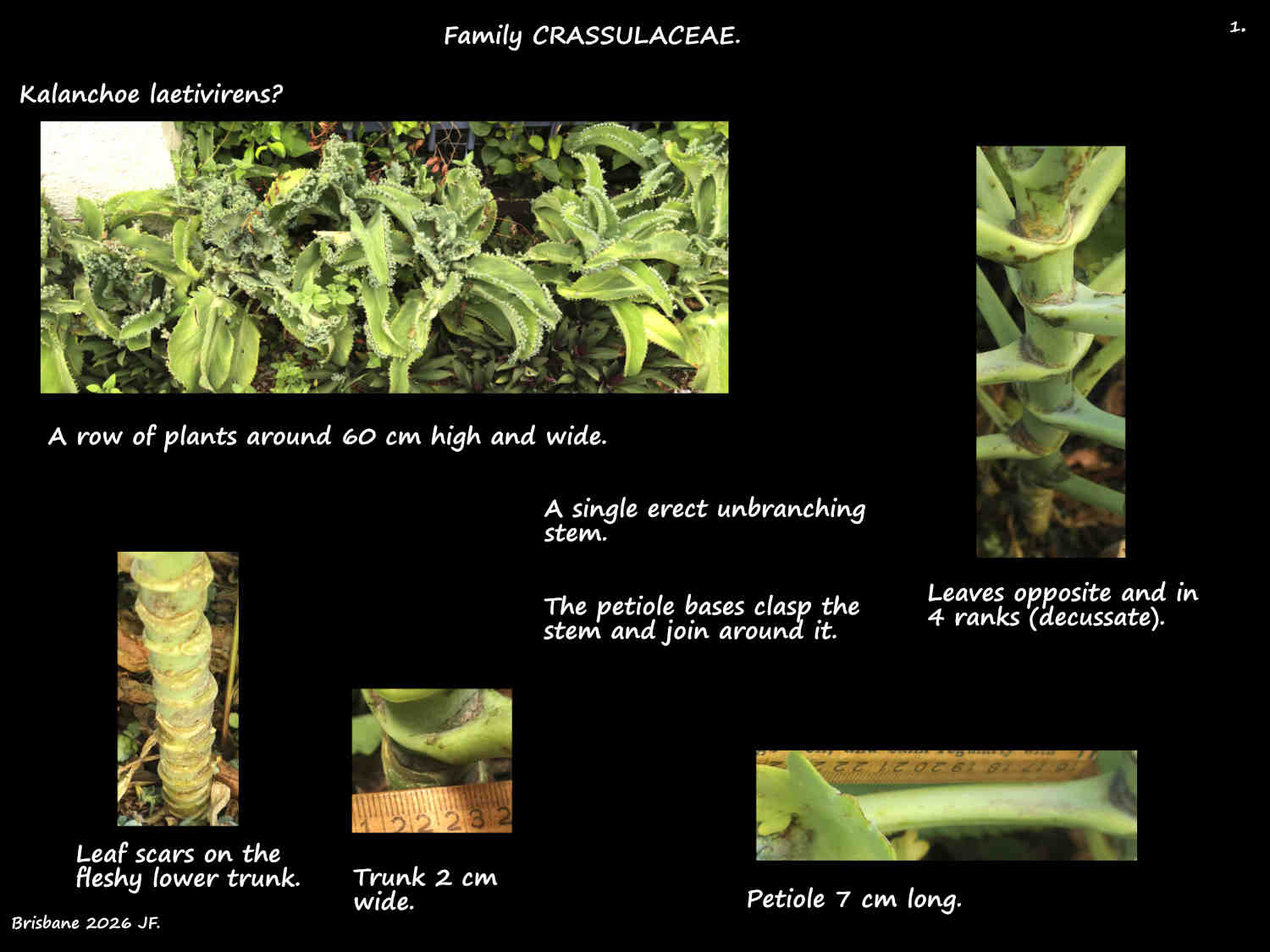
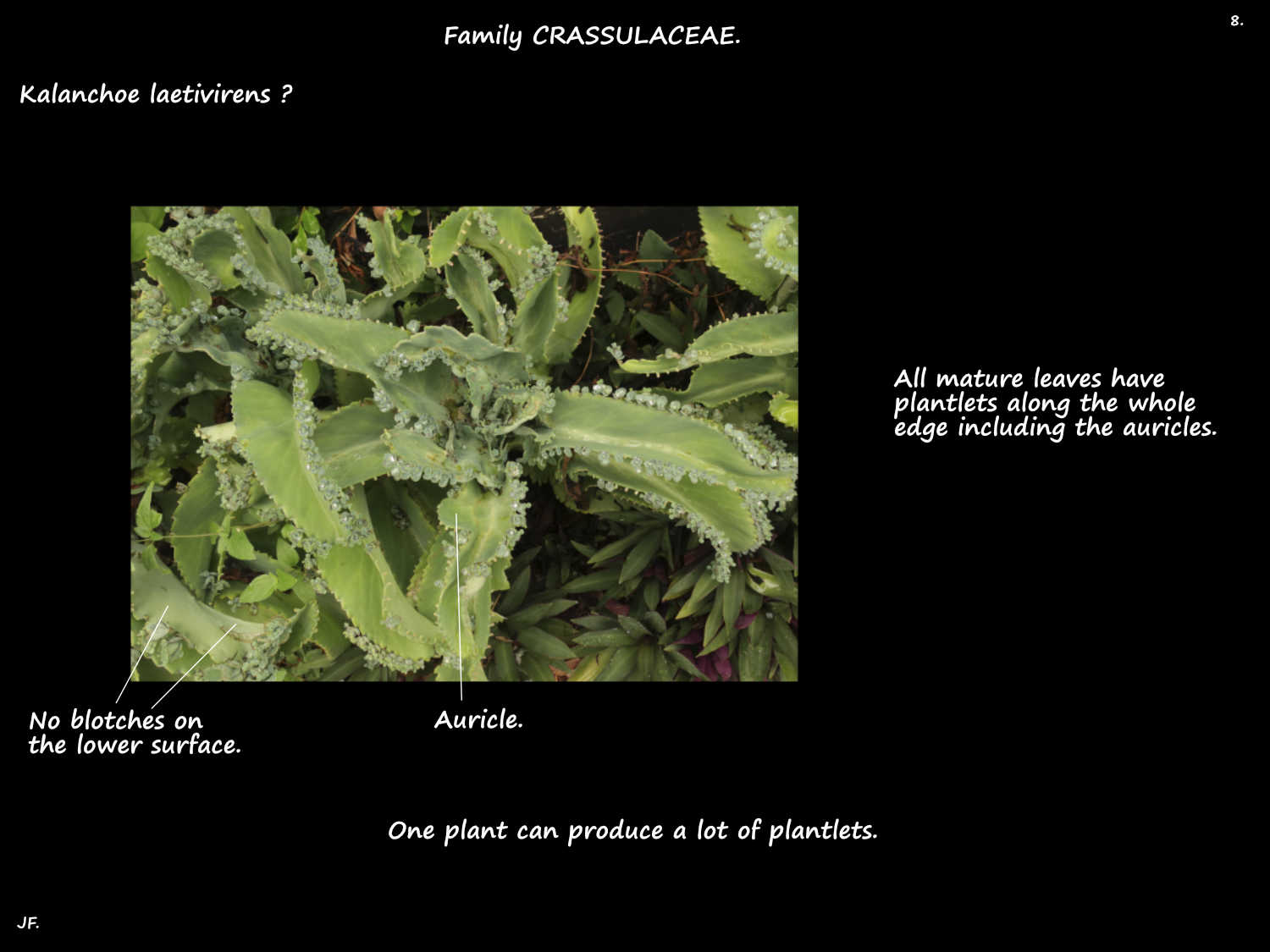
The plant illustrated below has a single unbranched stem.
The folded boat-shaped leaves are nearly 30 cm long.
The lower surface has no mottling and plantlets grow along the whole edge of all mature leaves.
It does not resemble any of the above.
Plantnet identified it, with 70% certainty as K. laetivirens with the next suggestion totally different.
Kalanchoe laetivirens has synonyms that include K. daigremontiana ‘Green Form’ and Kalanchoe × laetivirens.
Plants labelled as ‘Green Form’ are probably the similar K. laetivirens.
Some claim that K. laetivirens is a hybrid but Plants of the World Online (Kew) and World Flora Online accept it as a species.
Kalanchoe laetivirens grows up to 20 cm high and has a single unbranched stem.
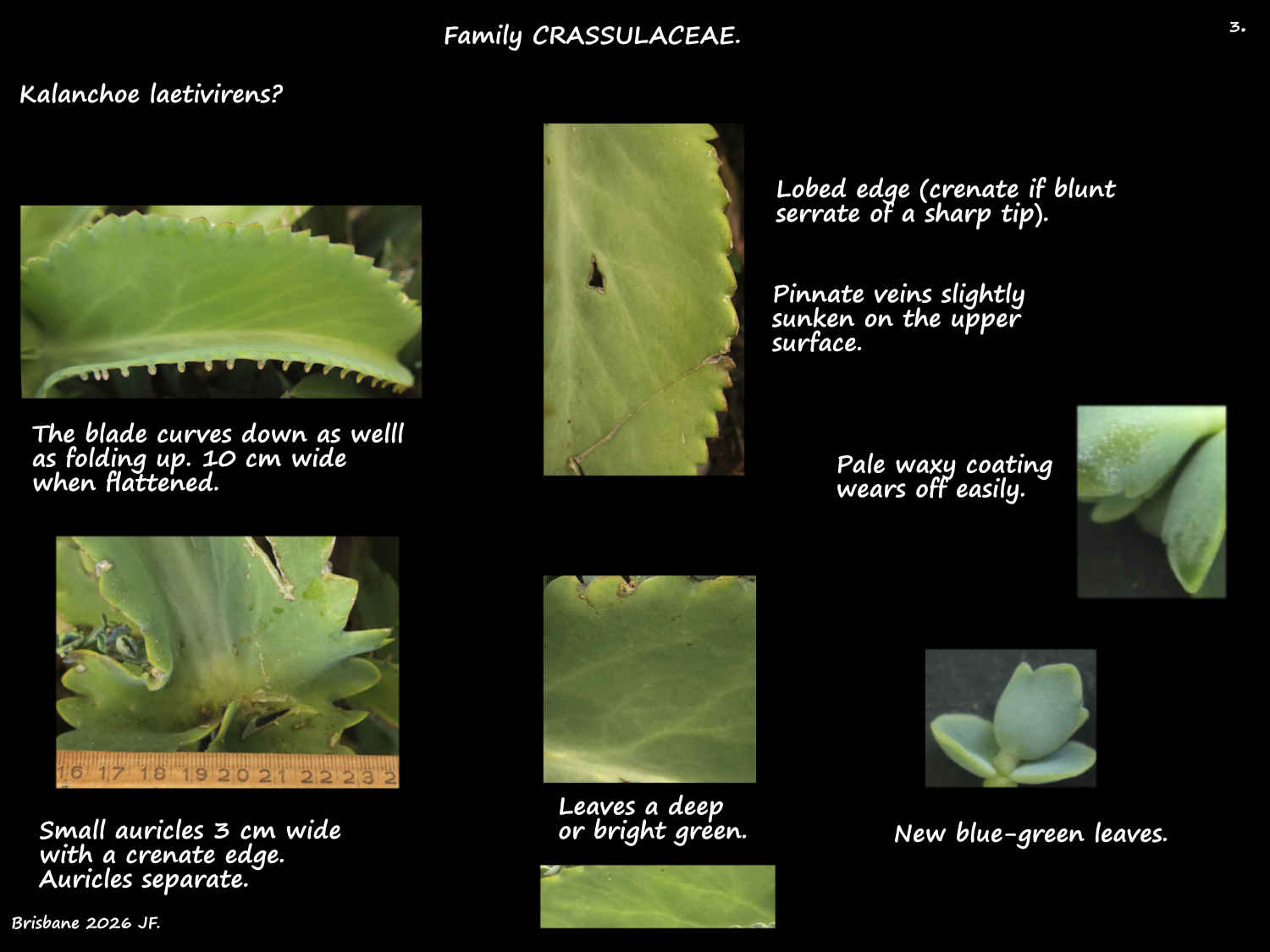
The ovate to elliptic, blue-green to bright green leaves are up to 15 cm long.
Leaves are green on both surfaces with no suggestion of mottling and yhey have plantlets on the whole edge.
I have not seen it available in Australia.
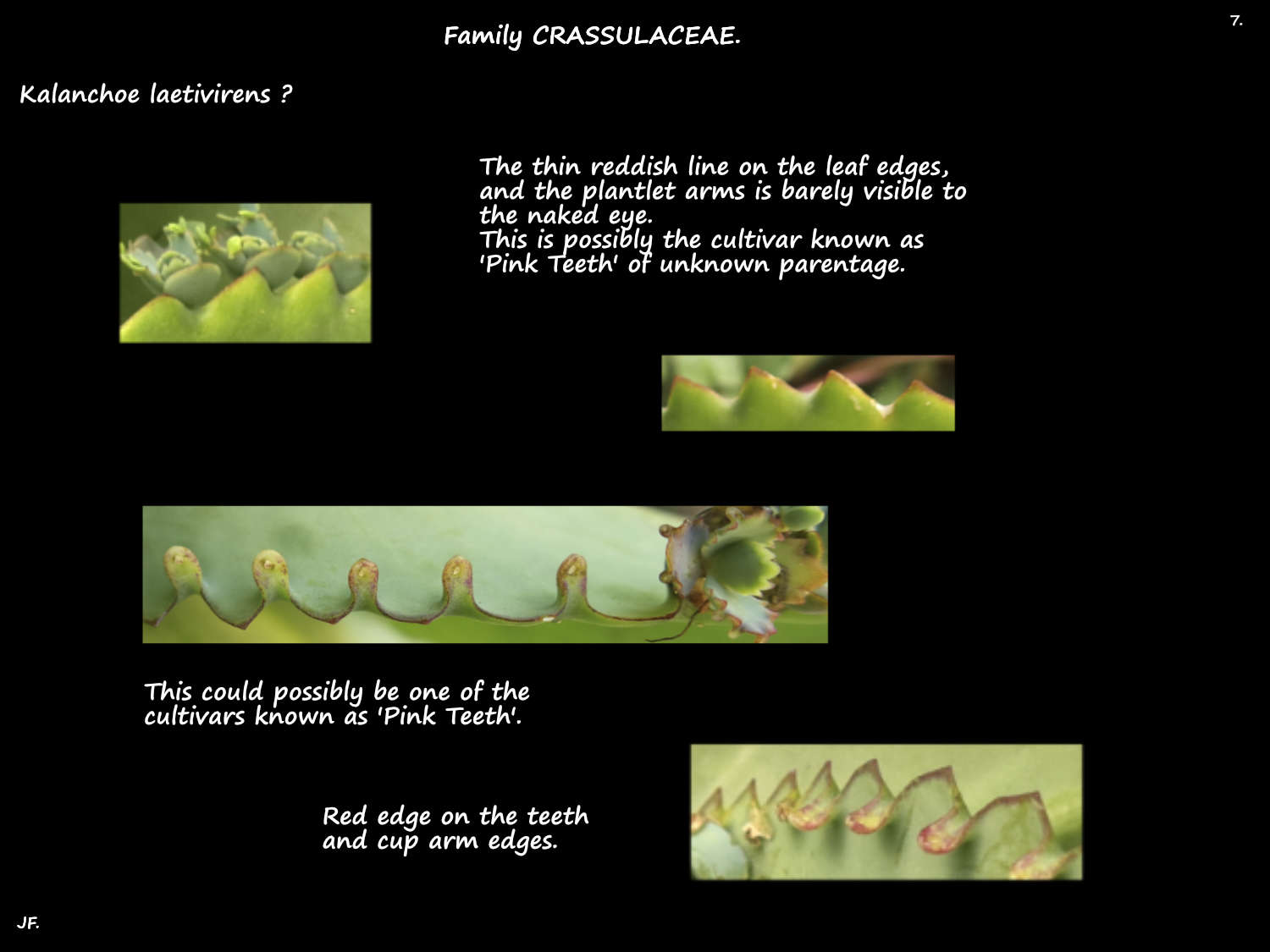
The plant below has a thin red line along the leaf edges but the plantlets are green.
There is a hybrid known as ‘Pink Teeth’ which could apply to it.
There is no authoritative source on the parentage of various plants sold under the trade name of Kalanchoe ‘Pink Teeth’.
Despite what websites and AI searches say there is no patent application and the nursery it came from has closed.
It also gets confused with ‘Pink Butterflies’ which has totally pink plantlets.
A university study has shown that, due to genetic changes these plants are unable to produce fertile seeds.
The gene controlling this is now found in the leaves.#
#Clifton B. Parker. Kalanchoe plantlets: How ‘mother’ does it. Journal Proceedings of the National Academy of Sciences. October 05, 2007.
J.F.