

The Coral tree is native from Mexico to Brazil and the Caribbean.
It is seen occasionally seen as a garden plant.
The small trees can grow to around 6 m but in gardens are usually less.
The single trunk branches into a open crown.
Pale grey or yellow-brown semi-succulent stems exude a milky sap when cut.
Stems have round to oval leaf scars and there are pale lenticels (small nodules).
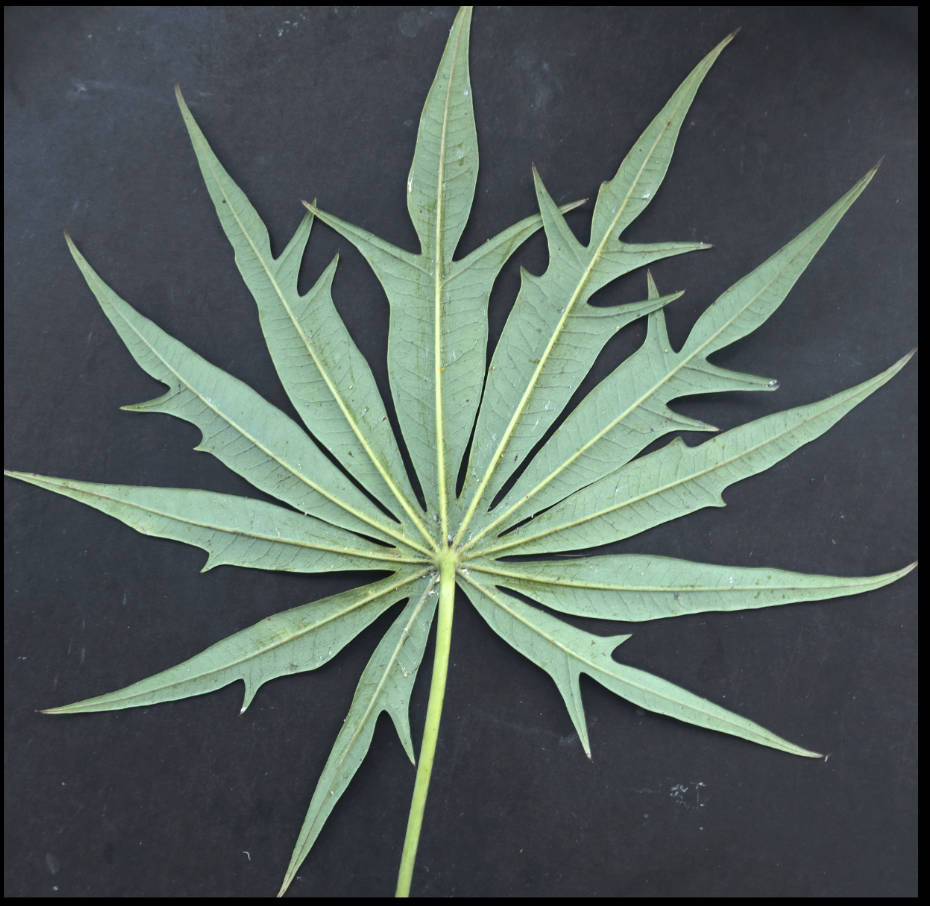
Alternately arranged leaves are on a petiole 20 to 30 cm long.
The evergreen leaves are concentrated near the branch ends.
Beside each petiole base is a pair of stipules up to 2 cm long.
The stipules are branched with the final segments thin and bristle-like.
The round to ovate or heart-shaped blades are 20 to 30 cm long.
Blades are divided almost to the base into 7 to 12 lobes (palmate).
The medial lobe can be up to around 25 cm long and 8 cm wide.
The smallest side lobes, at the base are around 16 cm long.
Lobes can be a simple lance-shape or further divided into shallow to deep lobes.
All lobes have a long tapering tip that may end in a bristle-like extension.
The single mid-vein in each lobe is prominent on the lower surface.
New leaves are yellow-green, older ones a deep green above and paler below.
Inflorescences are terminal then sub-terminal as the stem continues to grow.
The 20 to 25 cm long peduncle holds the flowers above the leaves.
Smooth red to green peduncles have lance-shaped bracts 4 to 5 mm long.
The branched clusters of flowers, up to around 26 cm long can have a flat or round top.
The basic unit is a cyme with flowers, on a pedicel along a midrib with the terminal flowers opening first.
The male and female flowers on each tree are bright coral to red.
Male flowers are on a pedicel up to 1 cm long.
The lower half of the 3 to 4 mm long sepals are fused into a calyx tube with 5 ovate lobes.
The cup to bell-shaped corollas have 5 free, 5 mm long scarlet petals.
The oblong to obovate petals have a round tip.
The 8 free stamens, in 1 whorl have 4.5 mm long filaments.
The 2 mm long linear to oblong anthers have basal lobes.
Inside the stamens are 5 free rounded disk (nectar) glands.
There is no ovary.
Female flowers are fewer in number but 1.5 times larger than the males.
They are on a shorter pedicel around 3 to 5 mm long.
The 5 red sepals are around 5 mm long and the petals nearly 1 cm.
There are no stamens but 5 similar free disk glands.
The ovary, of 3 carpels is sometimes reduced to 1 or 2 locules each with 1 ovule.
The 3 mm high ovary has 3 styles with their lower halves fused and bi-lobed stigmas.
Depending on the number of carpels that develop capsules can be 3-lobed or pear-shaped.
Capsules may eventually open along the septa or remain closed.
The shape of the mottled brown seeds depends on the number maturing.
J.F.


