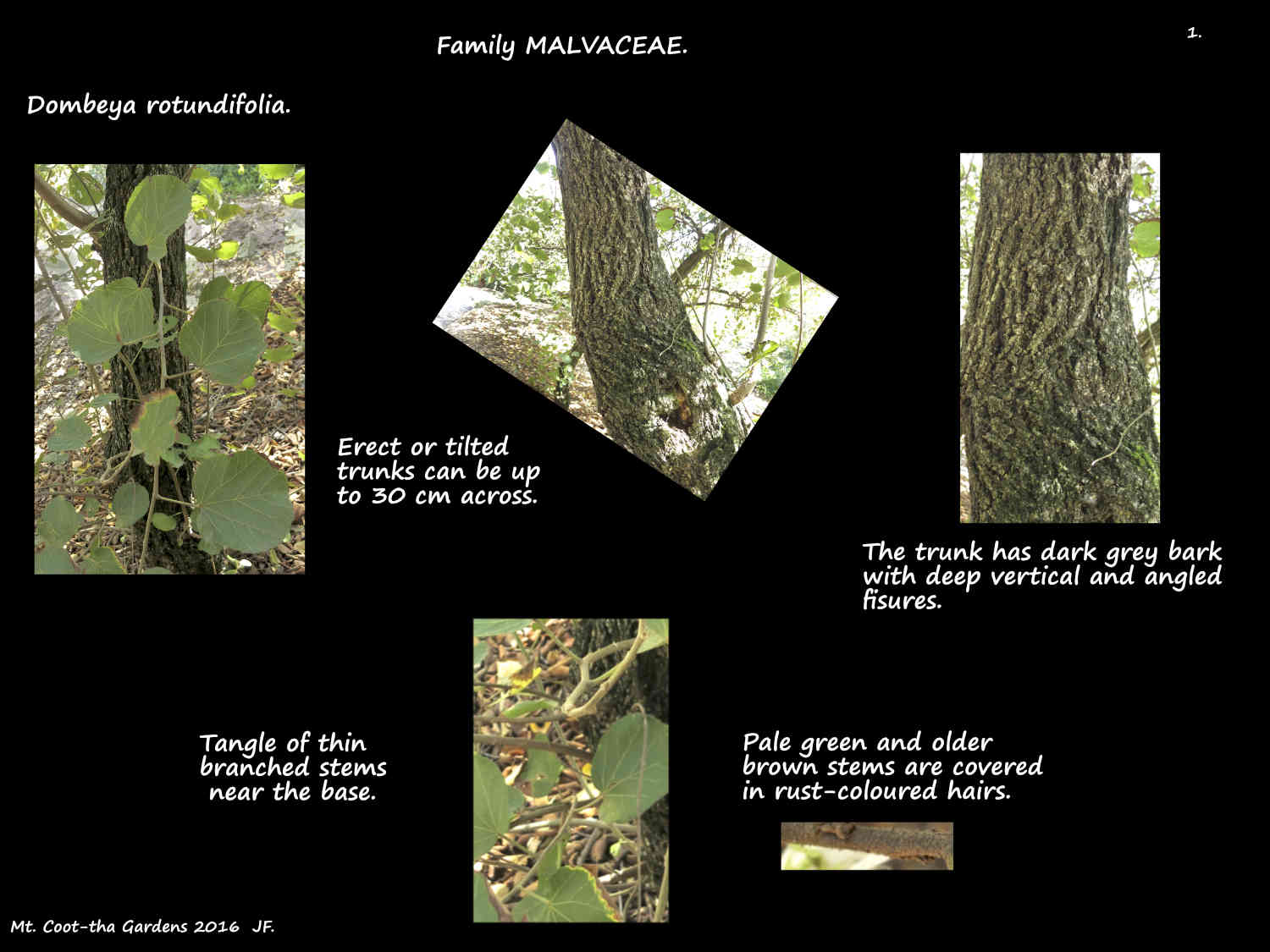
Round Leaf Dombeya are shrubs up to 5 m high with multiple stems from the base.
They can also be a small tree up to around 10 m high with an erect or tilted trunk.
New branches have rust-coloured hairs that are gradually lost.
Older branches have lenticels which are small nodules for gas exchange.
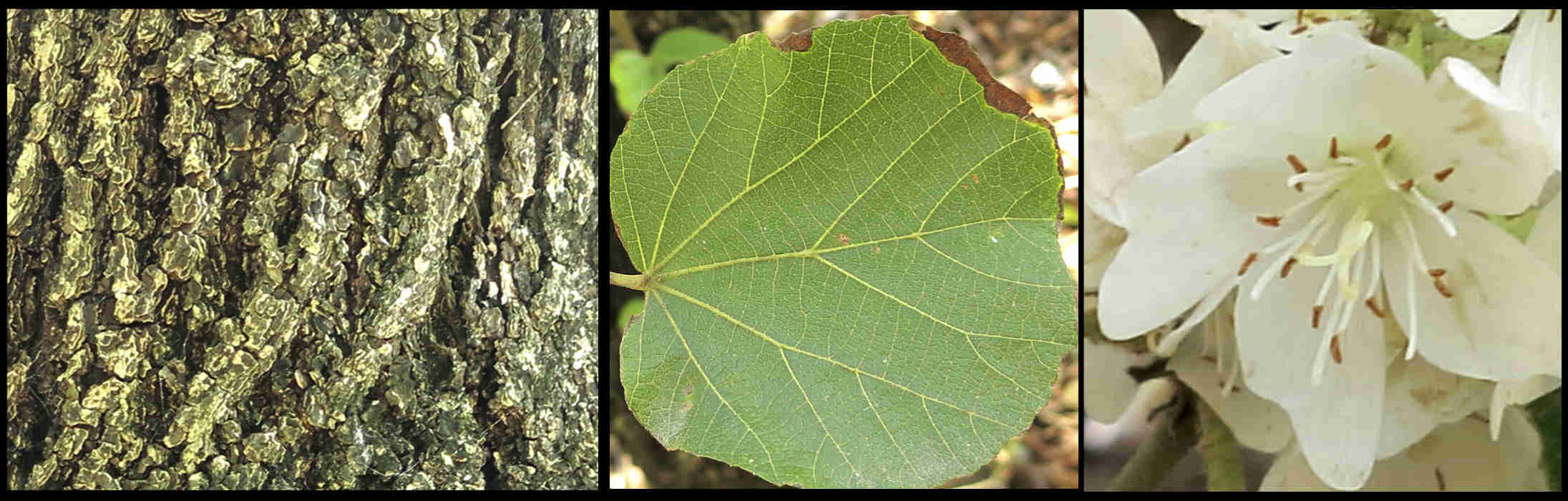
Thick dark grey bark on the trunk has vertical fissures.
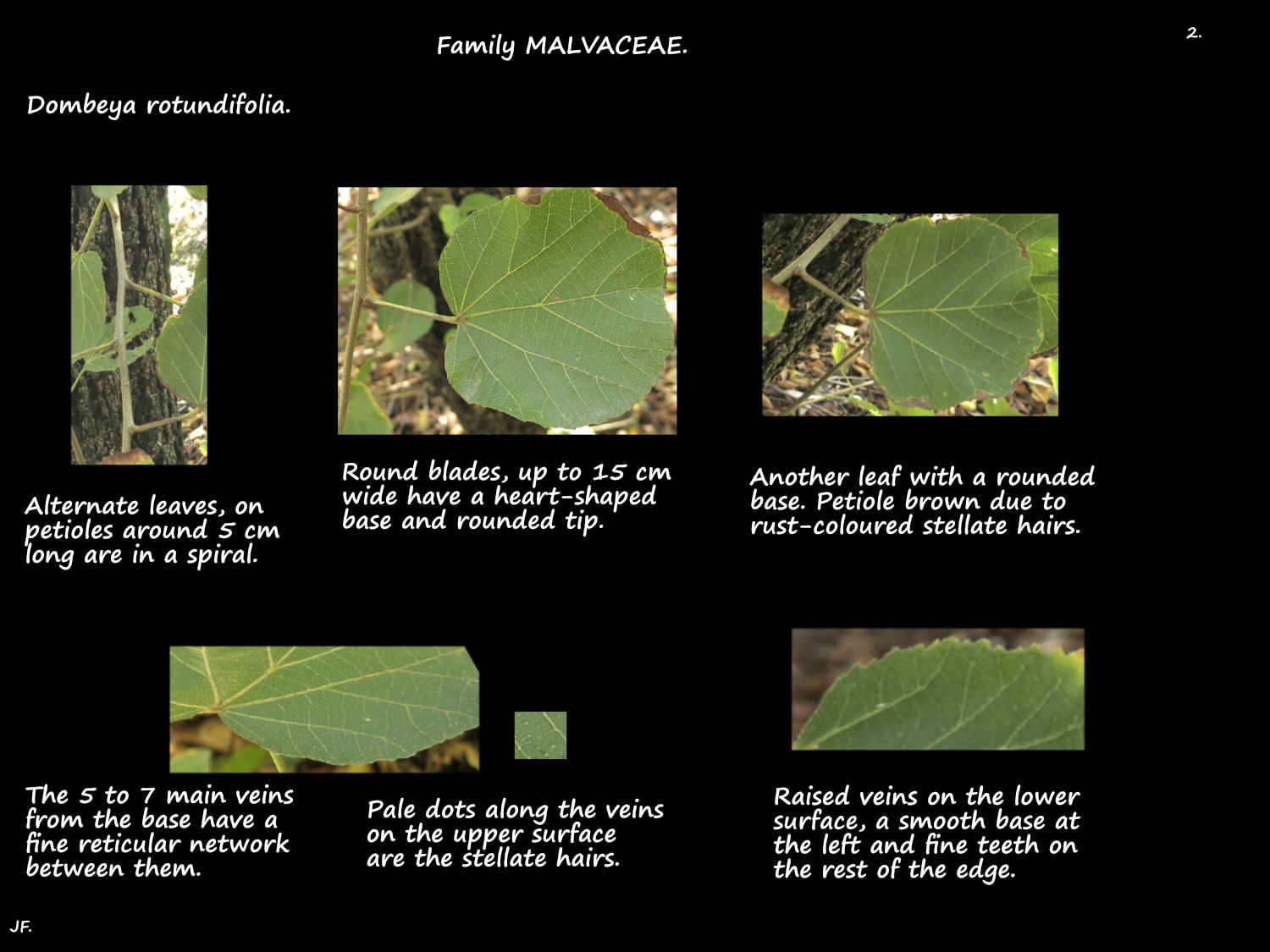
Deciduous leaves are alternately arranged in a spiral.
Petioles, around 4 to 6 cm long have stellate hairs.
Paired stipules at the petiole base are a few mms long.
The narrow triangular stipules, with short soft hairs fall very early.
Blades, up to 15 cm across are widely ovate to round.
The base is heart-shaped or round and the tip is usually rounded.
The edges may be smooth or have few to many small sharp to blunt teeth.
The 5 to 7 main veins from the base are raised on the lower surface.
The thick blades are dark green above, paler below and new leaves may be tinted.
The upper surface usually has small stellate hairs making it feel rough.
The lower surface has pale soft tangled hairs.
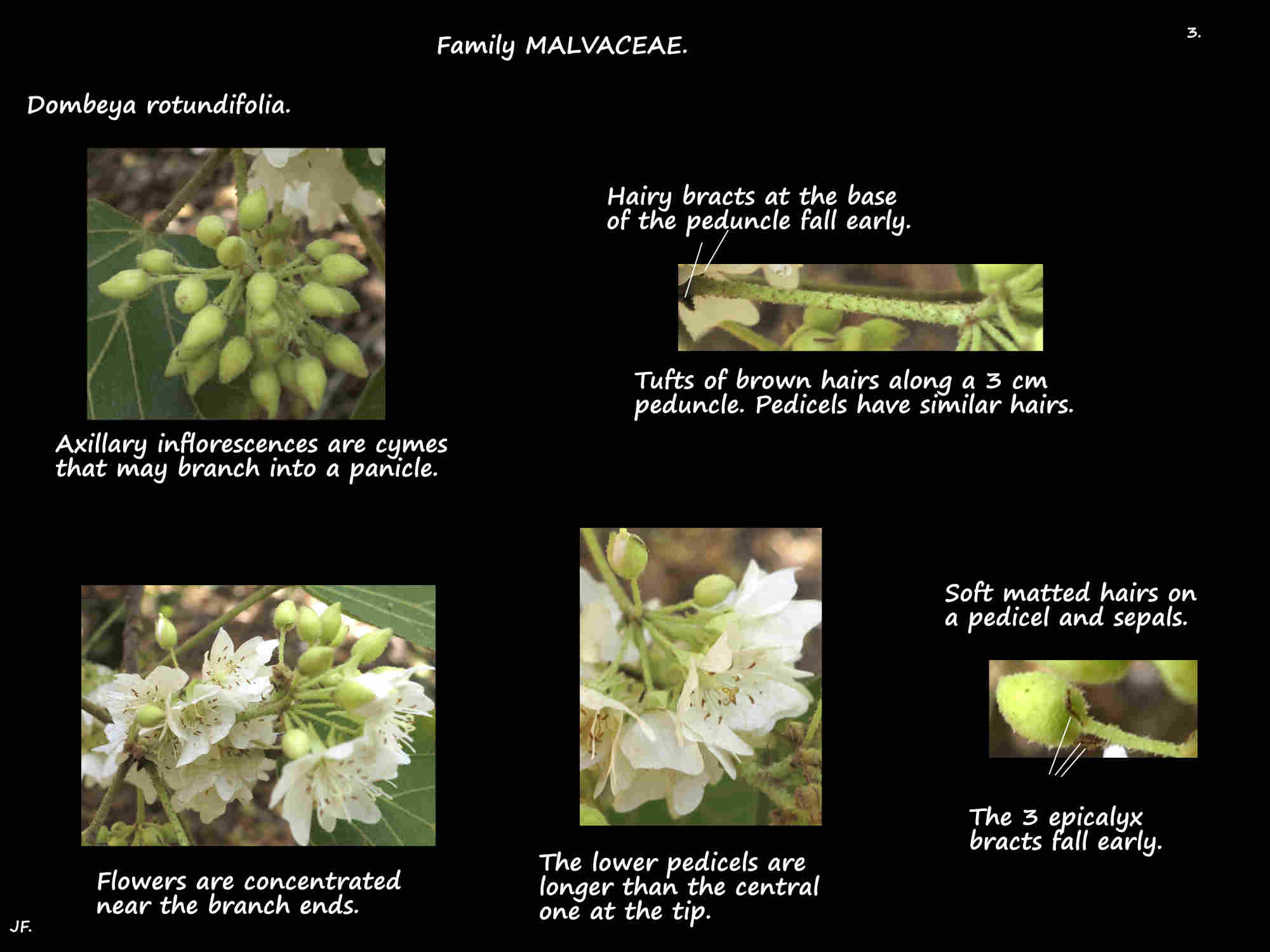
Axillary inflorescences (cymes) are concentrated near the branch ends.
Flowers may be seen before the new leaves.
The peduncle, around 3 cm long has tufts of short soft tangled hairs.
Each cluster of flowers is around 6 cm long and slightly wider.
The flower at the end of the floral axis opens before those lower down.
The hairy pedicels are longer on the lower flowers.
This brings all the flowers in an inflorescence to about the same level.
The peduncles may branch forming a panicle.
The peduncles have 3 linear bracts a few mms long that fall off early.
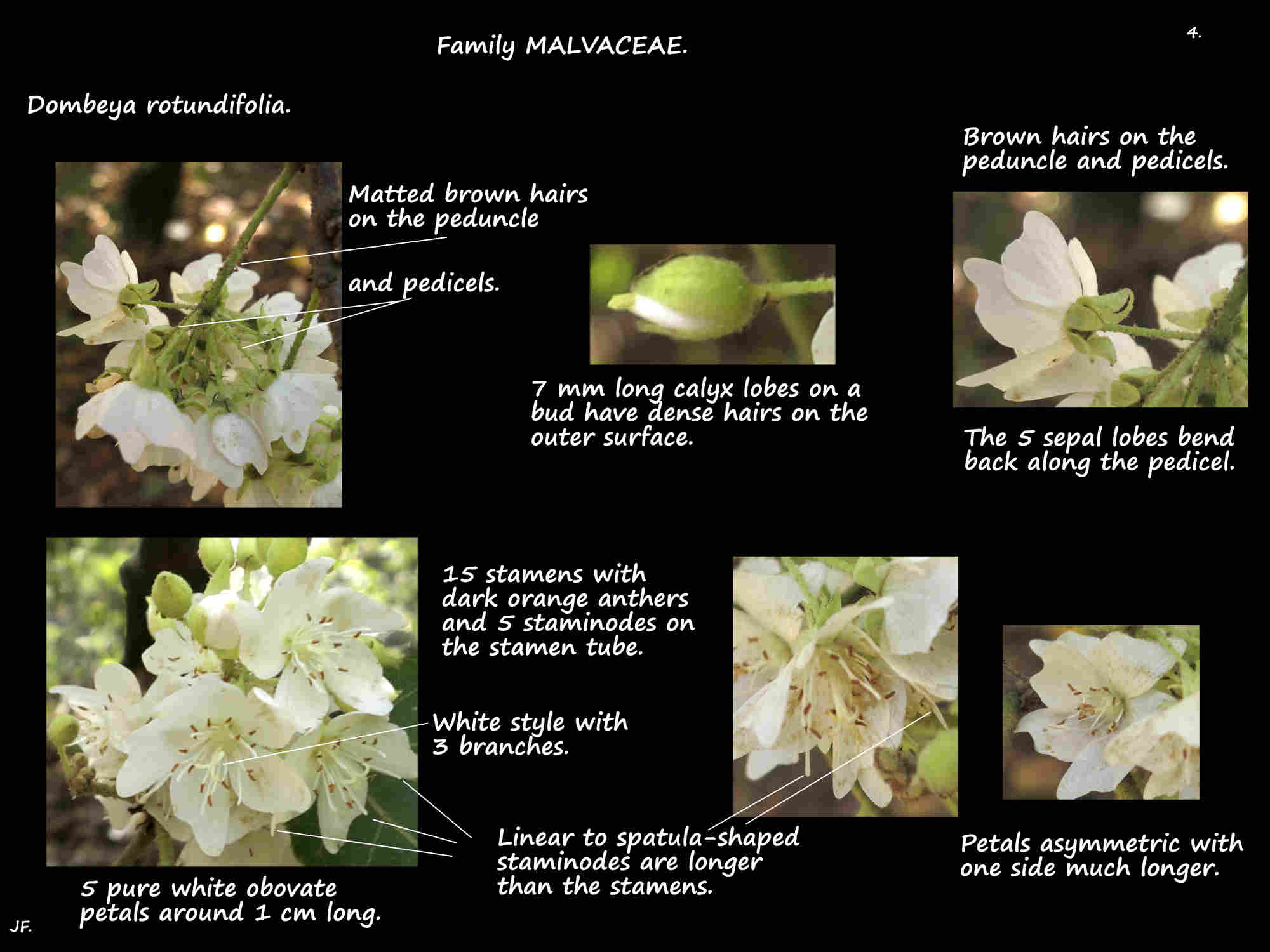
Peduncles, and the around 1.5 cm long pedicels both have soft matted hairs.
At the top of the pedicels are short linear bracts that fall early.
Bases of the sepals are fused for a few mms with 5 lance-shaped lobes.
The lobes, which curve back have dense soft hairs on the outer surface.
The 5 free petals are around 10 mm long and 7 mm wide at the tip.
The overlapping petals are obovate with one side longer than the other.
Petals are pure white but occasionally very pale pink ones are seen.
The petals don’t fall but turn a pale brown and persist on the fruit.
Bases of the around 15 stamens and 5 staminodes are fused for around 1 mm.
The free filaments, around 4 mm long are of slightly different lengths.
The orange anthers open through longitudinal slits.
The 5 linear or slightly spatula-shaped staminodes, with no anthers are white.
Around 7 mm long their tips are roughly level with the petals.
The slightly flattened spherical superior ovary is around 2 mm high.
It is densely coverfed with small bristles and soft stellate hairs.
There are no hairs inside the up to 5 locules each of which has 2 (3) ovules.
The 2 mm long style may have a few hairs at the base.
It holds the 3 (to 5) spreading and curved arms with the stigmas.
Fruit are said to be an almost spherical capsule around 5 mm wide.
The hairy capsules still have the brown petals and other dead flower parts attached.
The tiny brown 3-angled seeds have a hard wrinkled coat.
J.F.