In Family Malvaceae it is sometimes known as the Wax or Sleepy Mallow.
It is the type species for the Malvaviscus genus.
Rarely cultivated its var. arboreus is more commonly seen.
It is a very variable species mainly in the leaf shapes and hairs.
The following notes could apply to this or its var. abroreus.
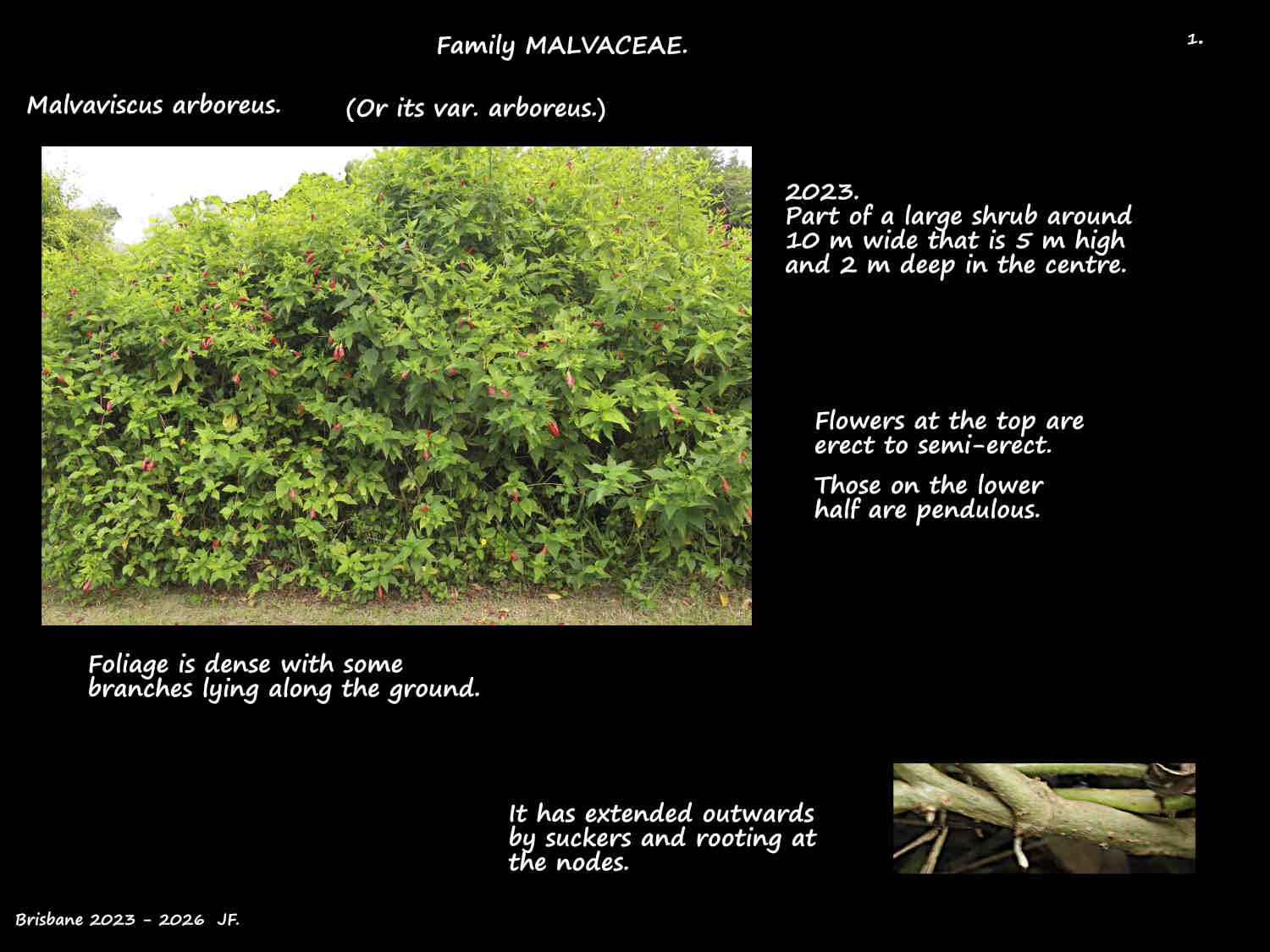
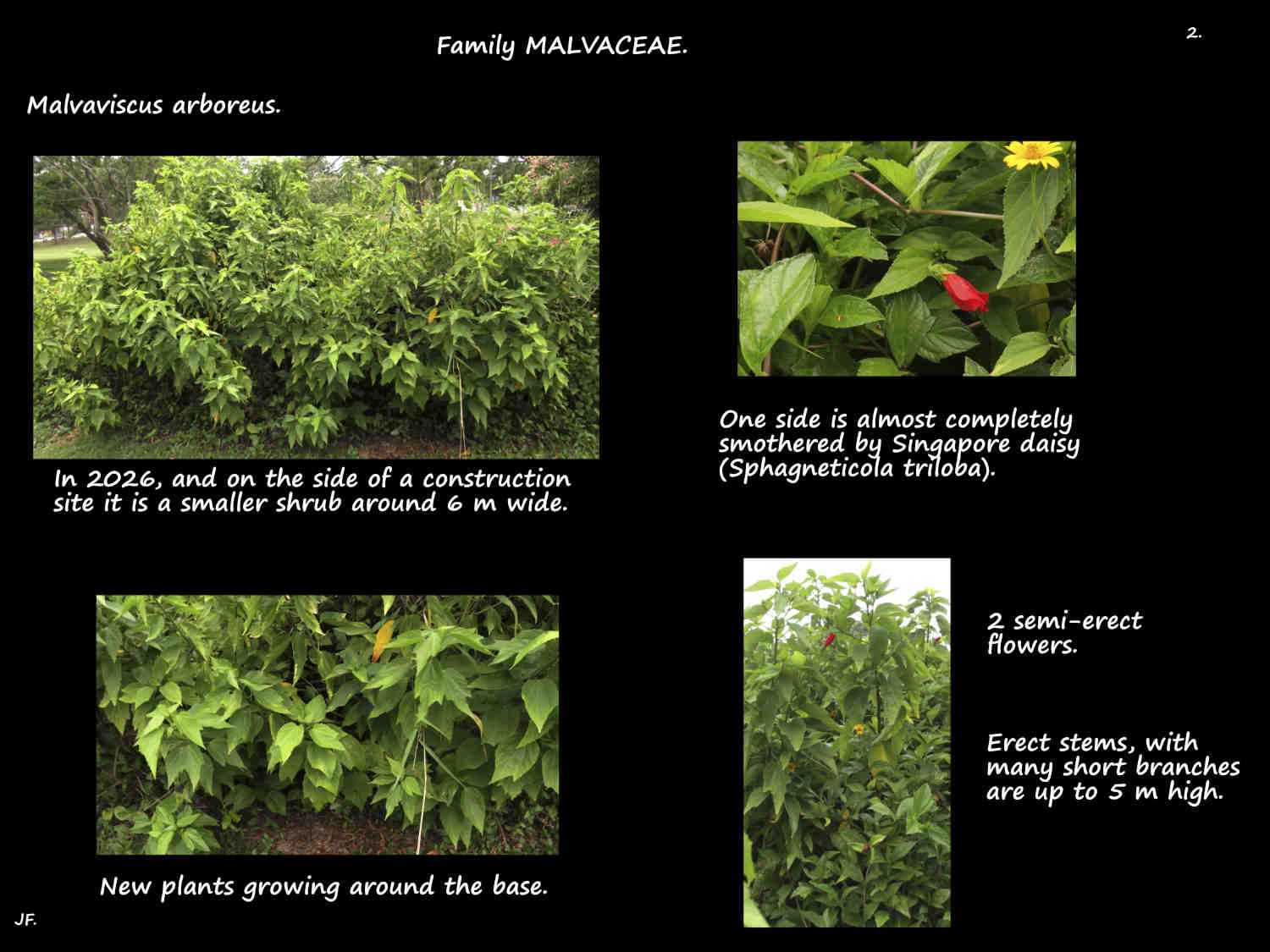
They mostly grow as shrubs from 1 to 4 or 5 m high and almost as wide.
They can sometimes scramble over other vegetation.
They can spread sideways from basal suckers or root from branches touching the ground.
When they escape cultivation they can form large dense infestations.
New twigs can have no, a few or dense simple and stellate hairs.
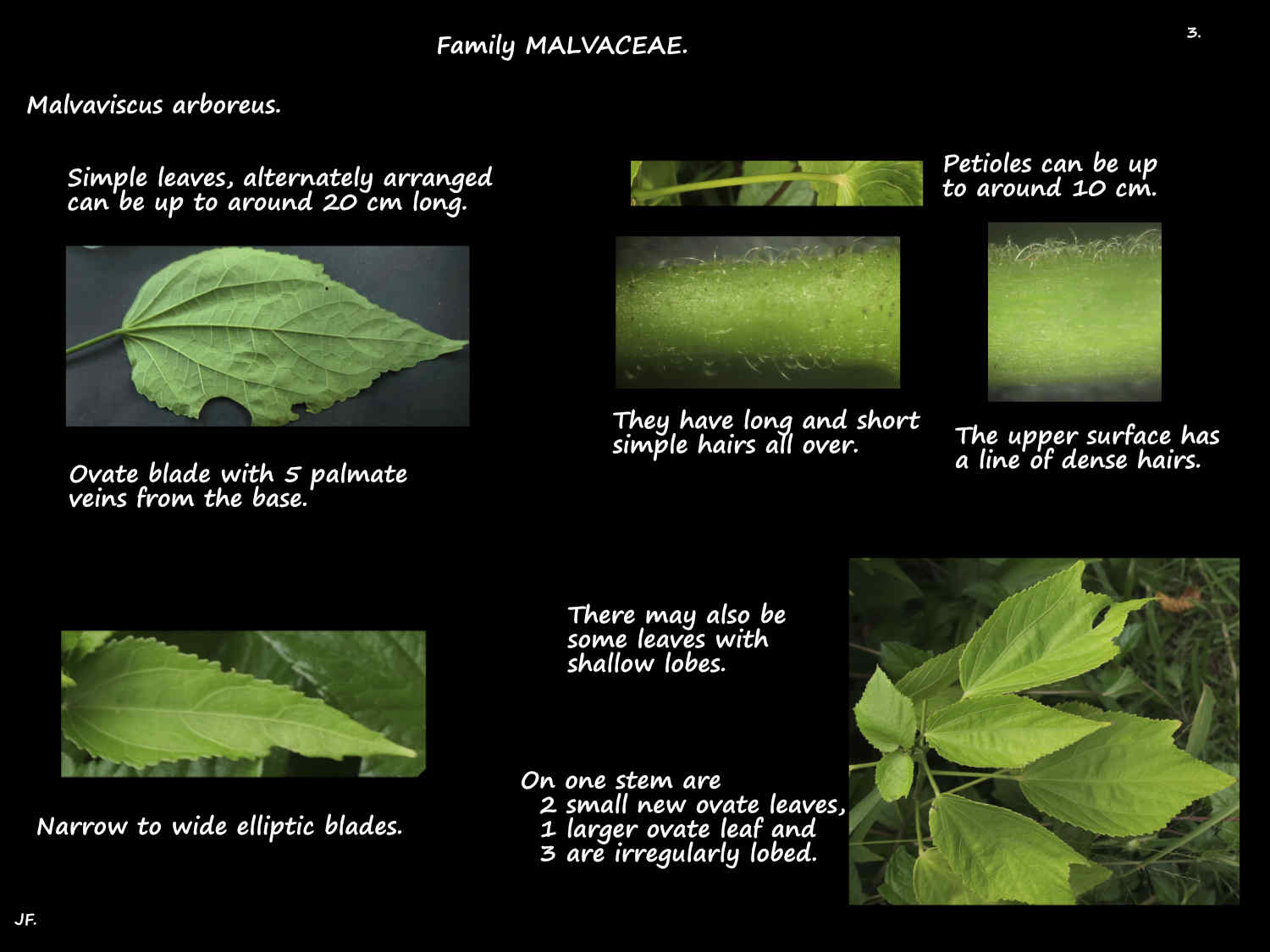
Alternately arranged leaves, on an often long petiole (7 to 15 cm) are in a spiral.
Petioles may have no hairs but there are usually small stellate ones.
The linear green stipules at the petiole base, a few mms long have short hairs.
The largest blades are 20 to 25 cm long and 10 to 15 cm wide.
They are elliptic to widely ovate with some having 3 shallow lobes.
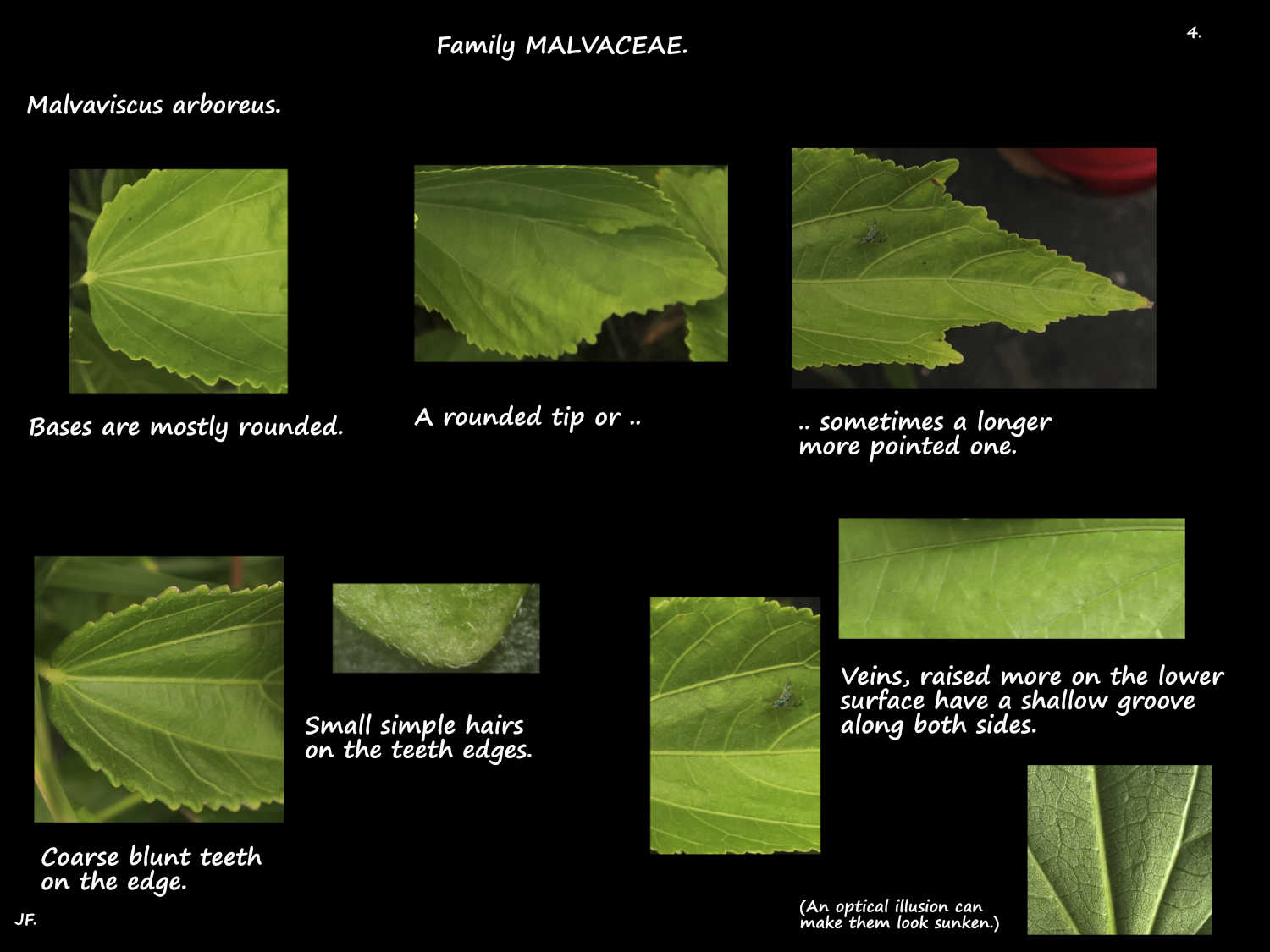
The base is mostly round but can be flat or slightly heart-shaped.
The tip tapers to a short point with the sides being straight or concave (acute or acuminate).
The edges have small coarse sharp or blunt teeth.
There are 5 or 7 (9) nerves (veins) from the base.
They are raised on both surfaces and there is a reticular network between them.
Blades can have just a few scattered hairs but they are often densely hairy.
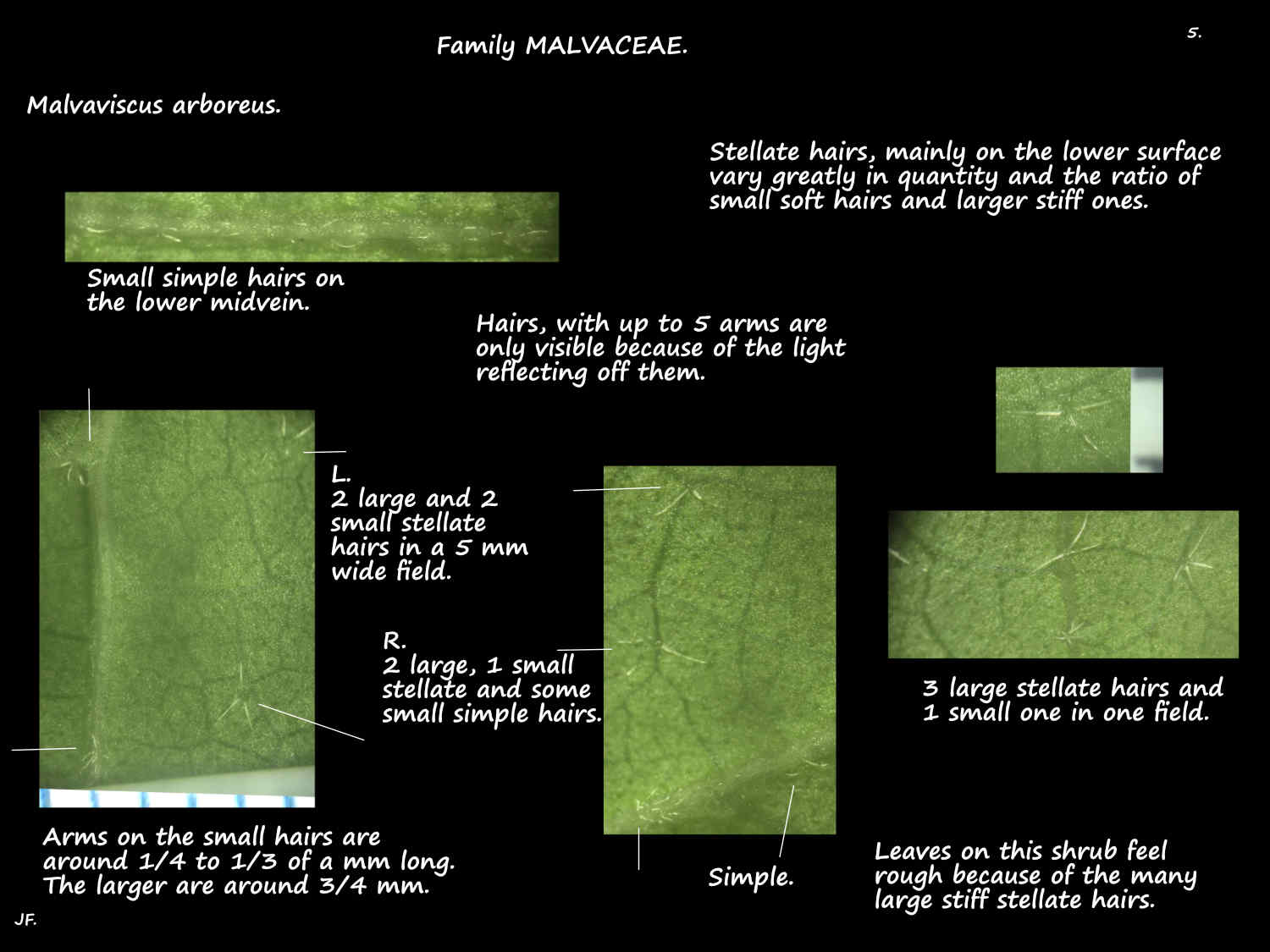
Hairs, mainly on the lower surface are extremely variable.
There are simple hairs and small soft stellate (branched) ones.
There are few to many larger stiff stellate hairs that make the leaves feel rough.
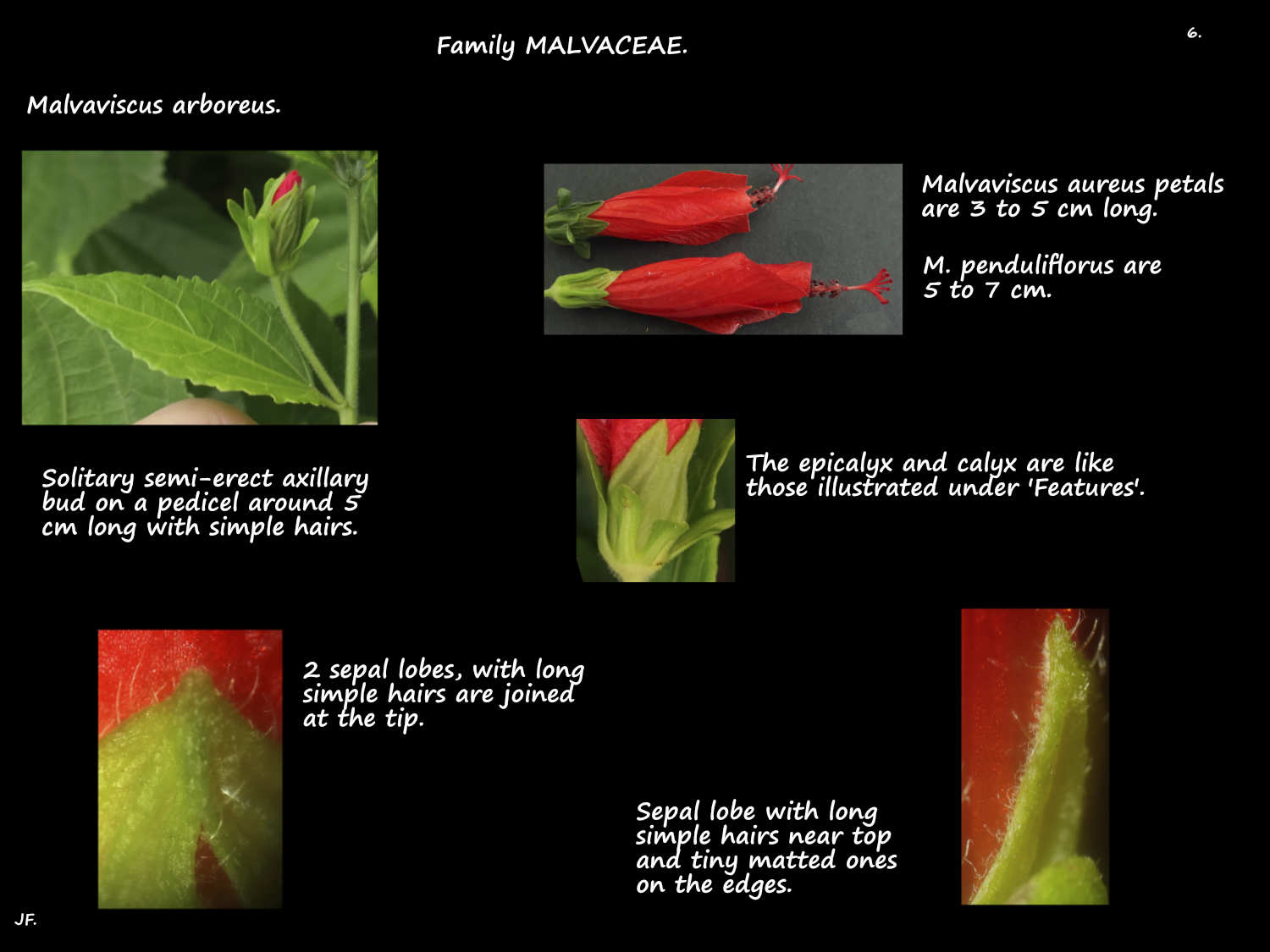
Inflorescences are a solitary axillary flower but occasionally a small terminal cluster.
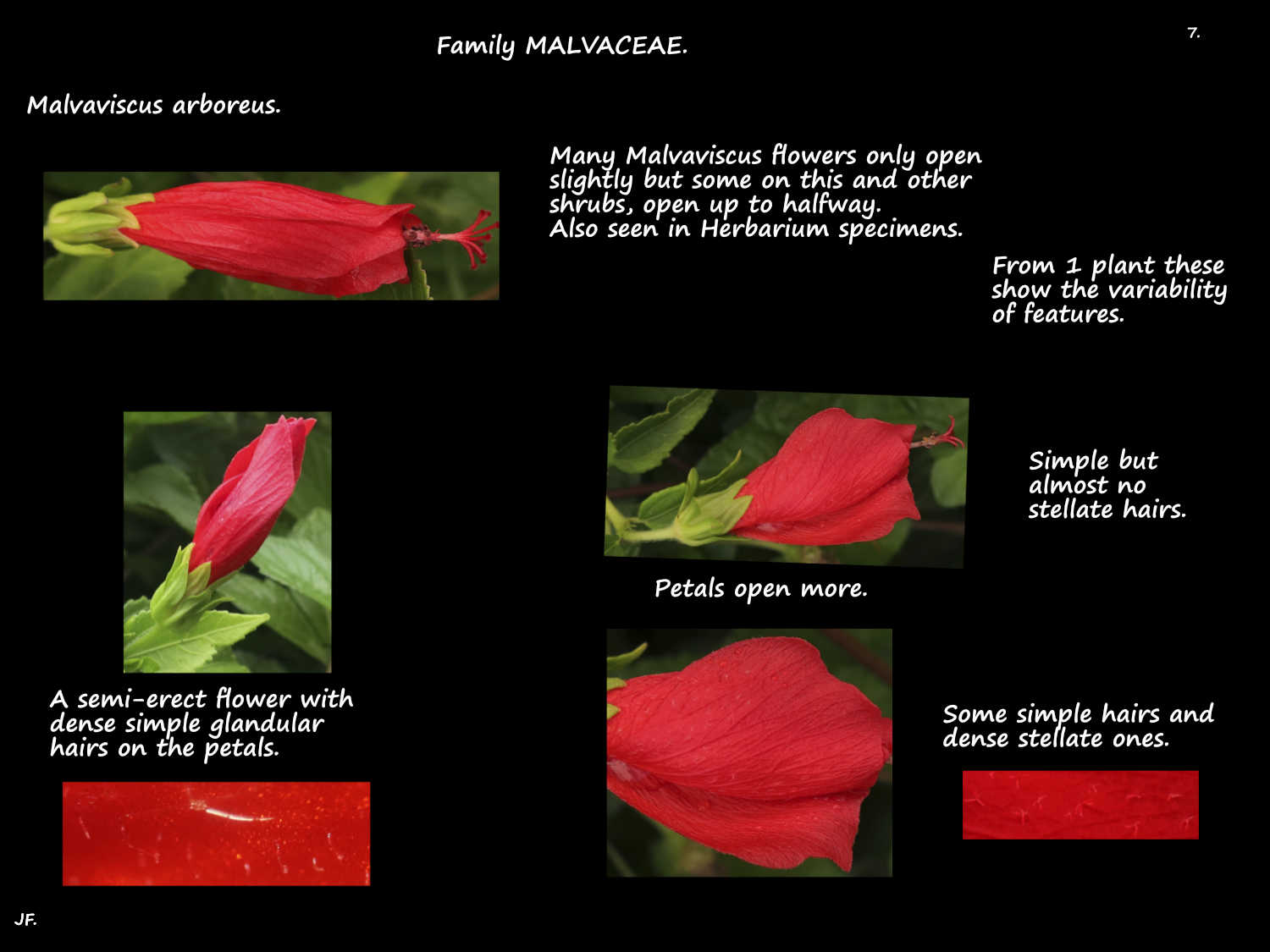
Most flowers are erect to semi-erect but some (possibly hybrids) can be pendulous.
Pedicles, up to 4 or 6 cm long can be smooth or slightly hairy.
The epicalyx (involucre) has around 8 free linear or spatula-shaped bracts.
Around 1 cm long and 1 to 2 mm wide they are shorter than the calyx.
They can have no or a few simple and stellate hairs but there are usully small simple hairs on the edges.
The tubular green calyx is around 1.5 to 2 cm long.
Bases of the sepals are fused for up to 2/3 of their length with 5 lobes.
There may be no hairs or small soft yellowish ones on the outer surface.
The 5 obovate petals are inserted onto the wide base of the staminal column.
Petals are around 3 (5) cm long and up to 2.5 cm wide near the top.
Each has a basal lobe or auricle a few mms long with simple hairs on the edge.
The overlapping petals are rolled up lengthwise and only open a little at the top.
There are usually no hairs but sometimes a few stellate ones on the outer surface.
Petals are almost always deep red but occasionally pink or white.
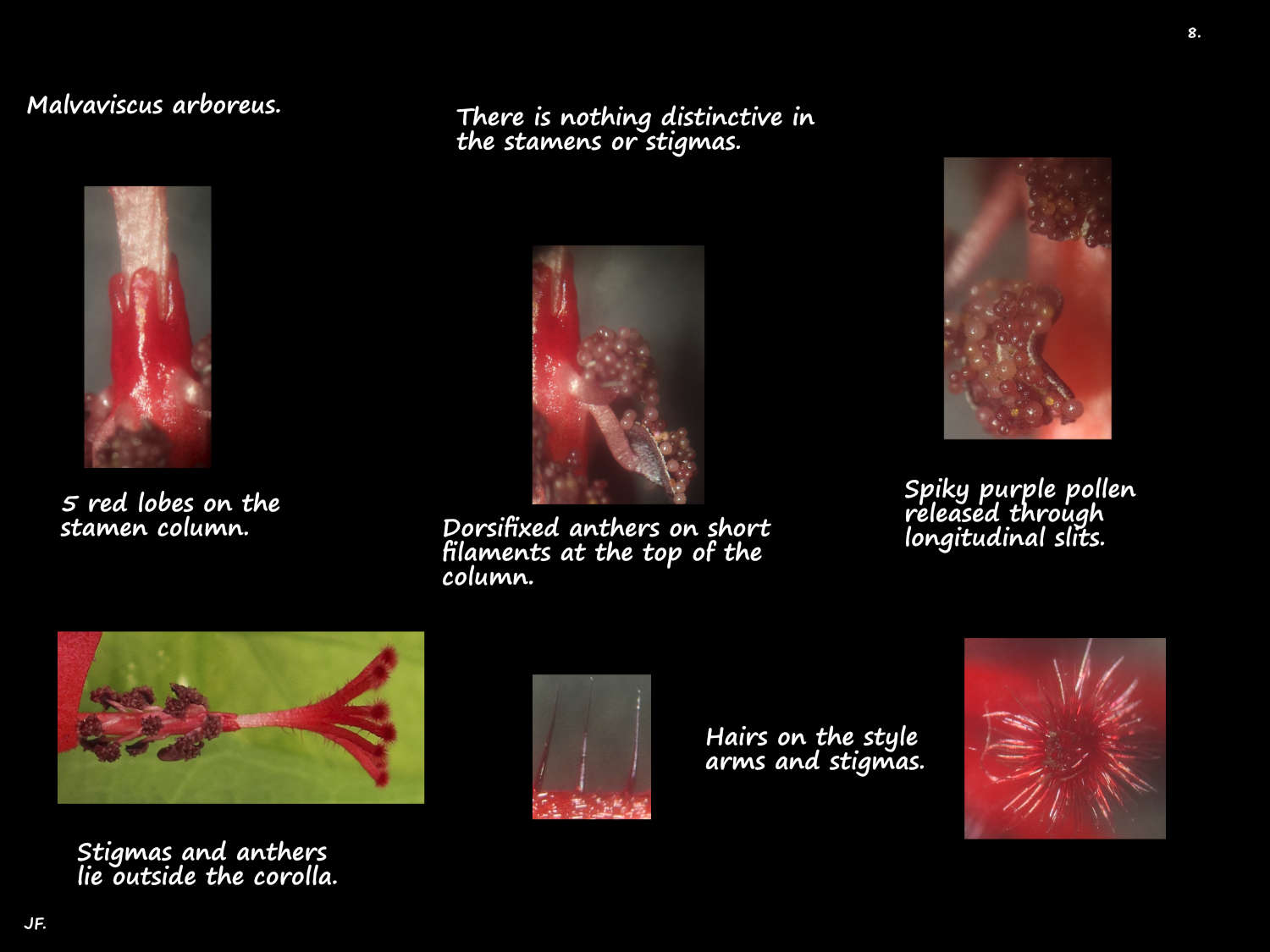
Filaments of the numerous stamens are fused into a red staminal column.
From around 4 to 6 cm long it has 5 red lobes at the top.
Anthers, in a cluster near the top are on smooth purple filaments up to 1 cm long.
The superior ovary has 5 free carpels, with 1 ovule in each locule, and 2 styles.
The 10 styles are fused while they pass through the column.
Outside the column the style branches into 10 arms with small roughly spherical stigmas.
There are simple red hairs on the branches and white ones on the stigmas.
At maturity the top of the stamen tube, anthers, styles and stigmas extend past the petals.
The 1 to 1.5 cm wide fruit are a red fleshy berry-like schizocarp.
When dried out the 5 mericarps separate and release their single kidney-shaped seed.
J.F.