The commonly cultivated Sleeping hibiscus is naturalised in parts of Australia.
An increased number of chromosomes indicate that it is a hybrid.
Not found in the wild its feature are much less variable than those of M. aureus.
It is sterile, extremely rarely has fruit and it spreads vegetatively.
Many features are similar to those of M. arboreus.
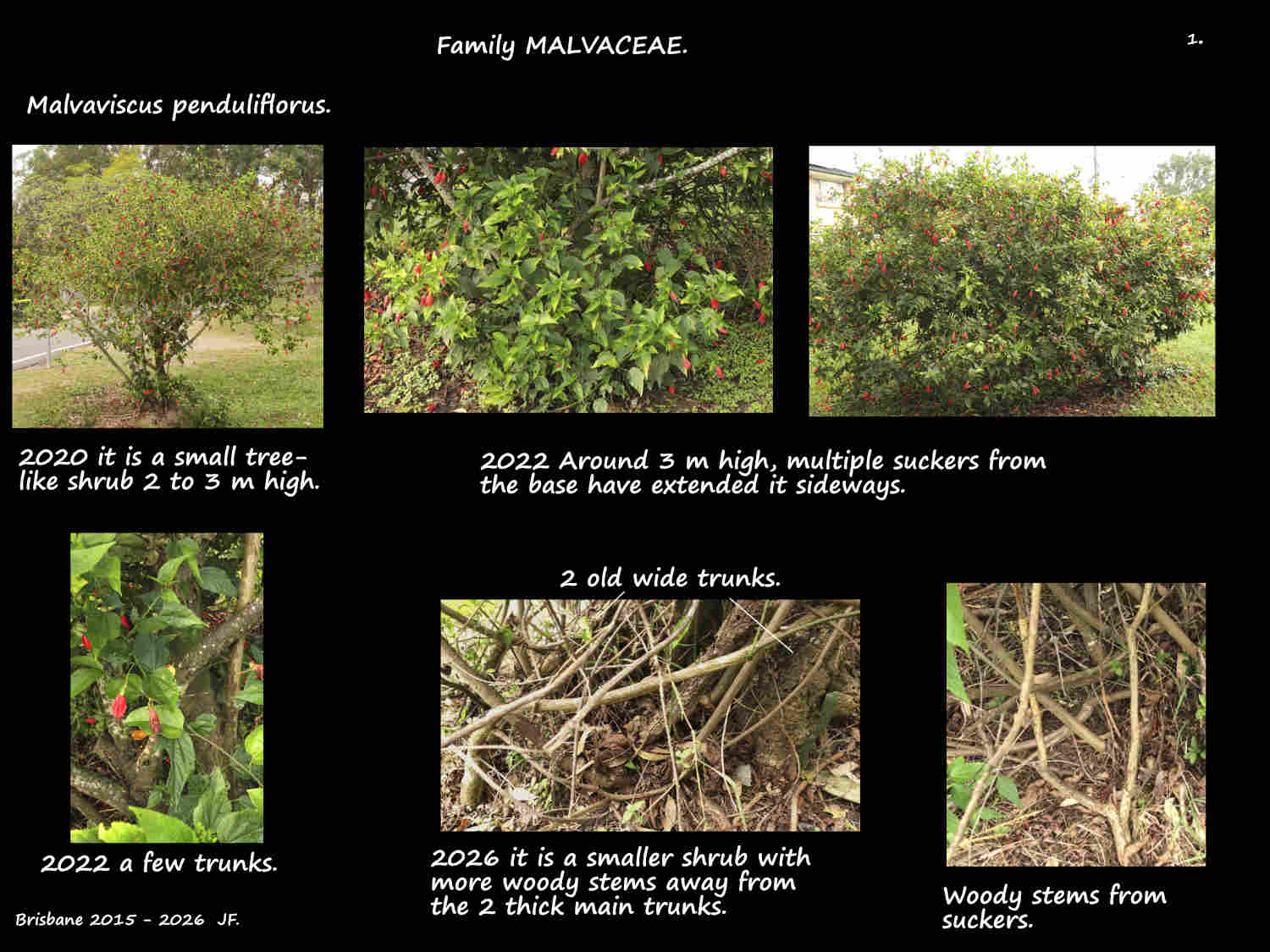
A vigorous erect shrub or sometimes a scrambling one with vine-like stems.
Up to 4 m high and wide one plant can cover a large area.
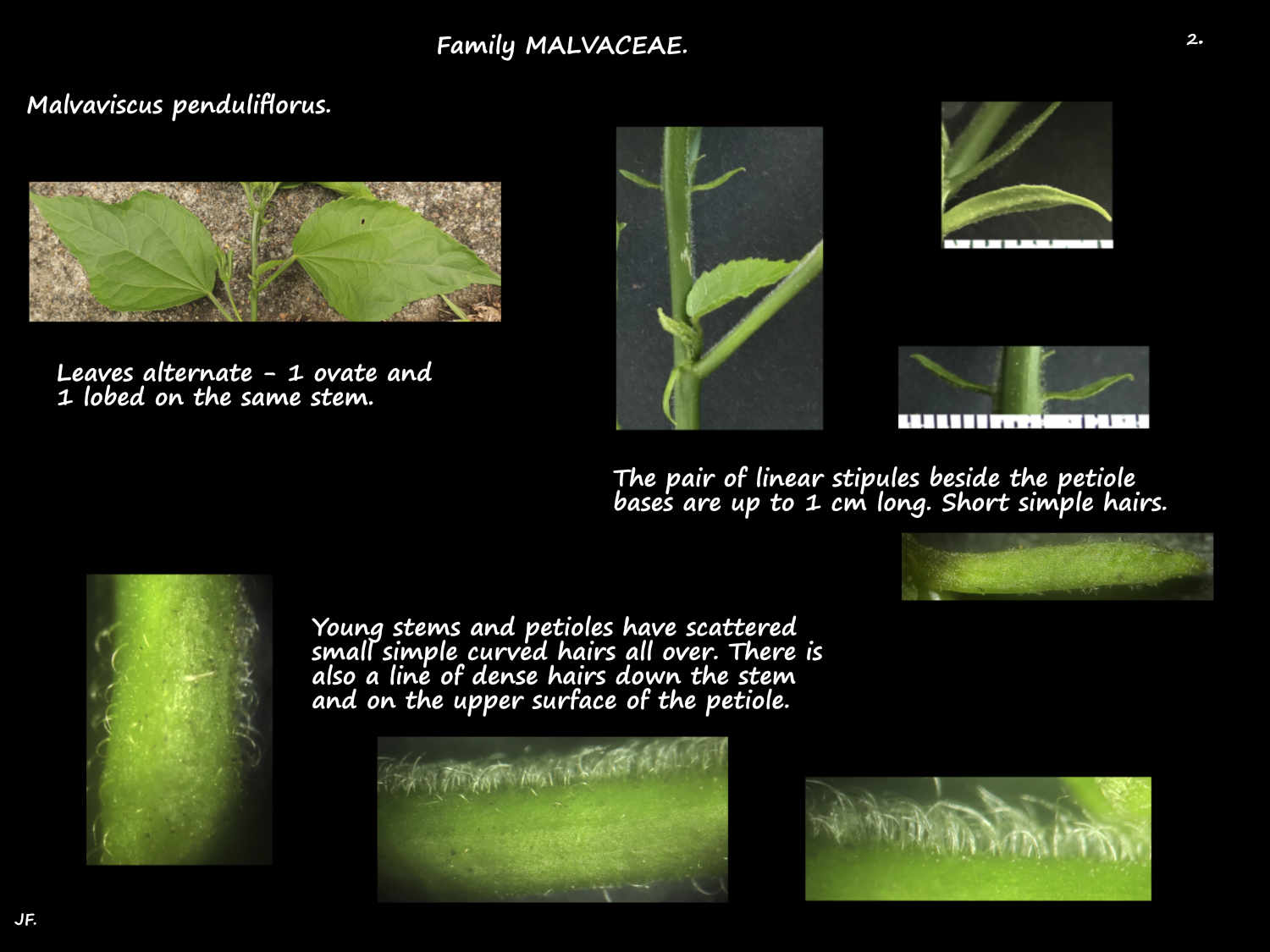
Small branches are smooth or have simple curved hairs.
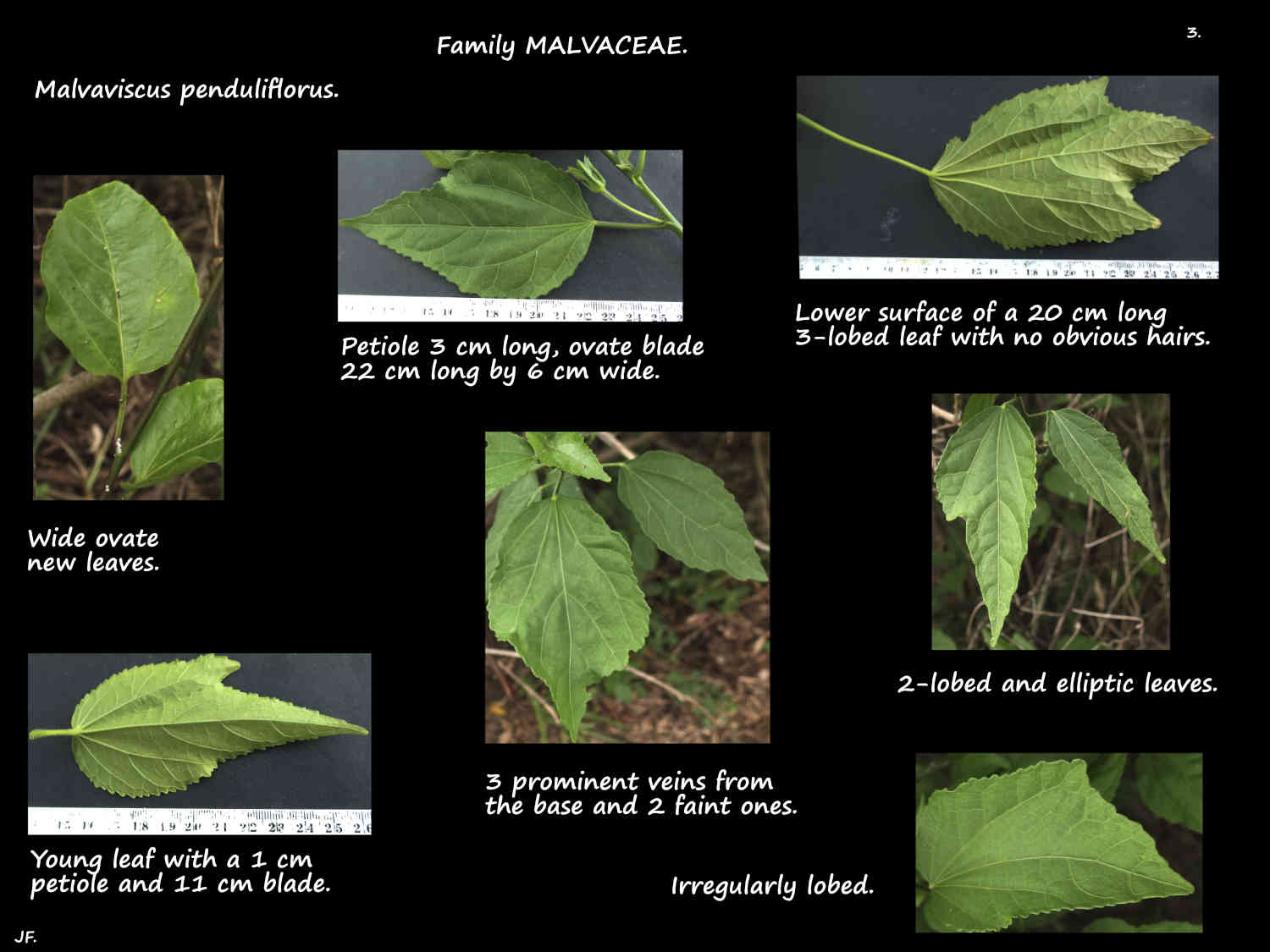
Alternately arranged leaves, in a spiral are on a petiole a few cms long.
There are small deciduous linear stipules at the base.
Blades are up to around 20 (25) cm long and half as wide.
They are mostly ovate (elliptic) and often have 3 (5) shallow lobes.
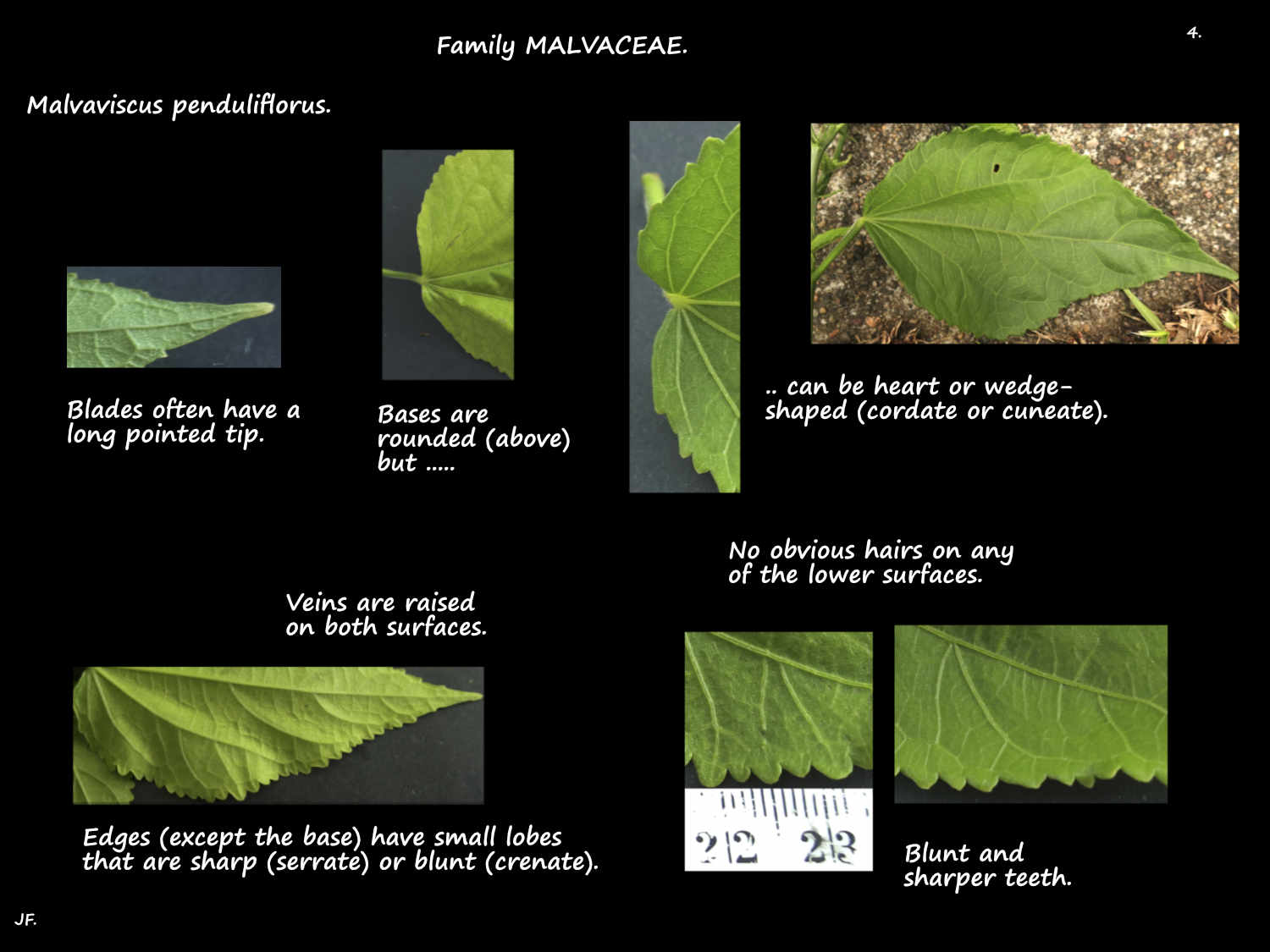
The base is usually rounded and the tip a long point.
The edges have small sharp or blunt teeth but the base may be smooth.
There are 3 main veins from the base.
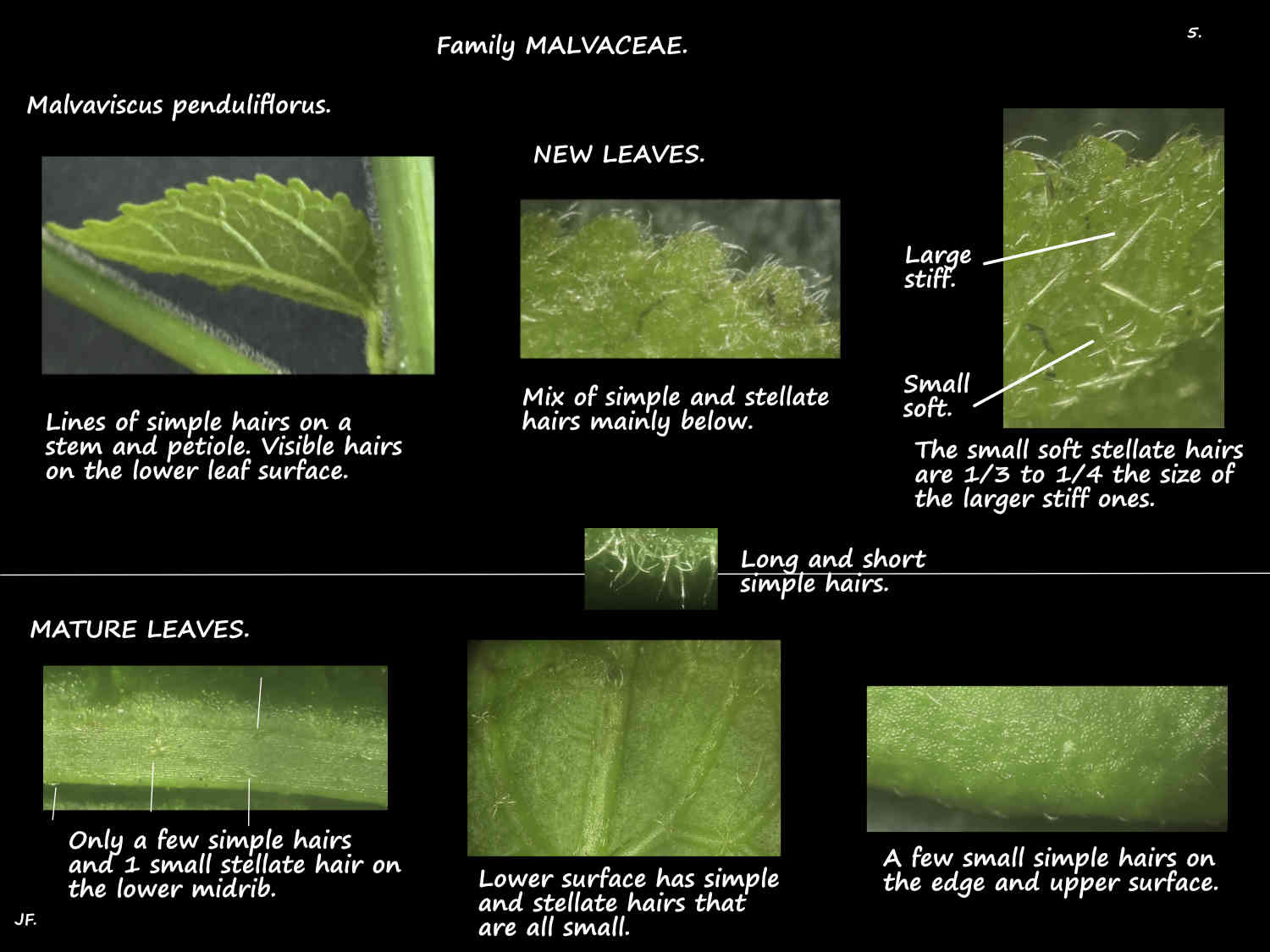
There may be no hairs and when present they are less than those on M. arboreus.
Any hairs, mainly on the lower surface are simple or small soft stellate ones.
Leaves do not feel rough as there are no large stiff stellate hairs.
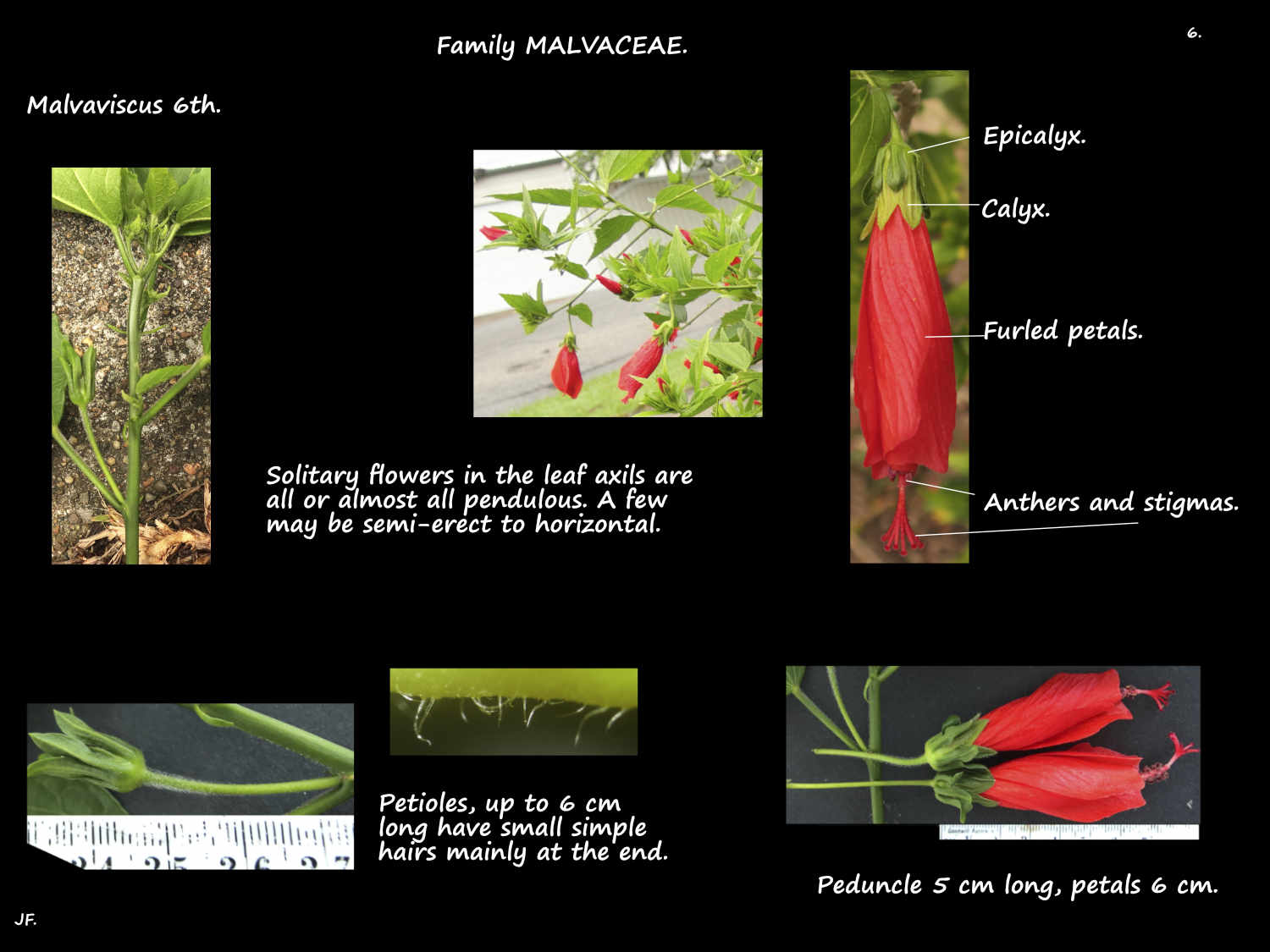
Solitary axillary flowers are longer than those of M. arboreus.
On as pedicel up to 6 cm long most are pendulous.
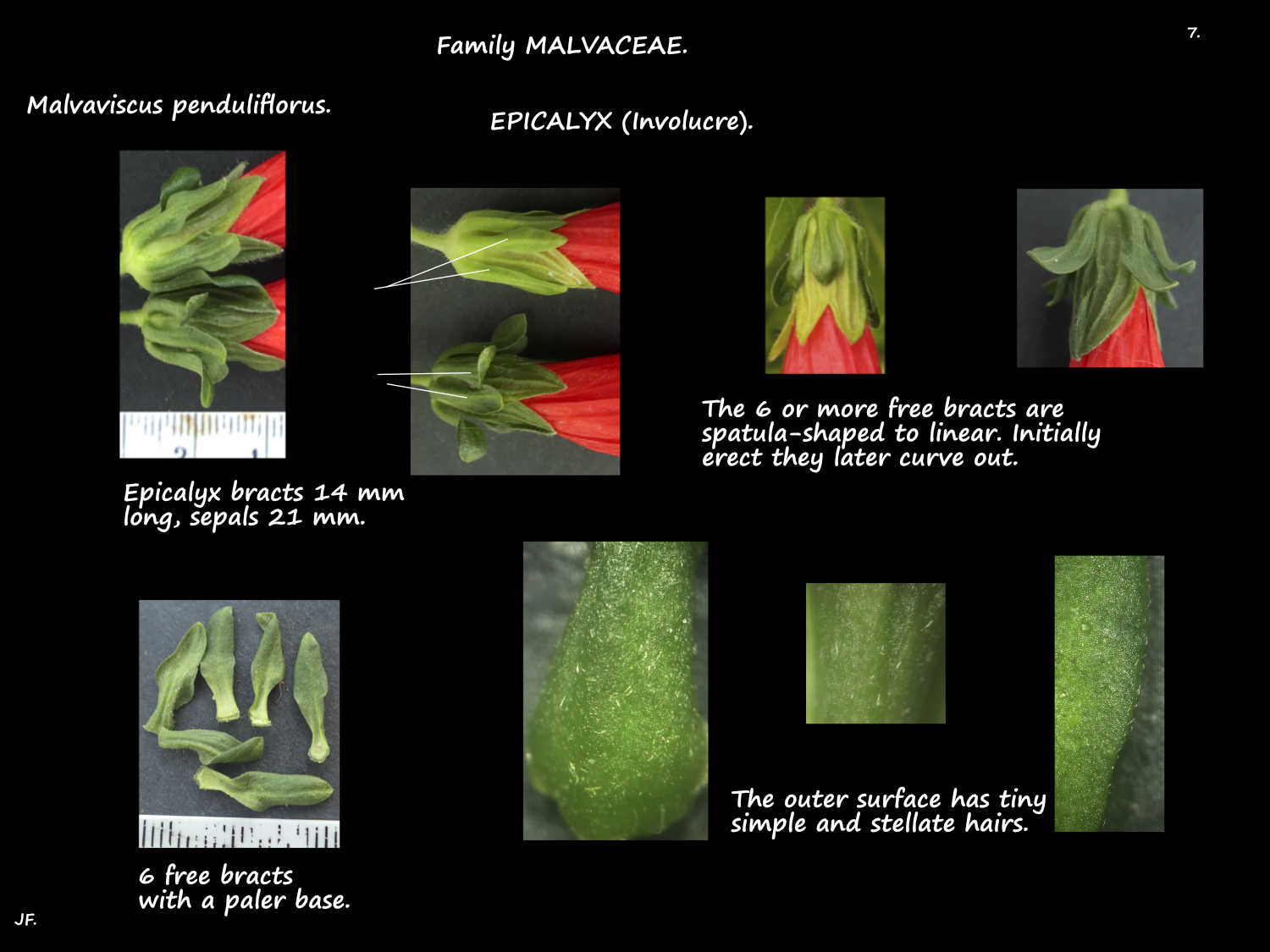
There are 6 or more linear or spatula-shaped epicalyx bracts up to 1.5 cm long.
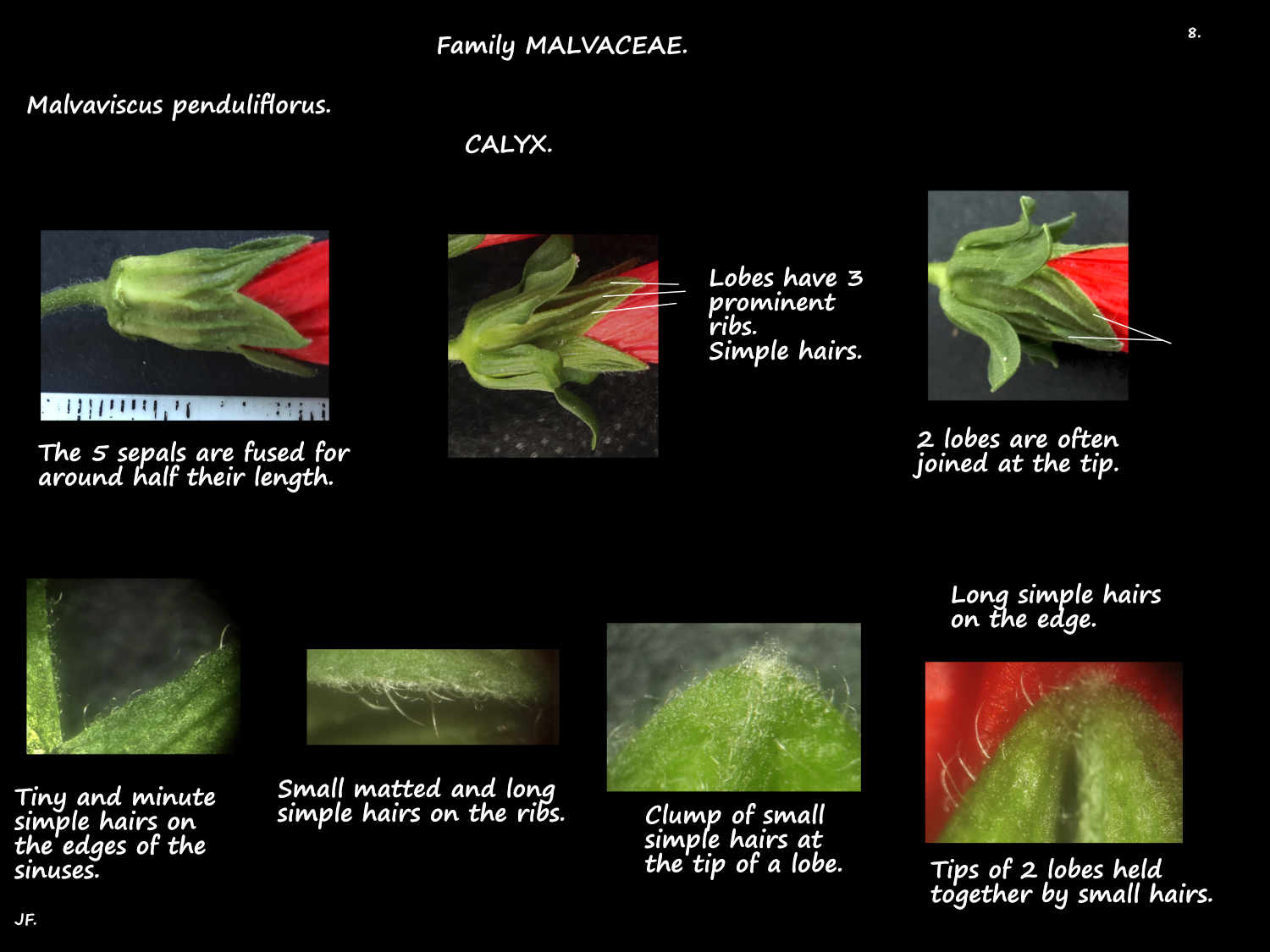
The 5 sepals, with bases fused for half their length are 1.5 to 2 cm long.
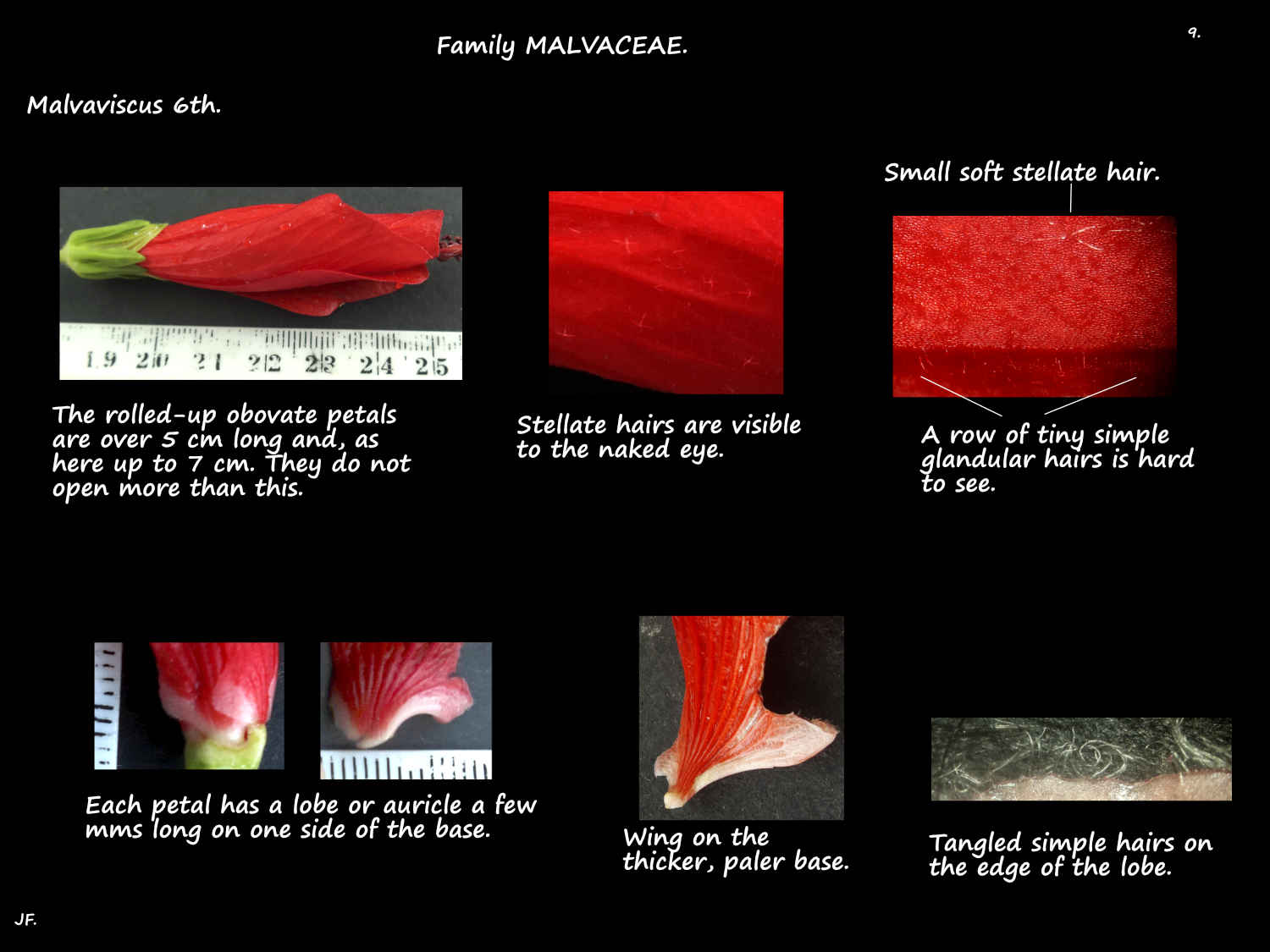
Petals are mostly over 5 cm long and can be up to 7 cm.
The obovate petals have a narrow base with a basal lobe (auricle) on one side .
Rolled up lengthwise the petals form a tubular corolla that only opens slightly.
Petals are a bright red but are occasionally pale pink to white.
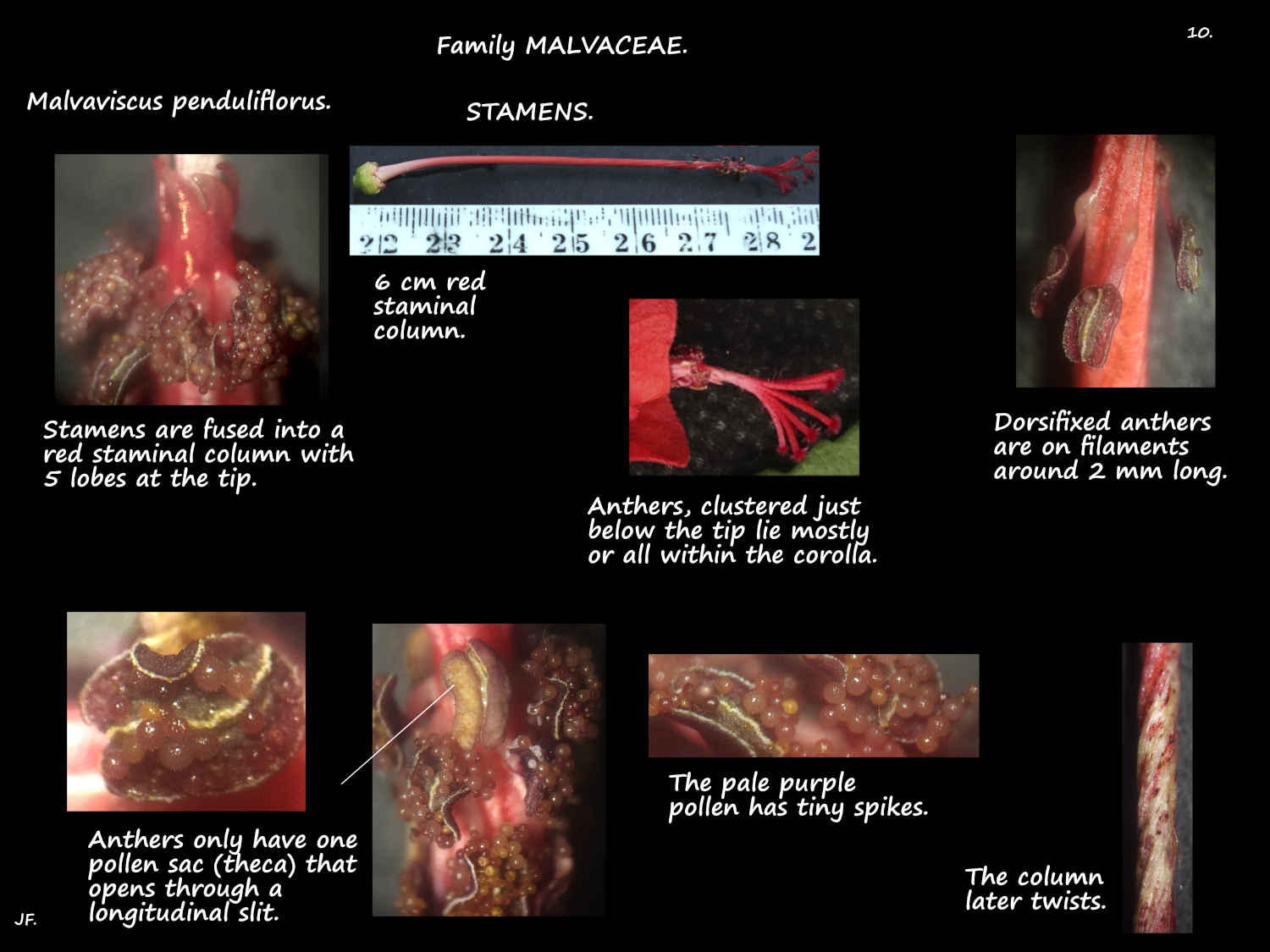
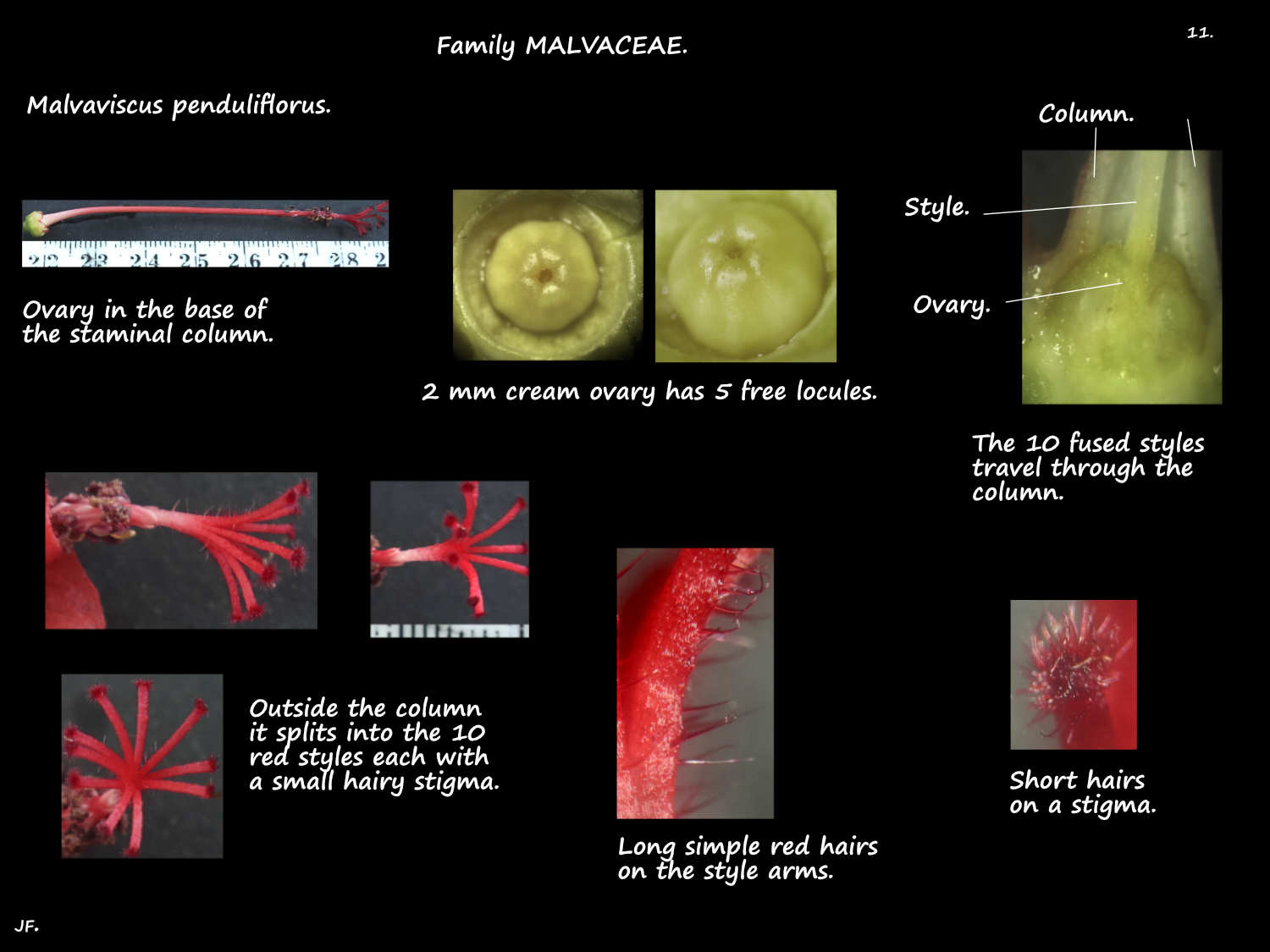
Staminal column, anthers, ovary and styles are as described under ‘Features’.
The only slight difference is that the anthers usually do not, or nor fully extend past the petals.
Being a sterile hybrid they do not have fruit.
J.F.