Family Myrtaceae > Subfamily Myrtoideae > Tribe Melaleuceae.
There are around 50 species of Callistemon Bottlebrushes with 36 native to Eastern Australia.
Callistemons are closely related to the paperbark Melaleucas which also have ‘bottlebrush’ flower spikes.
The main difference between the 2 genera has for a long time been the arrangement of the stamens.
In Melaleuca the stamens are in 5 bundles.
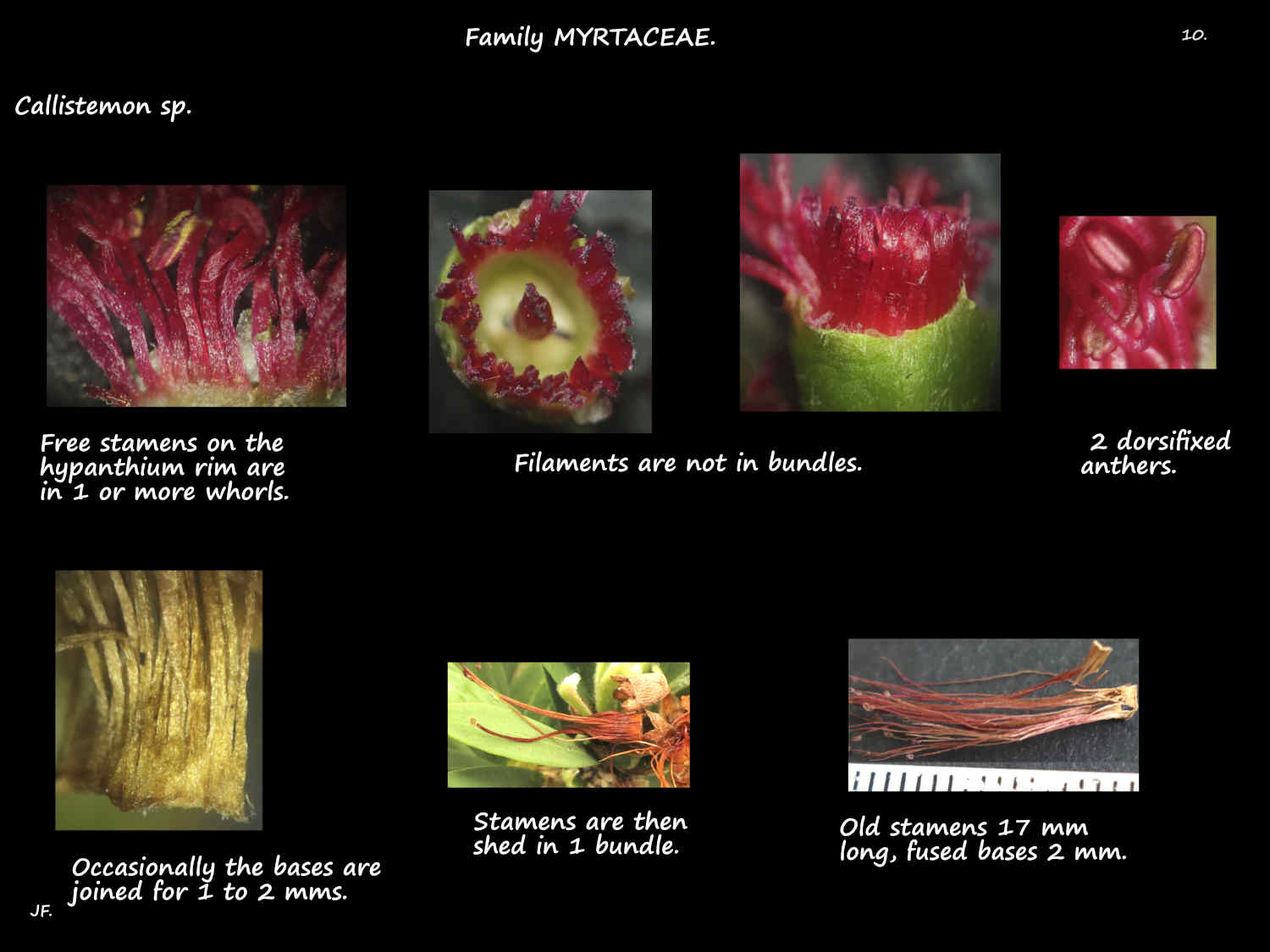
In Callistemon they are in whorls with the bases separate or all fused for a mm or so.
However the distinction is not as sharp as this suggests.
Some authorities have transferred most Callistemon species into Melaleuca while others retain the 2 genera.
This accounts for the different number of species in each.
Callistemons have descriptive names such as Lemon scented, Lesser, Needle, Prickly, Stiff and Weeping bottlebrush.
A number of species, and cultivars are very commonly cultivated.
Parents of most or many cultivars are Callistemon citrinus and C. viminalis.
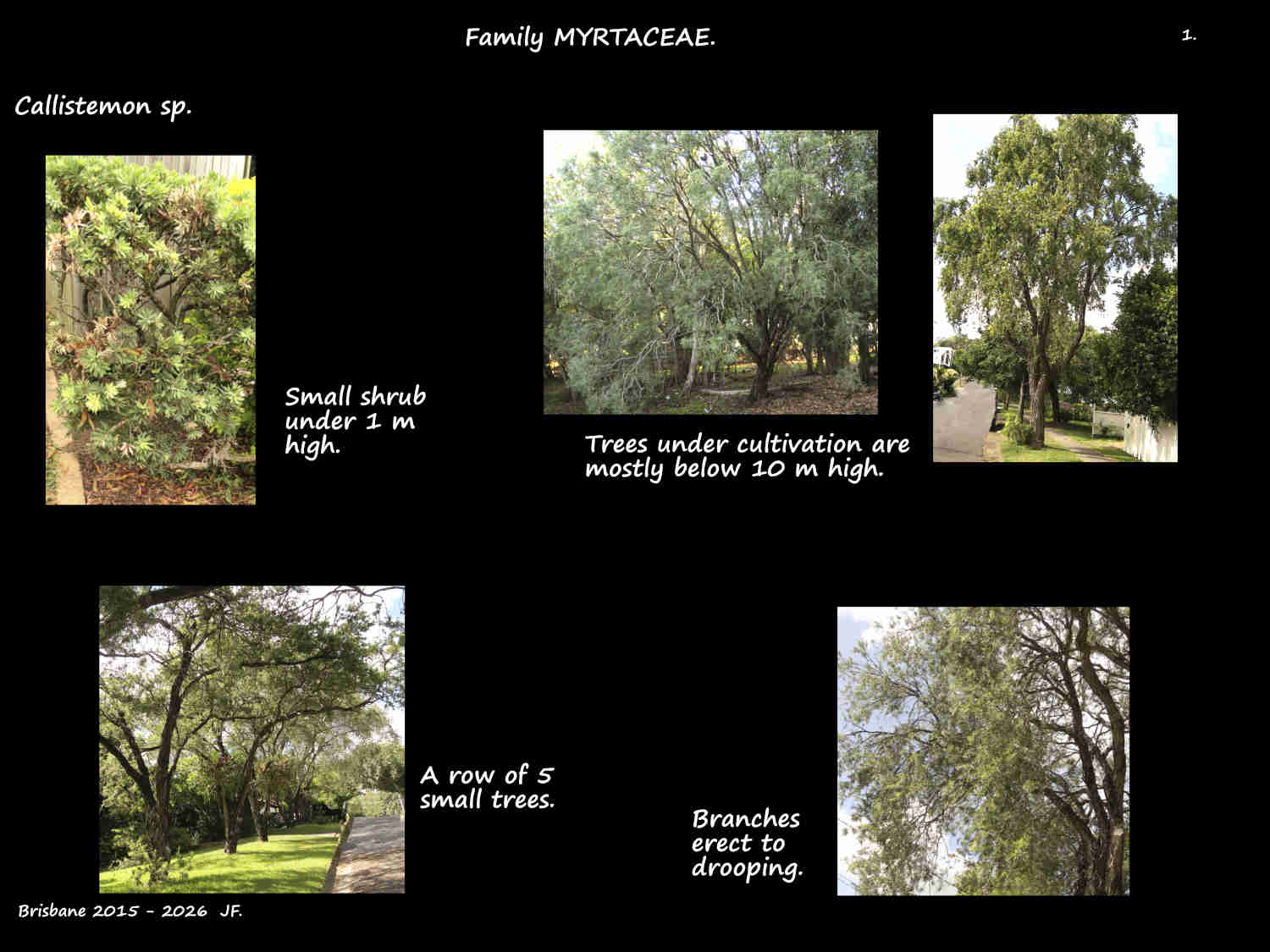
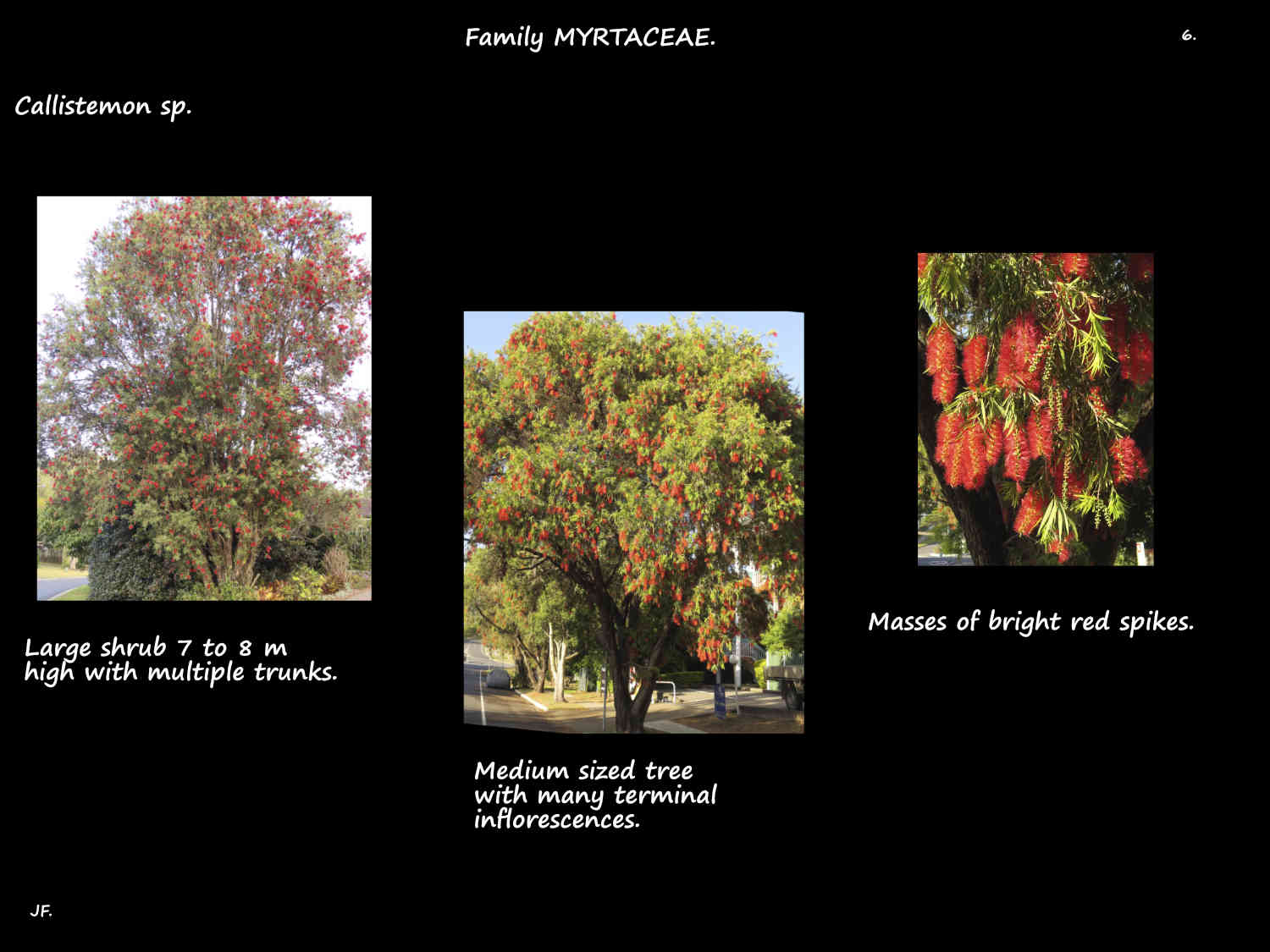
All are woody plants with some prostrate to erect shrubs half to 4 m high.
The trees are usually under 10 or 12 m high but can be much more.
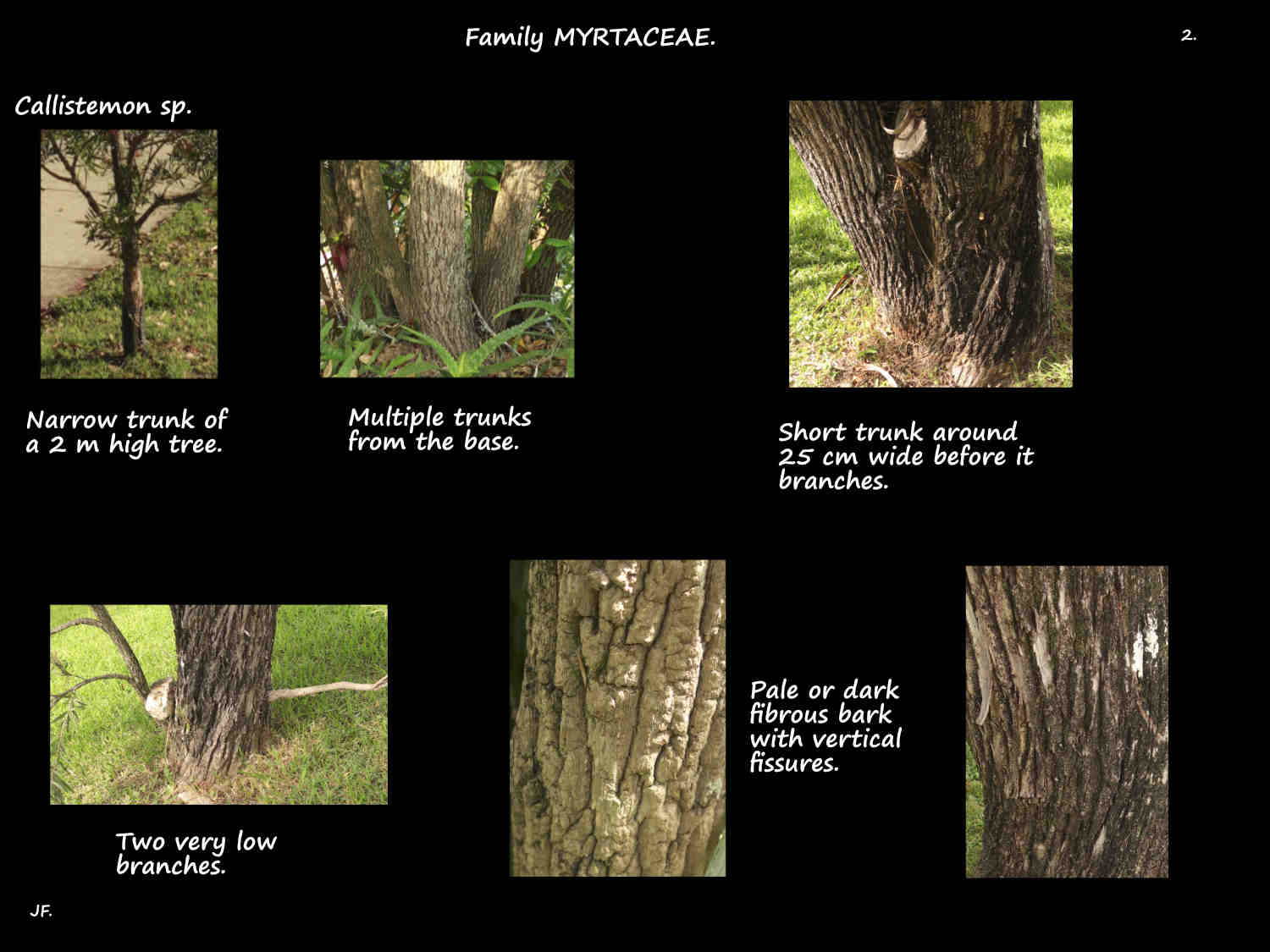
All can have one trunk or multiple ones and sparse to many branches.
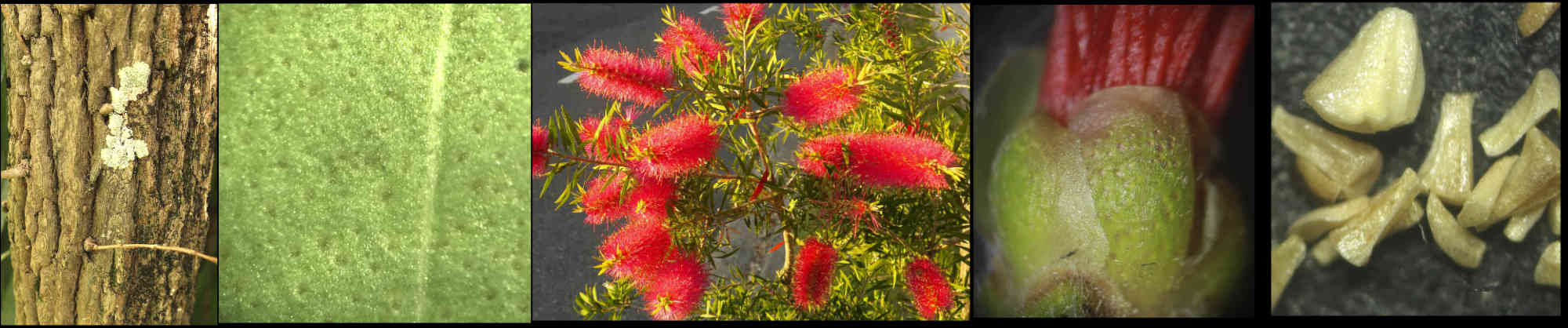
Bark can be pale or dark and is typically fissured vertically.
Branches can be erect to weeping.
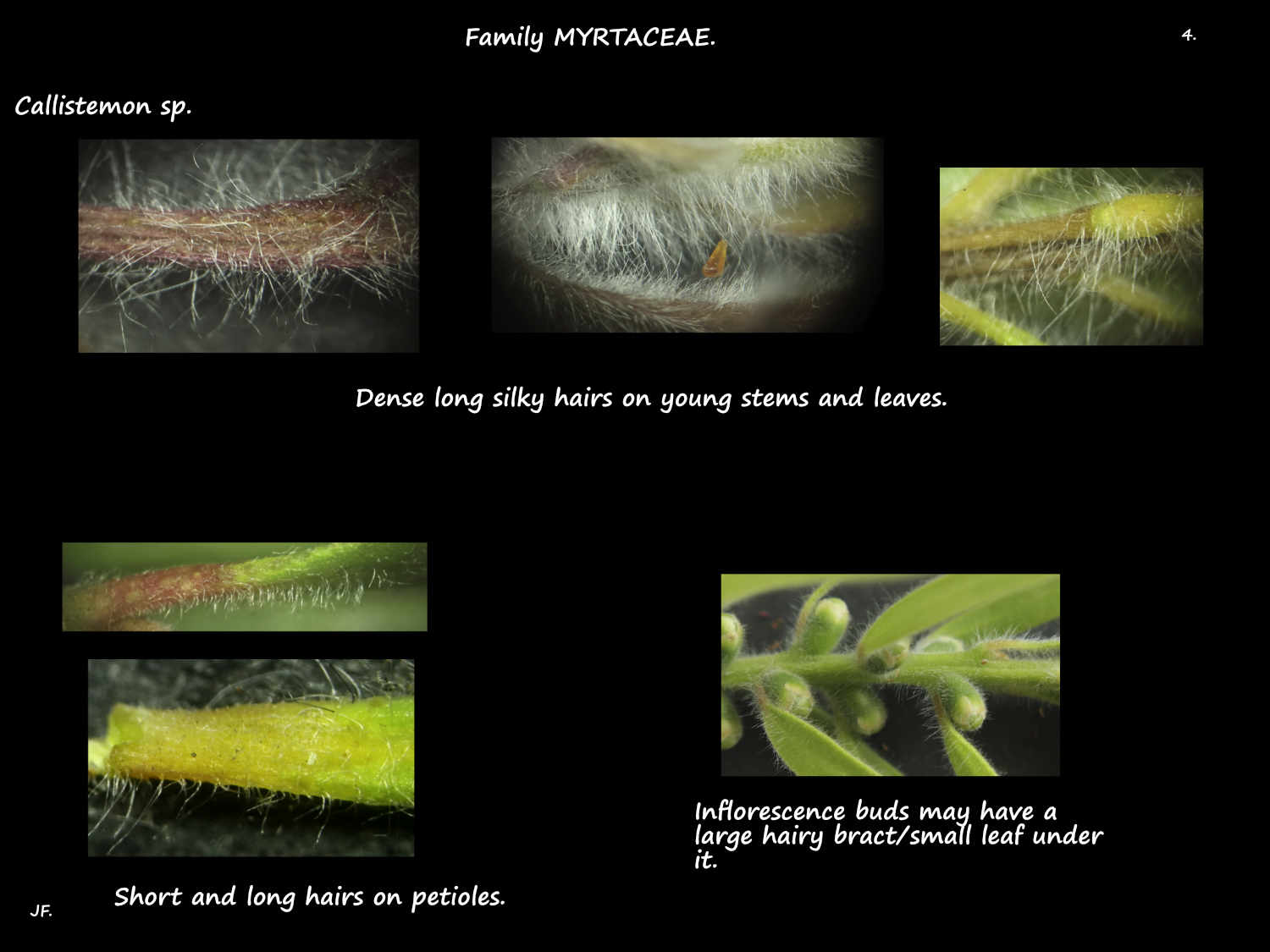
Small branches often have soft hairs.
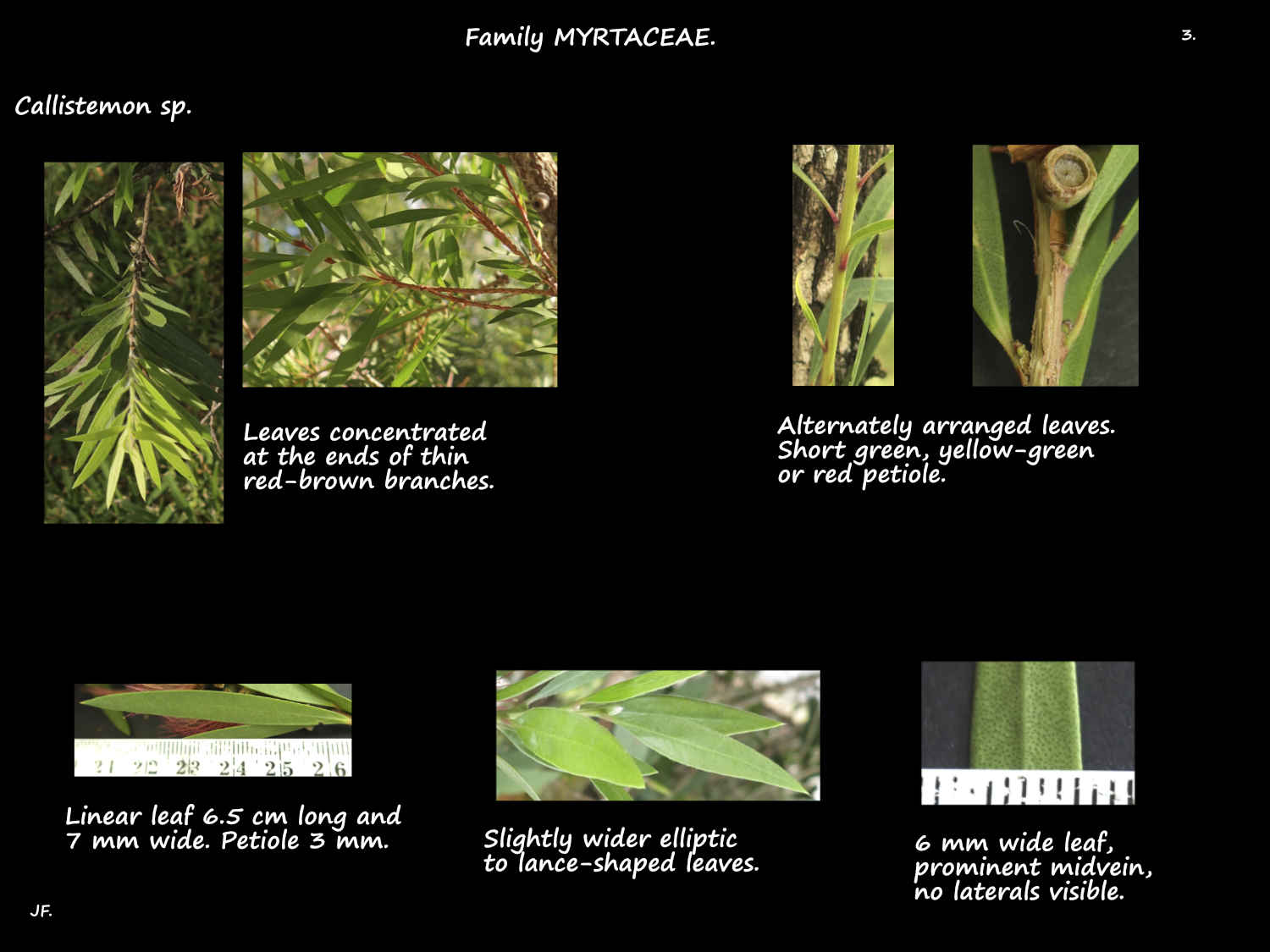
The alternately arranged leaves have no, or a very short petiole.
Leaves are often concentrated at the branch ends.
The narrow blades are up to around 11 cm long and 0.1 to 1.6 cm wide.
Many have linear blades that can be flat or round in cross section.
Other blades are narrowly elliptic, oblong, obovate or lanceolate.
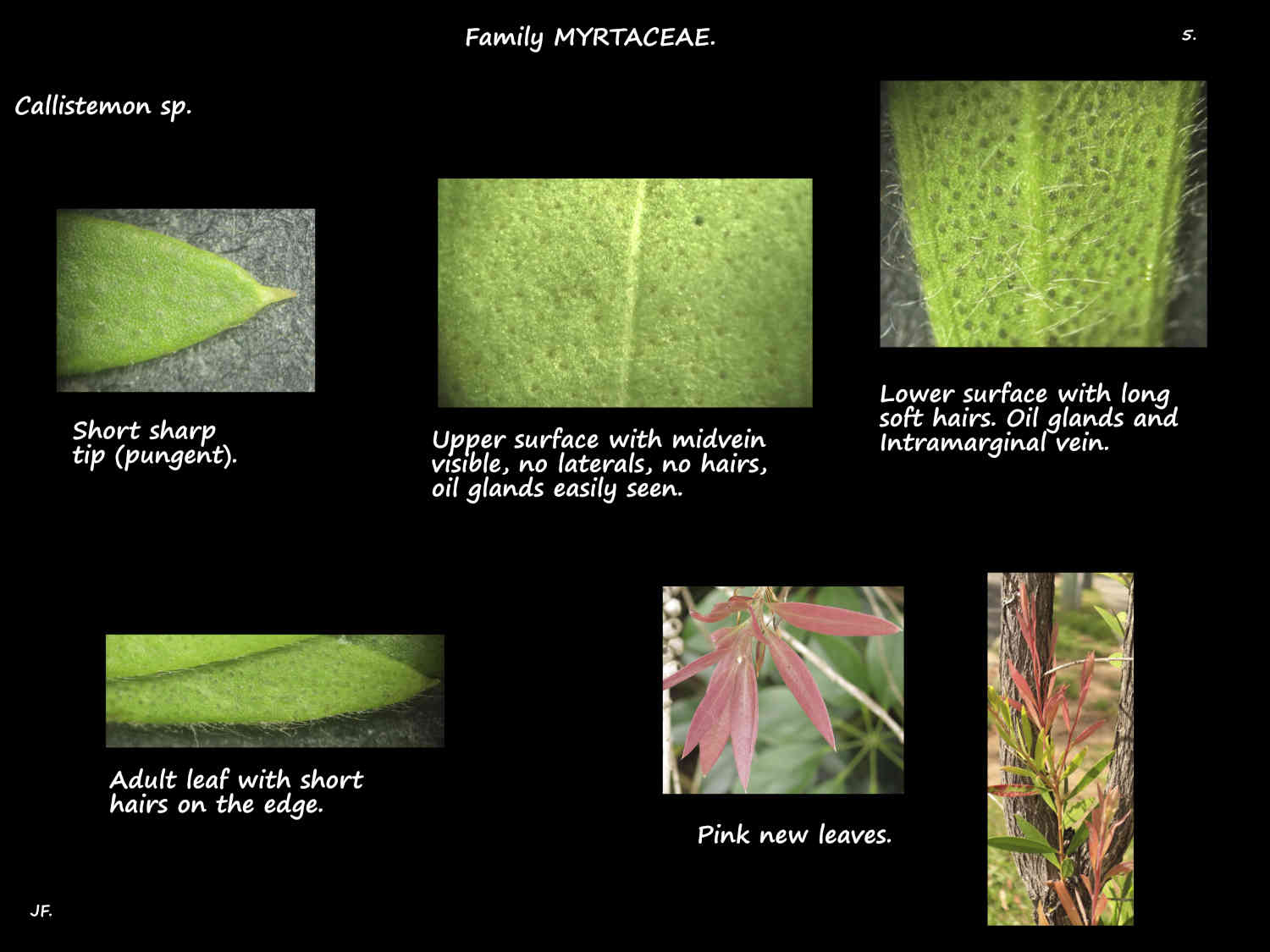
Tips can be round to pointed sometimes with a short sharp rigid mucro.
The midrib is typically easy to see but the lateral and intramarginal veins can be faint.
Oil glands are usually prominent.
New leaves are often pink.
New growth can be smooth or have few to dense pale soft hairs.
Adult leaves typically have no hairs.
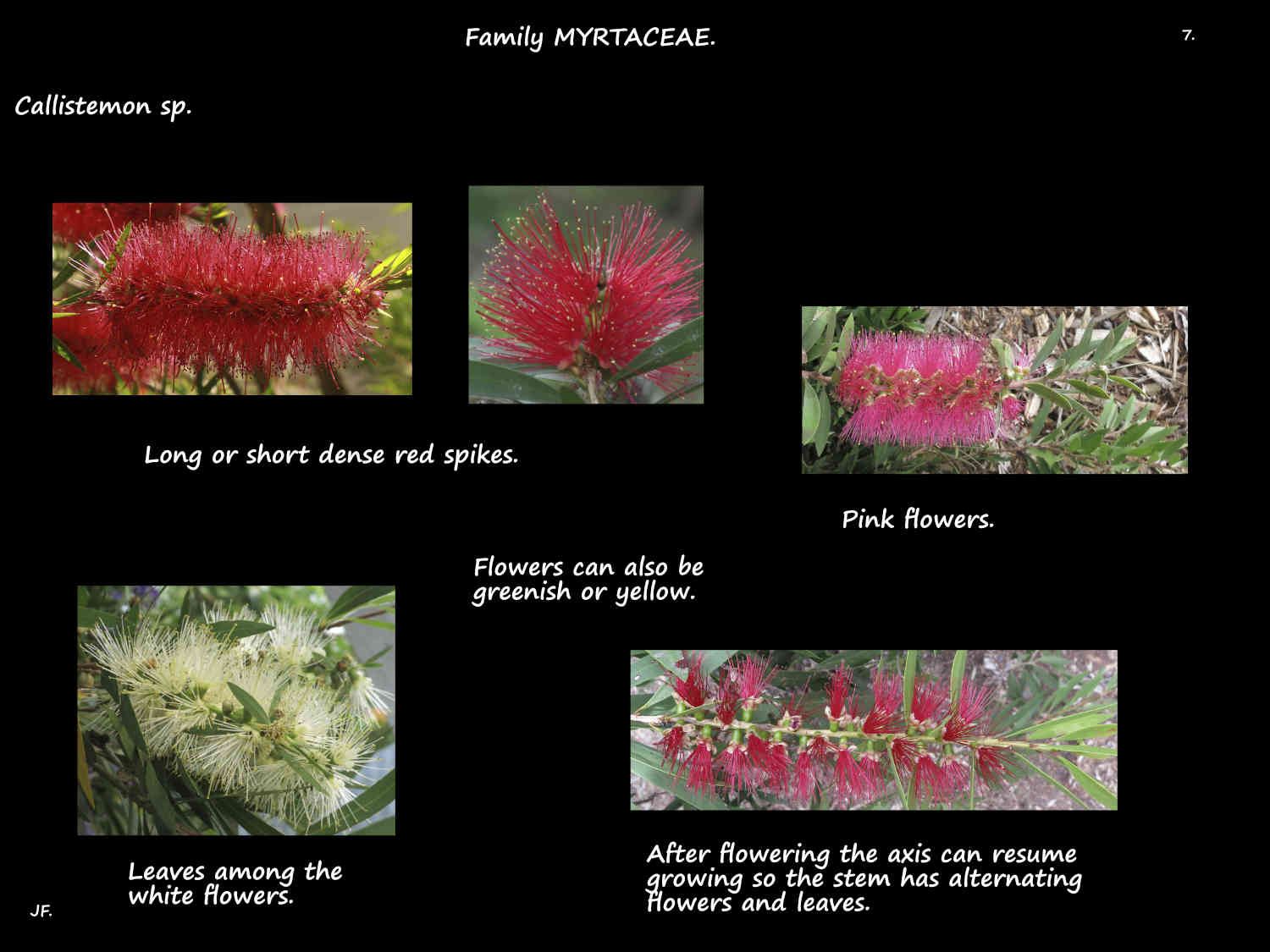
Inflorescences are a cylindrical spike with flowers along a central axis.
The lower flowers open fist.
When flowers appear the terminal vegetative bud stops growing for a time.
It can resume growing before or after flowering has finished.
After adding a few leaves another inflorescence can develop the following year.
This means a stem may have alternating leaf clusters and inflorescences.
Inflorescences can be up to around 15 cm long and 2 to 6 cm wide.
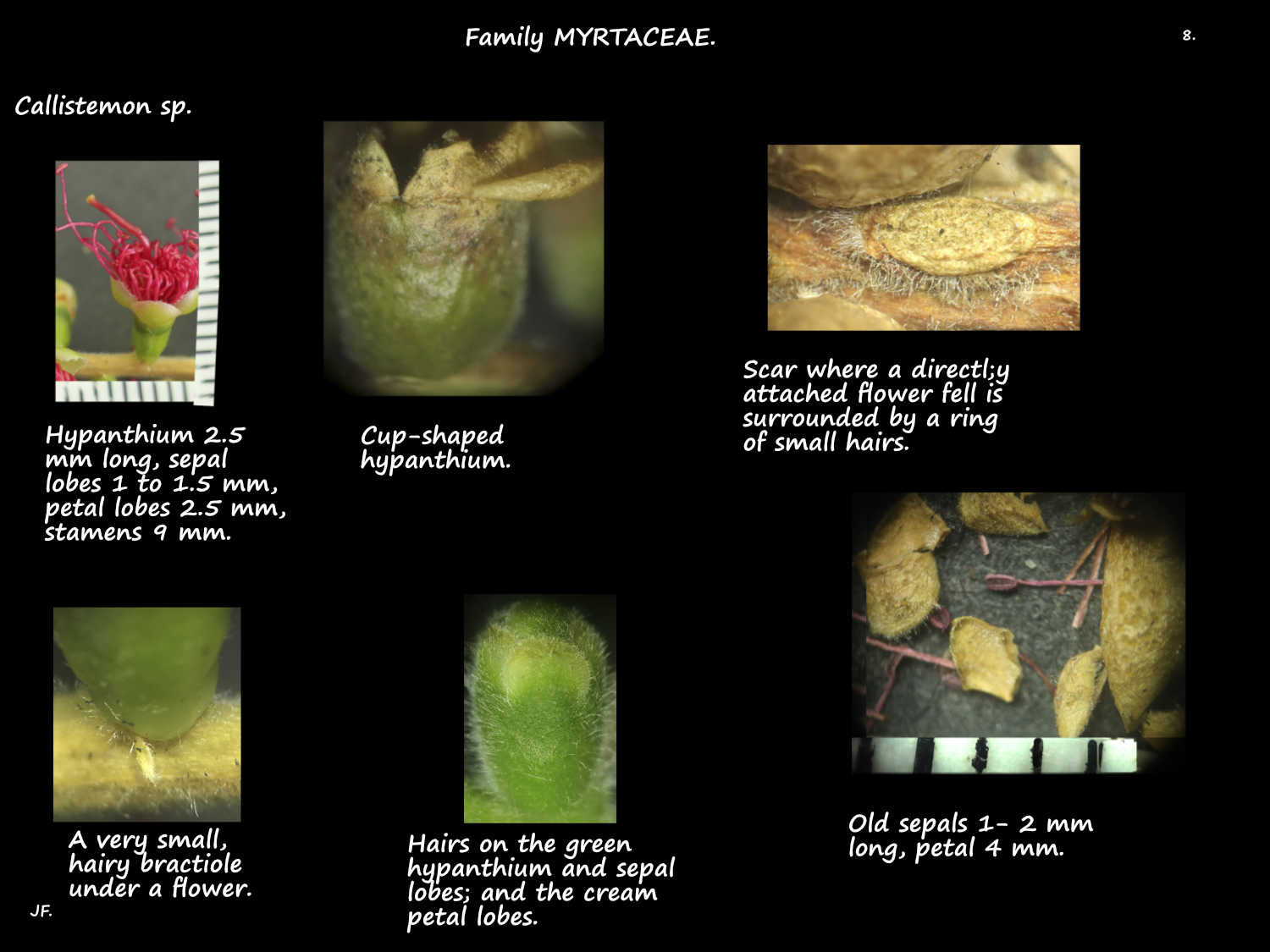
There may be tiny deciduous bracts under the flowers.
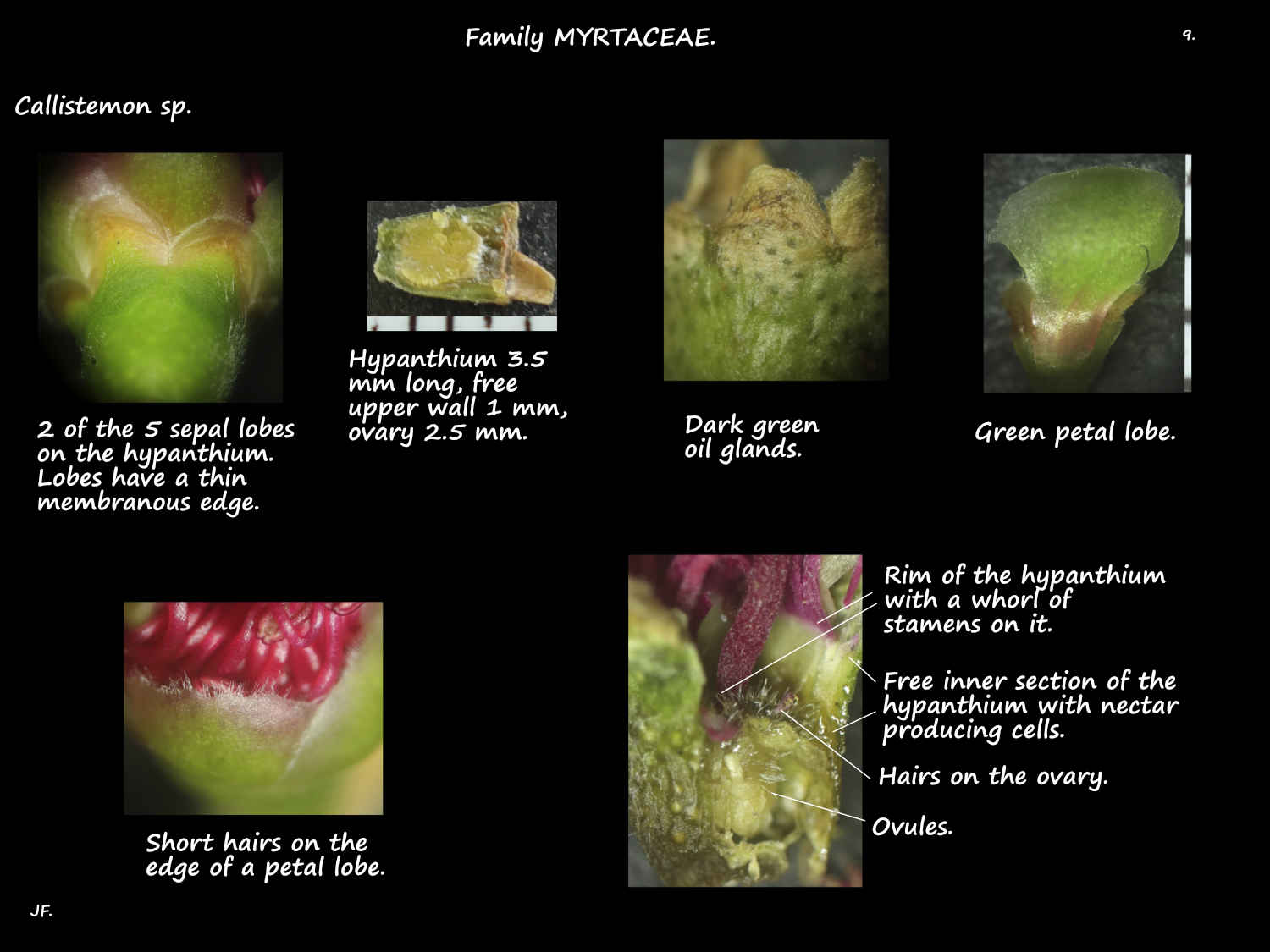
Each flower has a hypanthium of fused sepal and petal bases.
Most are bell or urn-shaped and up to 5 mm long.
They can be smooth or have a few to dense soft hairs.
On the rim are 5 sepal lobes alternating with 5 petal lobes.
The greenish sepal lobes are 1 to 2 mm long and may persist.
The round mostly red concave petal lobes are up to 5 mm long.
The outer surface can be smooth or have few to dense hairs.
Hairs can be all over the outer surface or just on the edges.
Filaments of the numerous stamens are inserted on the hypanthium rim inside the petals.
Up to 2.5 cm long they are in 1 or more whorls.
The bases may be free or all fused for a mm or so.
Much longer than the petals the stamens give flowers their colour.
Most species have red petals and stamens but sometimes all are cream, yellow, pink, purple or white.
Anthers are yellow or occasionally brown, purple or green.
They open through longitudinal slits.
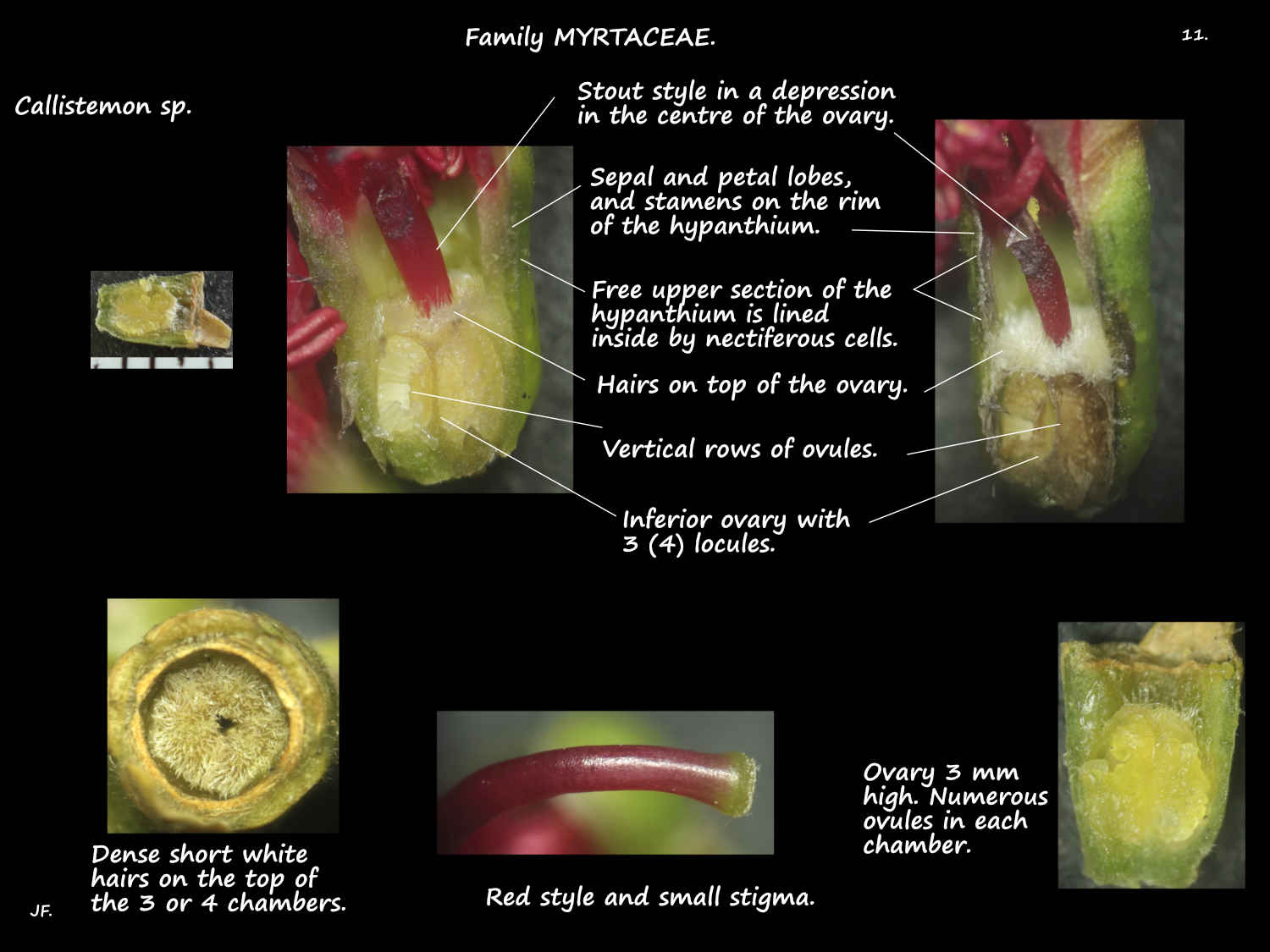
The top of the inferior ovary is below the rim of the hypanthium to various amounts.
It has 3, or occasionally 4 locules each with numerous ovules with axile placentation.
The single style is the same colour as the stamens – usually red or crimson.
At up to 3 cm long it extends just past the anthers.
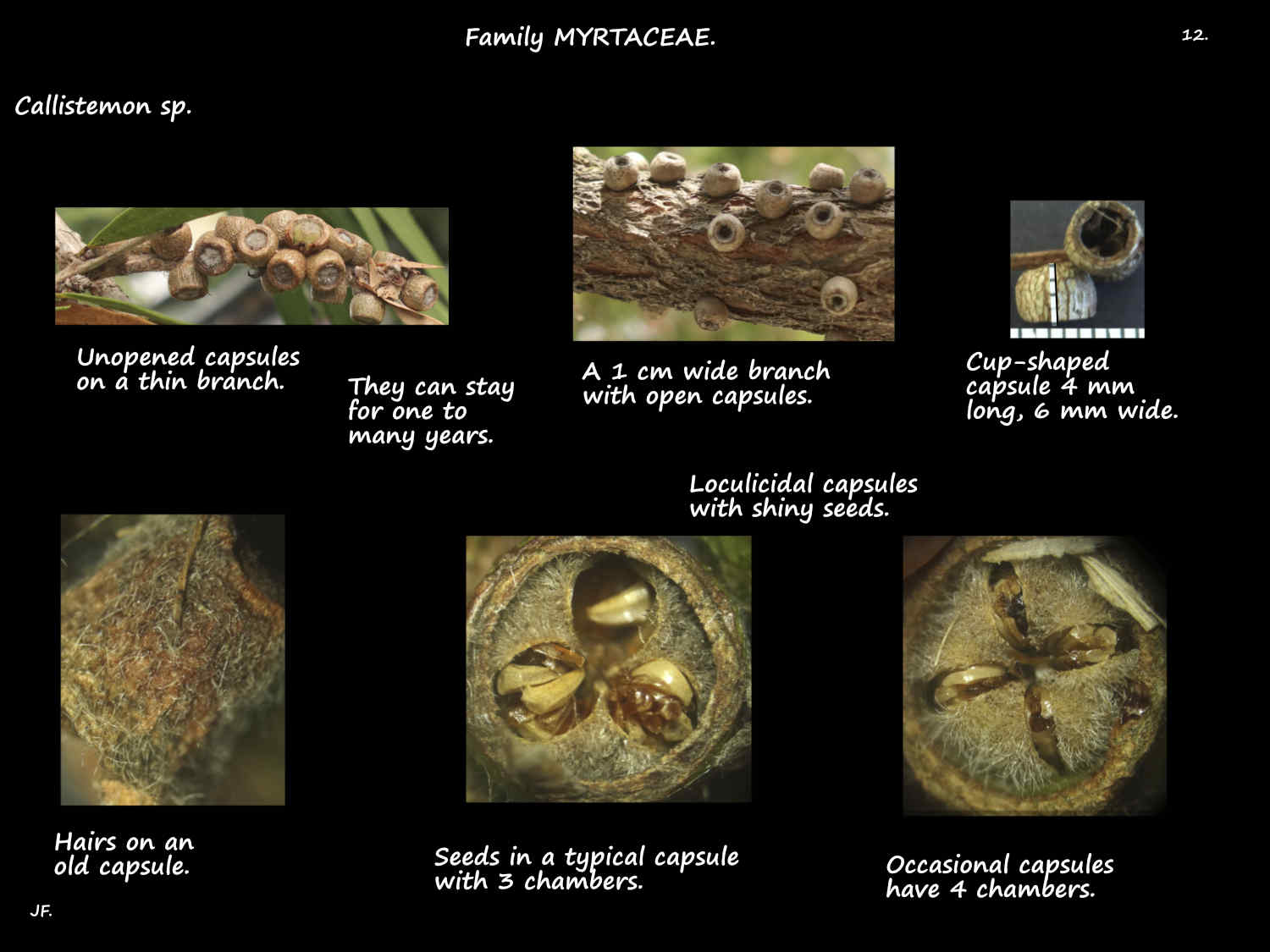
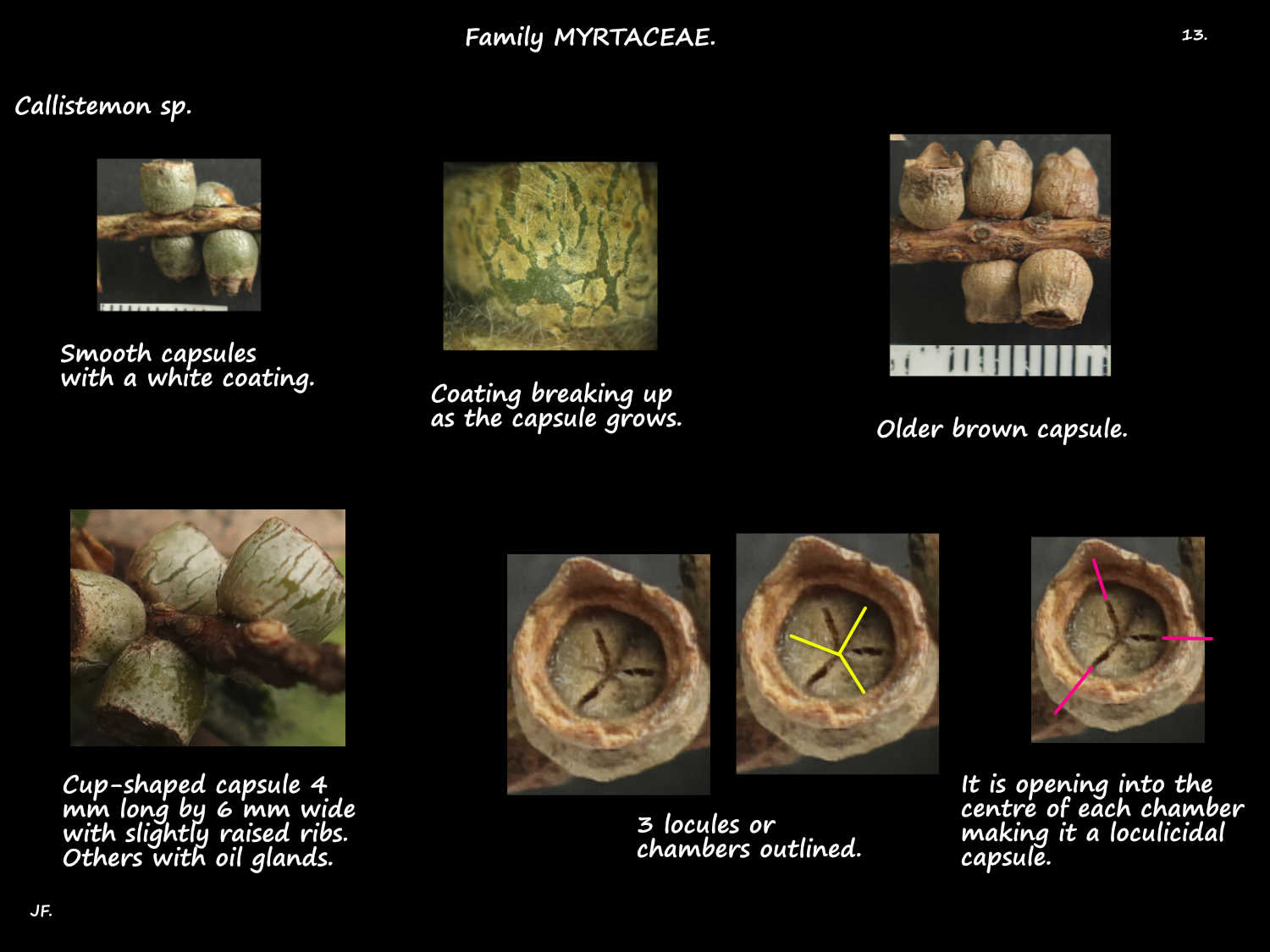
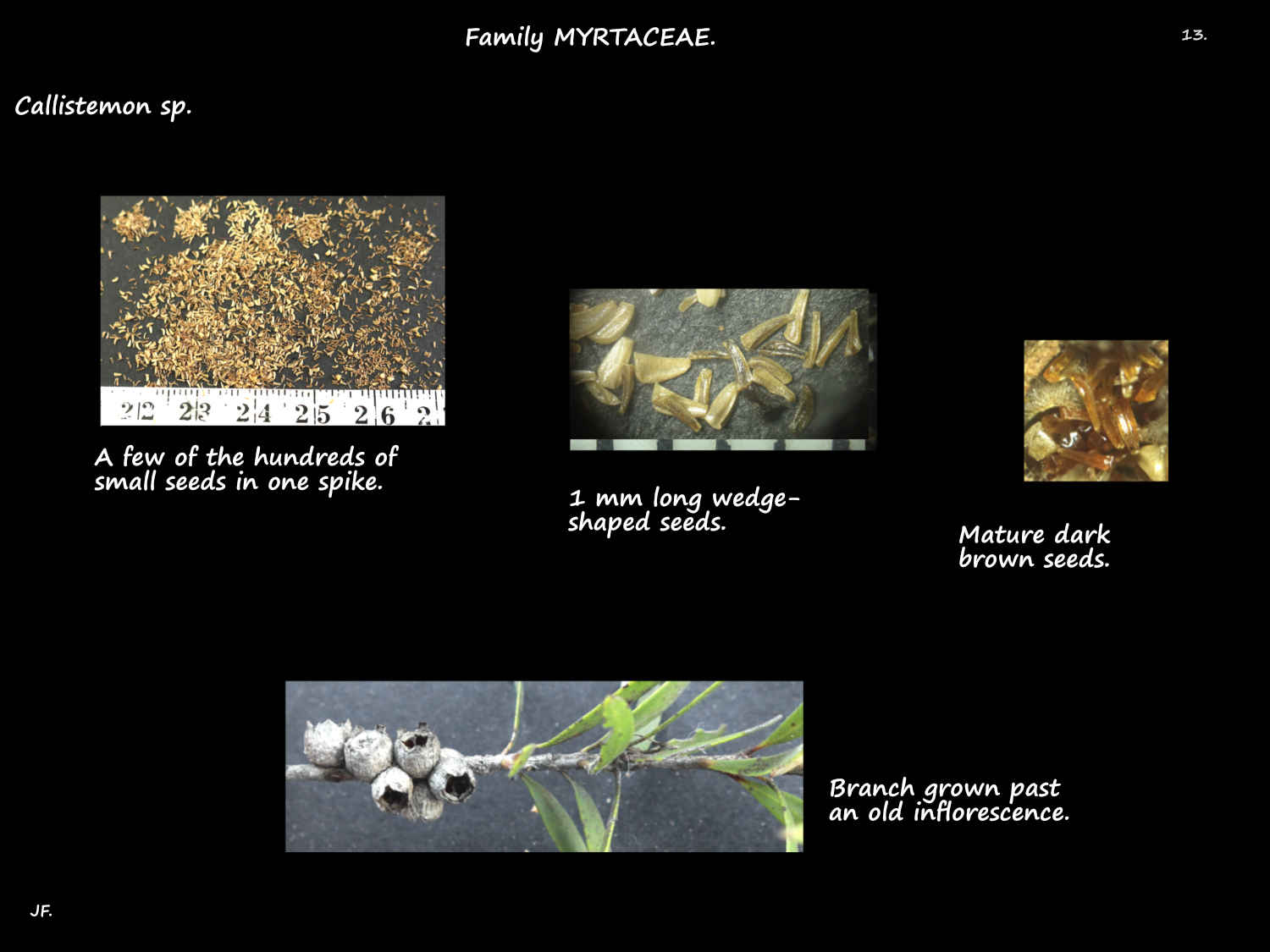
Fruit are a woody loculicidal capsule in the hypanthium often with the sepal lobes still attached.
Shaped like a cup or urn they remain on the branch for one year or many.
Under 1 cm long/wide they have fairly dense pale hairs on the top.
The sides can be smooth or have some hairs.
The 3 or 4 chambers have numerous small narrow wedge-shaped seeds.
There are many hybrids and cultivars.
J.F.