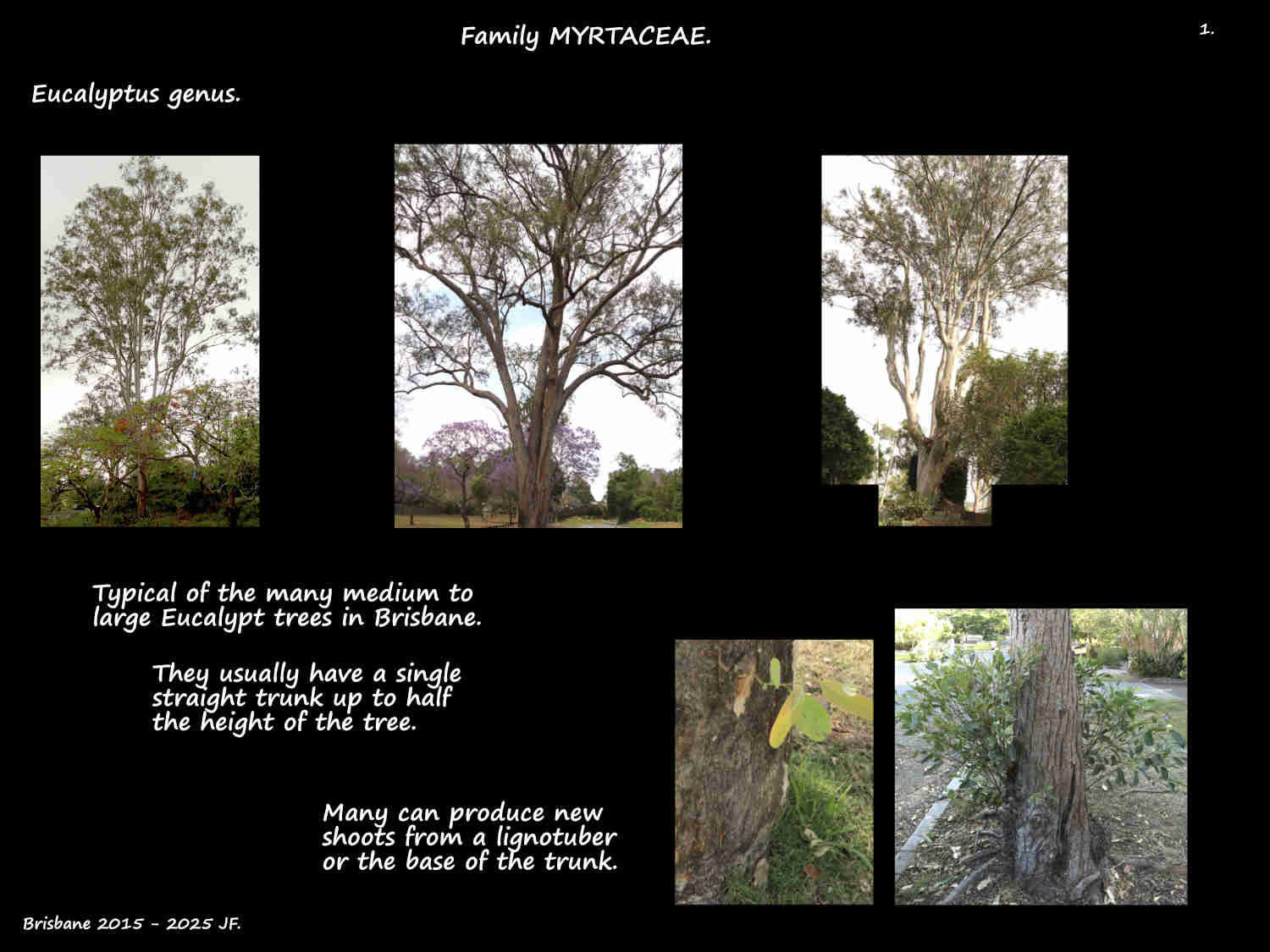
(Eucalyptus genus – NOT Eucalypts.)
There are 716 (POWO) to over 800 or 900 Eucalyptus species.
Most are native to Australia with a few in countries to the north.
In family Myrtaceae over one third are mallees and a few shrubs.
Of the rest just under a quarter are small trees up to 8 m high.
The rest are medium trees to 60 m and large ones up to 100 m.
Mallees are small multi-stemmed trees with a lignotuber.
Their multiple trunks are all around the same length.
Other Eucalyptus species can have a lignotuber which is a swollen area on an underground stem.
All form a new layer of bark each year and the old may be shed or retained.
The old bark may fall off all or part of the trunk and branches.
Old bark can be shed in flakes, small blocks, sheets or strips.
There are many types of bark from rough to smooth.
Bark may be fibrous with the fibres being long or short.
New bark can be white or variously coloured.
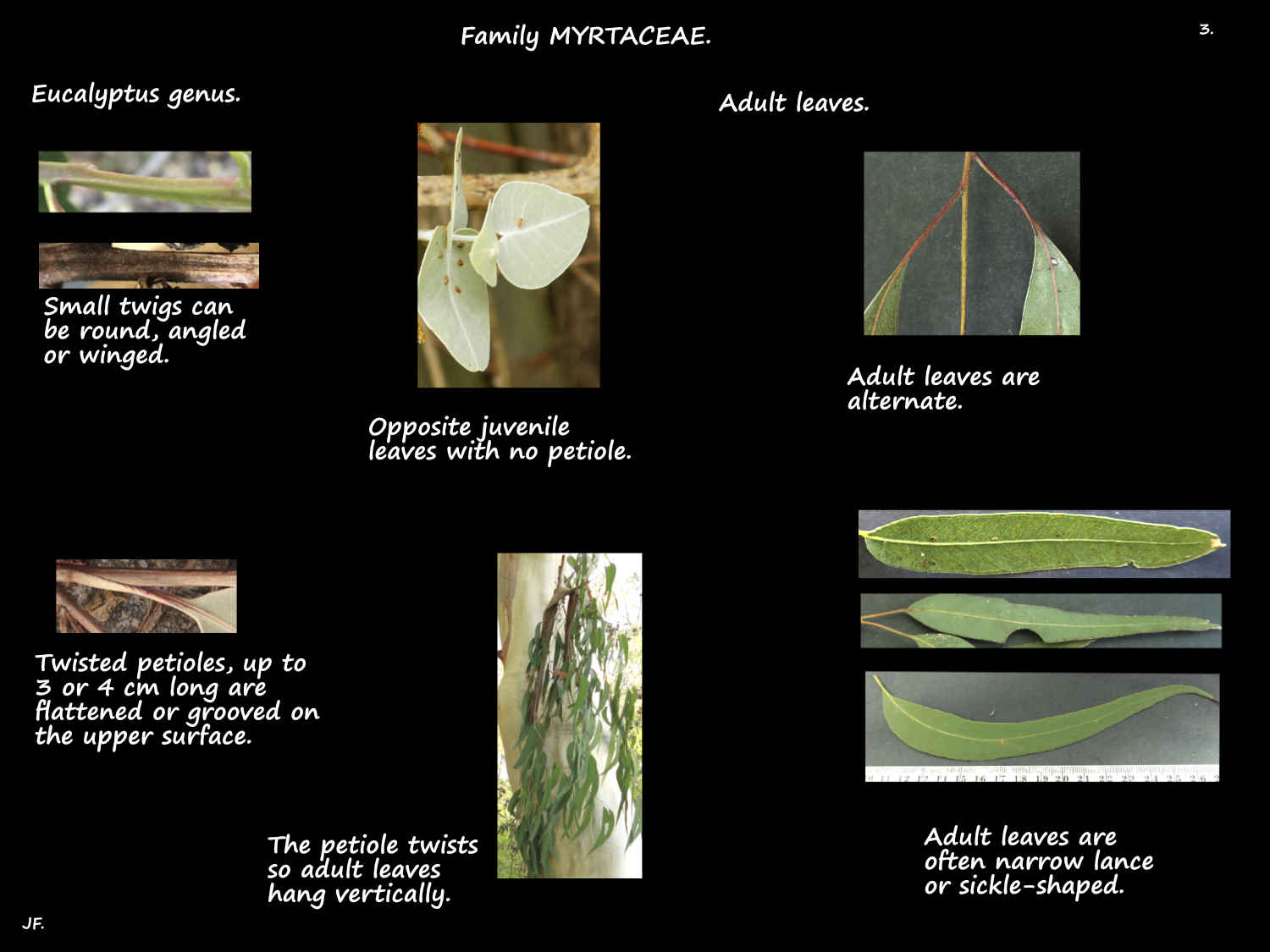
Most species have different juvenile, intermediate and adult leaves.
Typical juvenile leaves are held horizontally to catch the sun.
Mostly arranged in opposite pairs they often have a heart-shaped base and no petiole.
Alternate adult leaves are typically drooping.
Usually on a petiole, many are a narrow lance or sickle-shape.
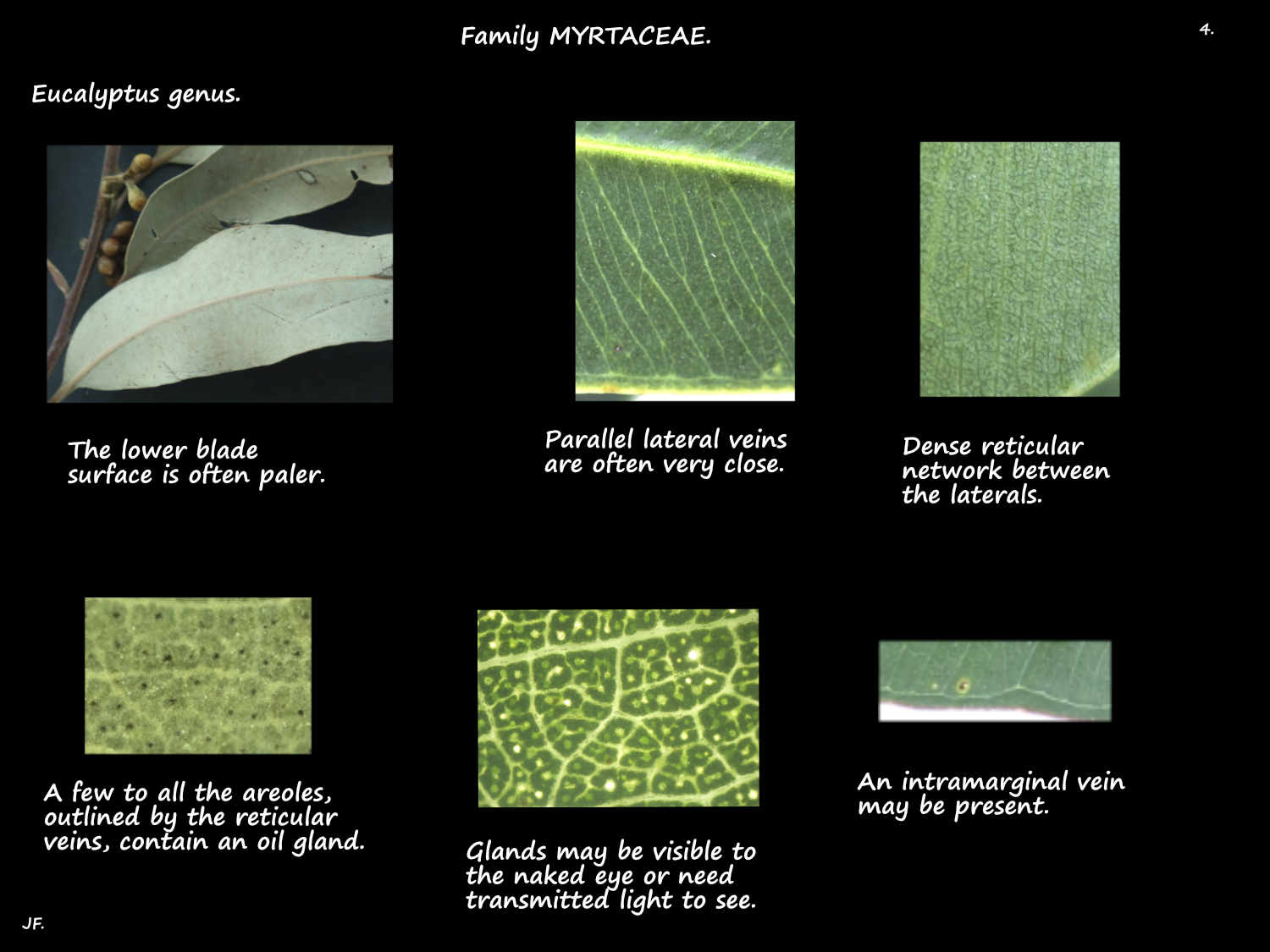
Both blade surfaces can be the same colour or the lower can be paler.
The blade tip is pointed, there are no hairs and most species have oil glands.
There is a midvein and the parallel lateral veins can be spaced to very close.
The side veins run into an intramarginal vein that is at, or 2 to 3 mm inside the edge.
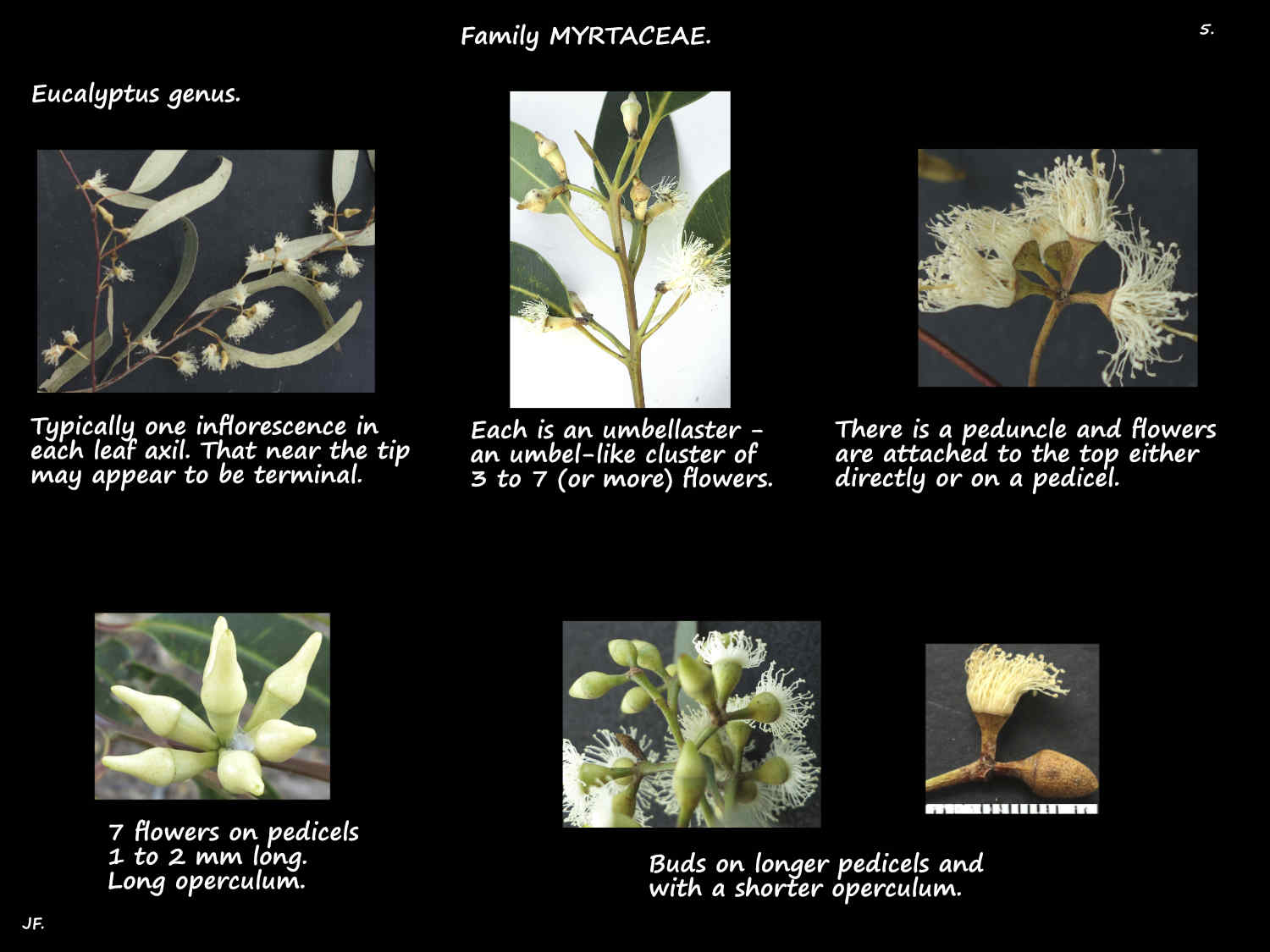
Inflorescences are axillary but that at the end of branches may appear to be terminal.
There is usually only one in each axil but occasionally there are two.
On a peduncle, they are an umbel-like cluster of flowers (an umbellaster).
Technically they are a cyme with the flowers so close they all appear to be a attached to the tip of the peduncle.
Cymes are a branched inflorescence with the terminal flowers opening first.
Umbellasters have 3 to 7 or more flowers that may or may not be on a pedicel.
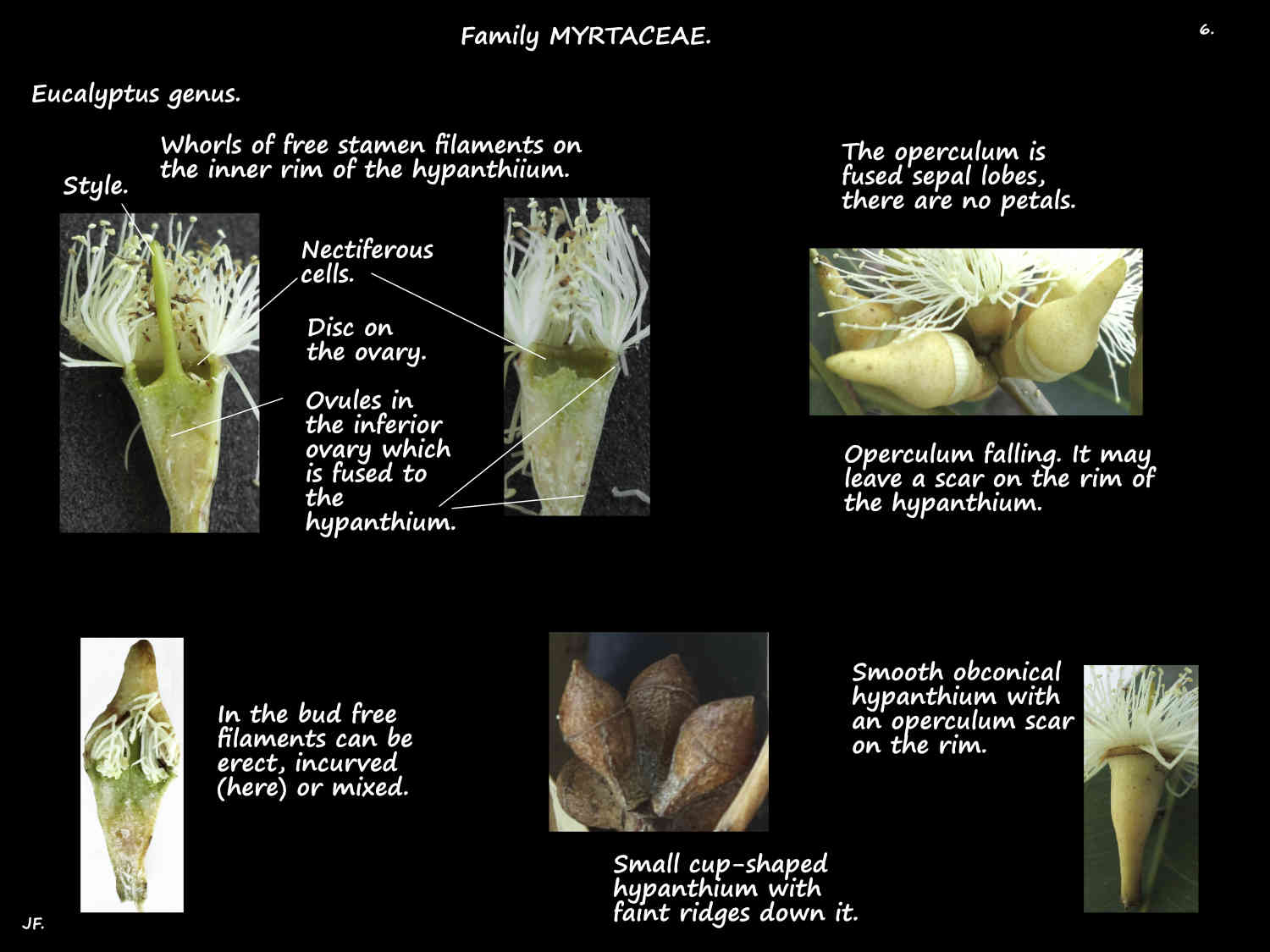
The bisexual flowers have a hypanthium of fused sepal and filament bases.
The sepal lobes on its rim are mostly fused to form an operculum or lid.
The operculum falls off as the stamens mature sometimes leaving a scar where it was attached.
Most species have no petals but when present the lobes can be free or form an inner operculum.
The numerous free stamen filaments are attached to the rim of the hypanthium inside the sepal (or petal) lobes.
They are in a few whorls and rarely their bases are fused for a short distance.
Dorsifixed anthers have 2 pollen sacs that open through a joint slit or separate slits or pores.
Most species have a gland on the connective tissue between the thecae (pollen sacs).
The inferior or half inferior ovary lies in the hypanthium often with their side walls fused.
The annular disc, attached to the inner edge of the hypanthium rim, lies over the ovary.
Derived from the nectary it has nectar secreting cells on its surface.
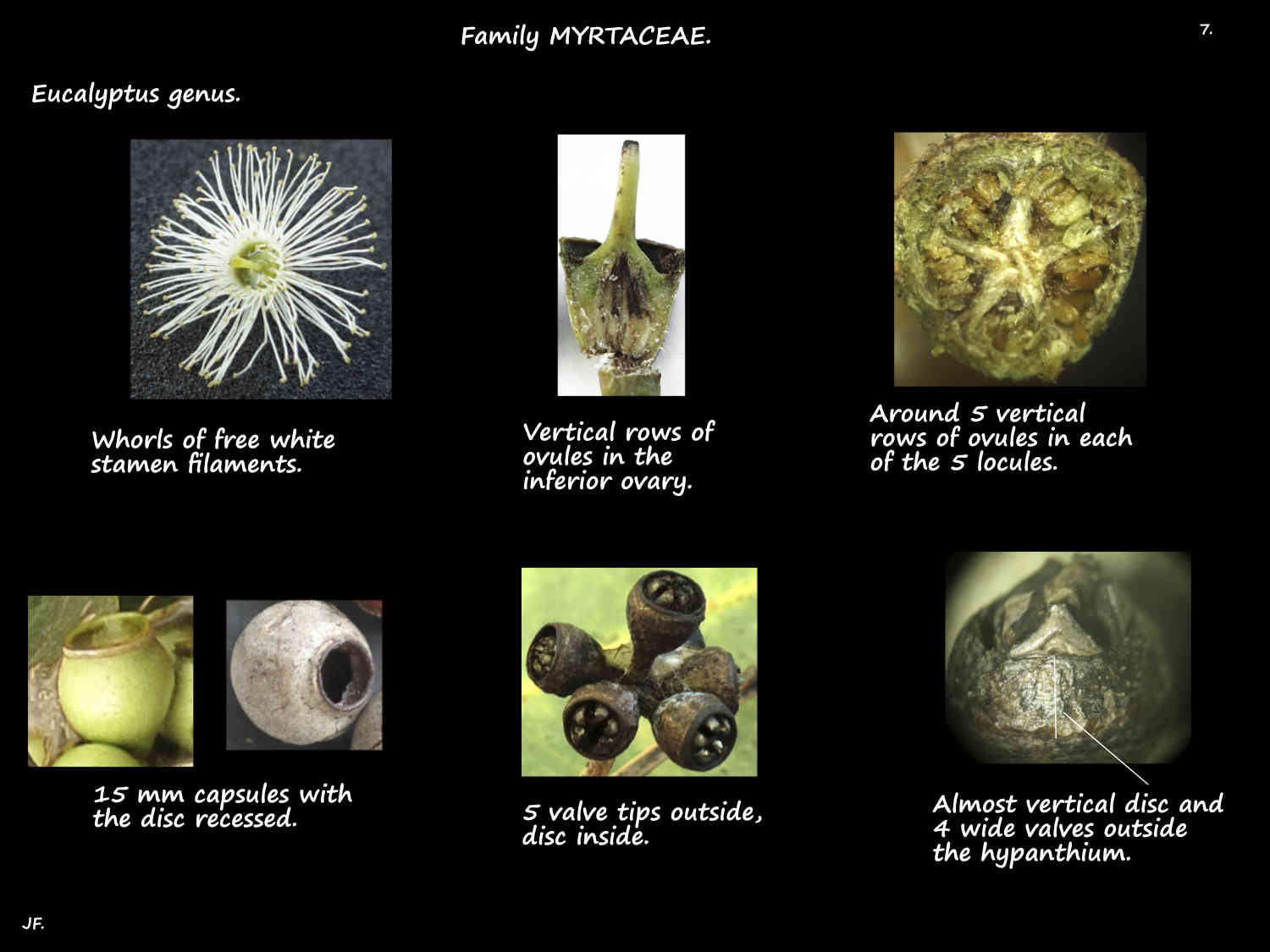
The ovary has up to 7 locules each with numerous ovules.
Ovules, in vertical rows have axile placentation.
The style has a small stigma.
Typical fruit are a woody capsule that splits vertically into each chamber (loculicidal).
The fused walls between adjacent chambers form the valves.
The disc can be flat, domed above, or recessed in, the hypanthium.
Valves can be inside the hypanthium or above the rim.
The wide to narrow tips can curve in or outwards.
Some capsules may remain on the tree for years.
Seeds can be flat or variously shaped and angled.
J.F.