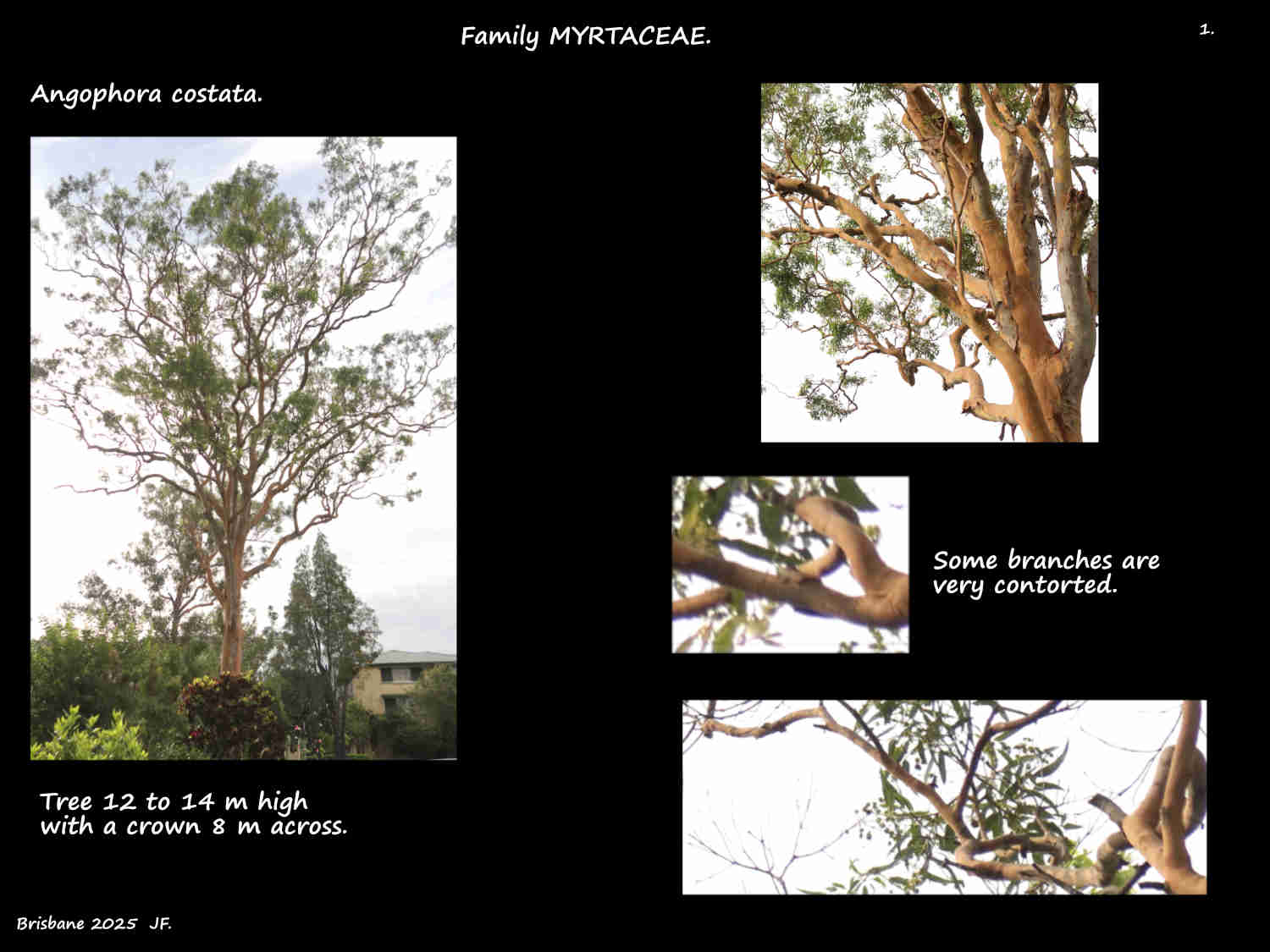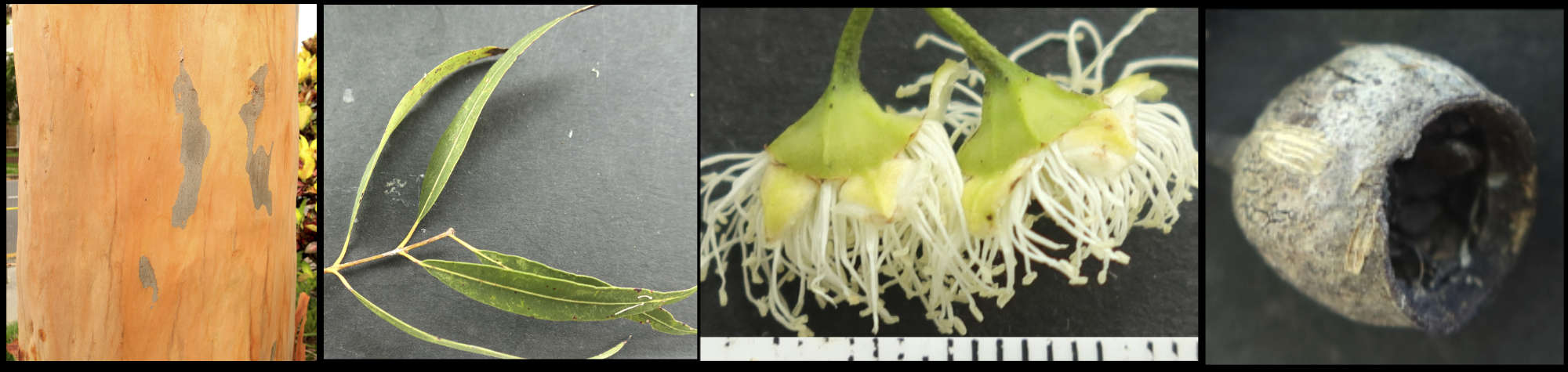
The Smooth-barked apple or Sydney red gum is native to coastal New South Wales.
They are used as an ornamental tree.
The medium to large trees can be up to 25 or 30 m high.
They usually have a single straight trunk and they form a lignotuber.
They have a wide spreading crown and the branches may be crooked.
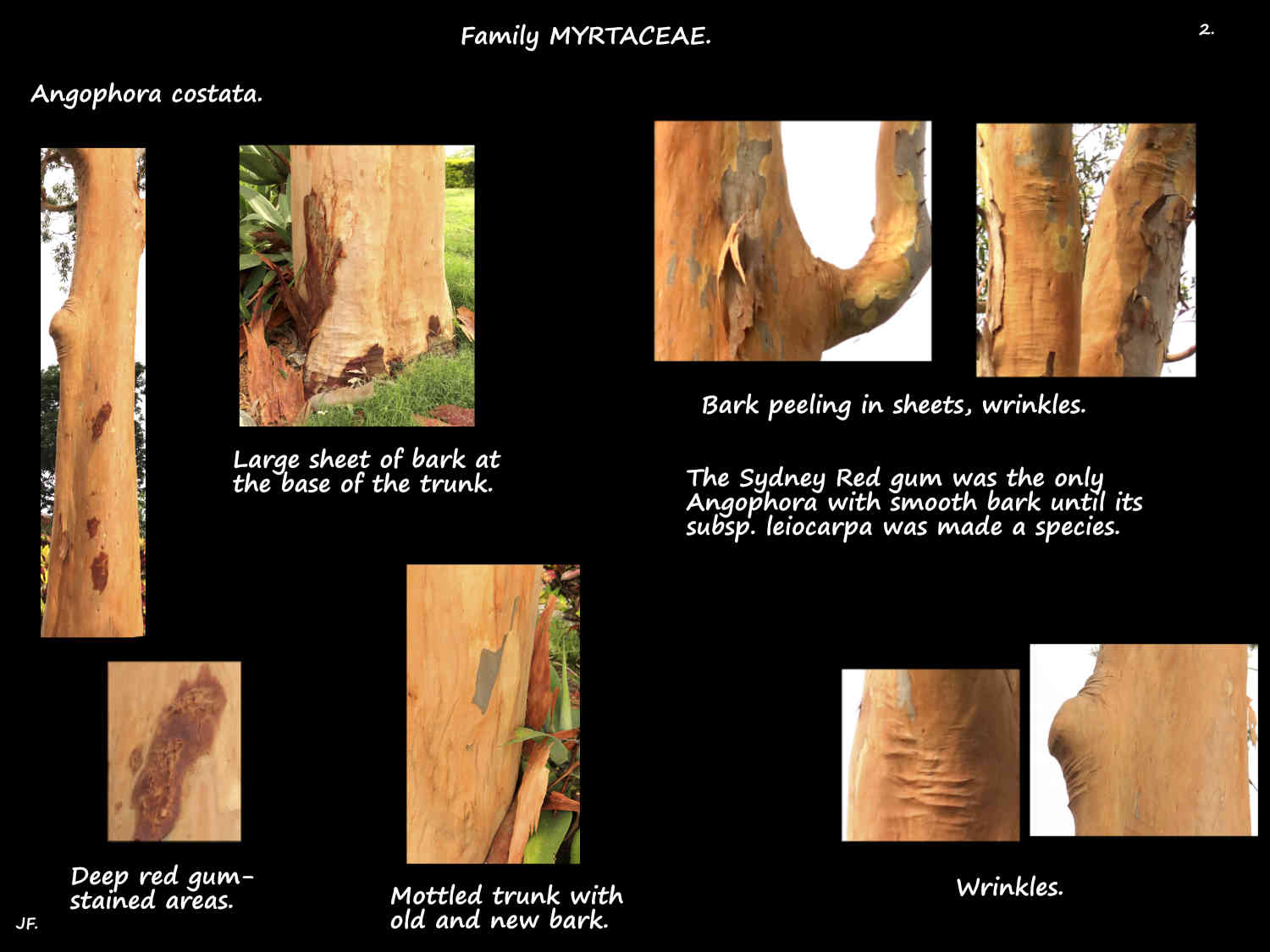
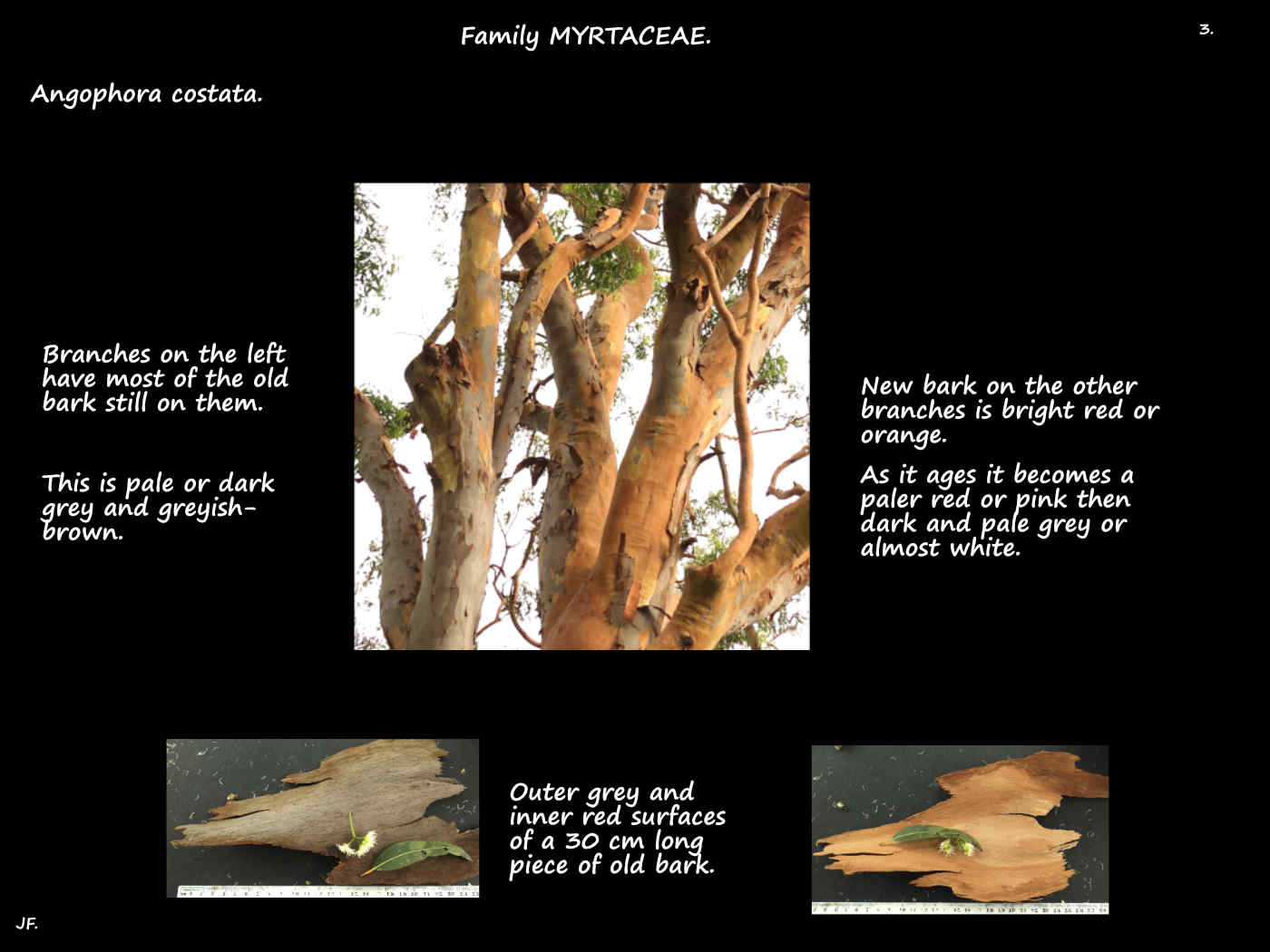
Each year the old grey bark falls off the trunk and branches in large pieces or strips.
The new bright red to orange bark is smooth and mottled for a time with patches of the old grey bark.
Over the following year the new bark fades to a paler pink then grey.
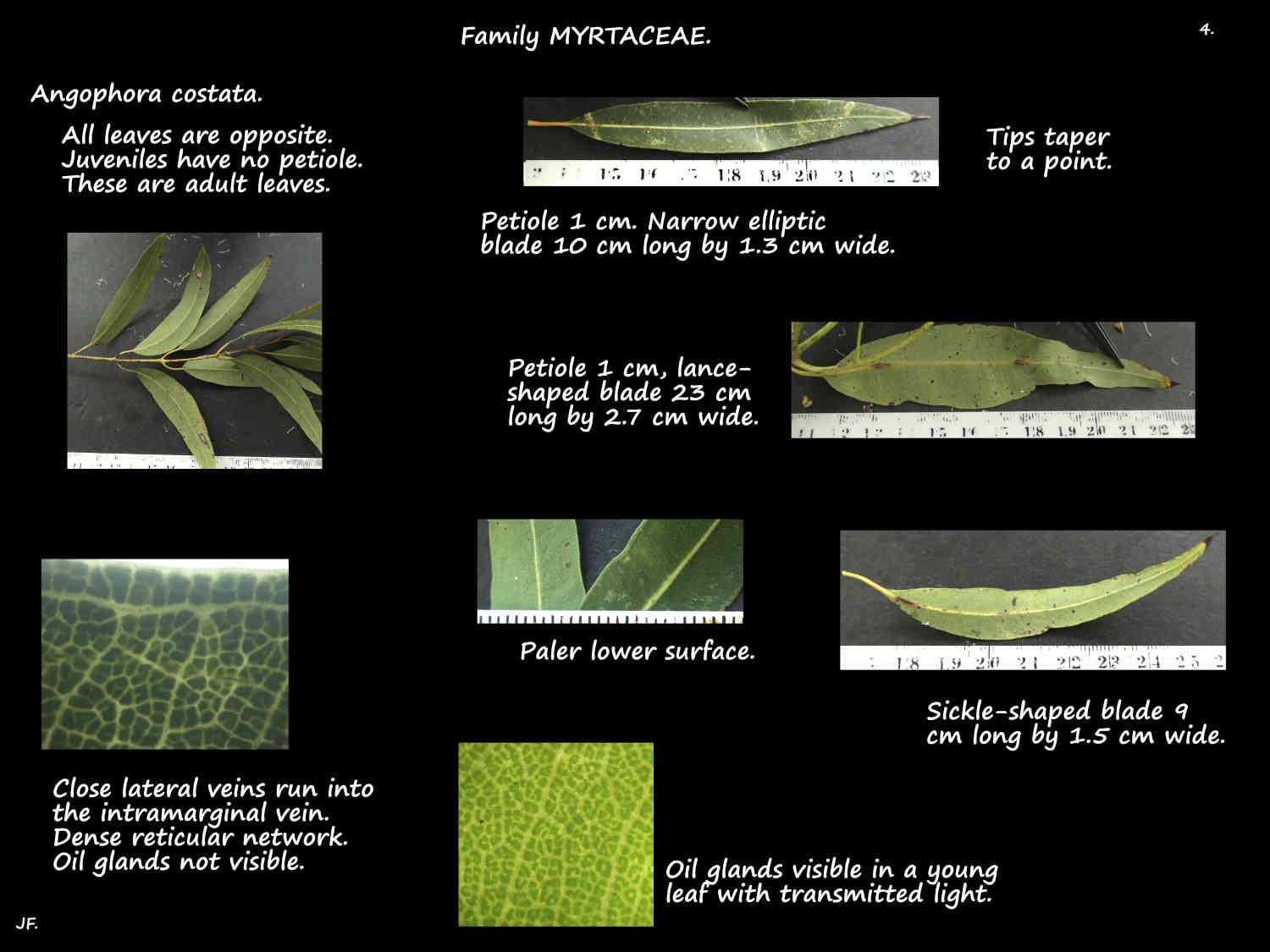
The juvenile and adult leaves are opposite.
Juveniles, 6 to 14 cm long and 2 to 6 cm wide have no petiole.
Blades are oblong or lance-shaped, the tip is pointed and the base clasps the stem.
Adult leaves are on a petiole up to around 2 cm long.
It may be slightly flattened on the upper surface.
The blades are elliptic, lance or sickle-shaped with a tip that tapers to a point.
Adult blades can be up to around 18 cm long and 2 to 3 cm wide.
They are a shiny green above and paler underneath.
The many close lateral veins come off the midrib at an acute angle.
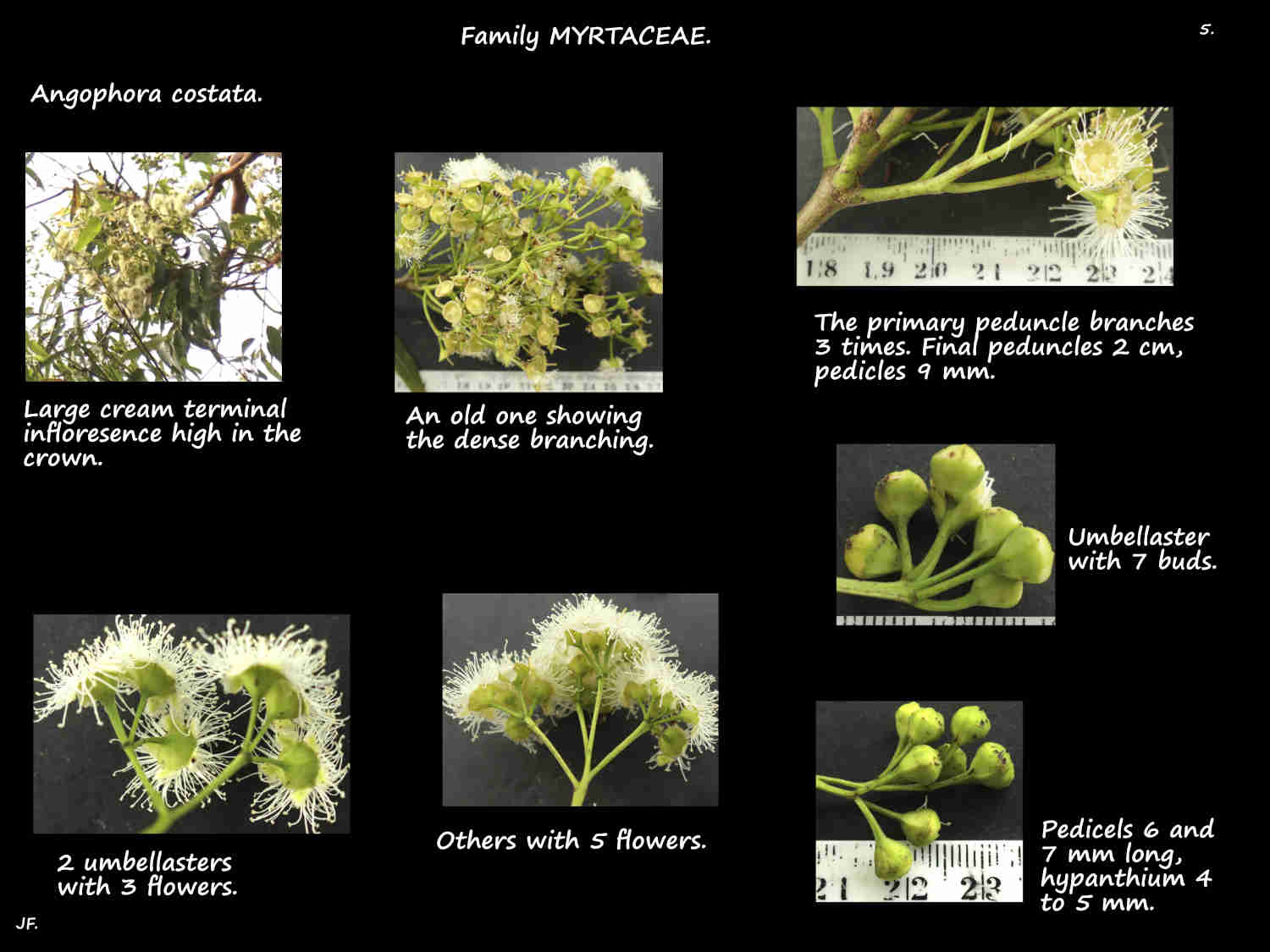
Terminal inflorescences, on a 2 to 3 cm peduncle are large branched clusters.
The terminal branches have 3 (or 7) flowers at the tip – umbellasters.
Flowers are on a pedicel 5 to 10 mm long.
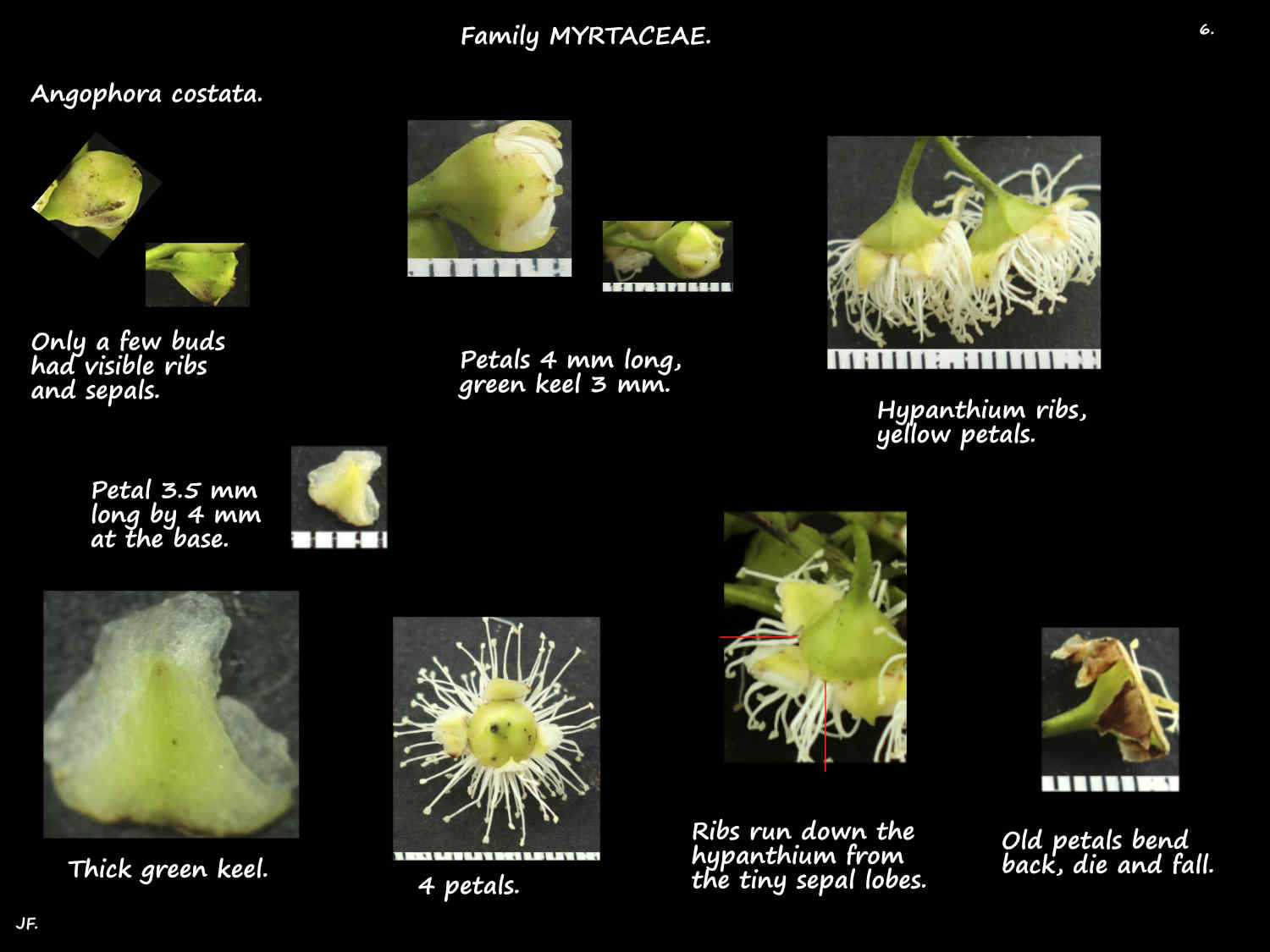
The spherical or ovoid buds have a cup-like hypanthium around 7 mm long and 6 mm wide.
It may have 4 or 5 faint to obvious ribs and there is no operculum.
Peduncles, pedicels and the hypanthium may be smooth or have hairs.
The hypanthium rim has 4 or 5 green, 3 mm long sepal lobes with a pointed tip.
Alternating with the sepals are the round 4 mm long petals.
The cream to white petals have a large pale green keel.
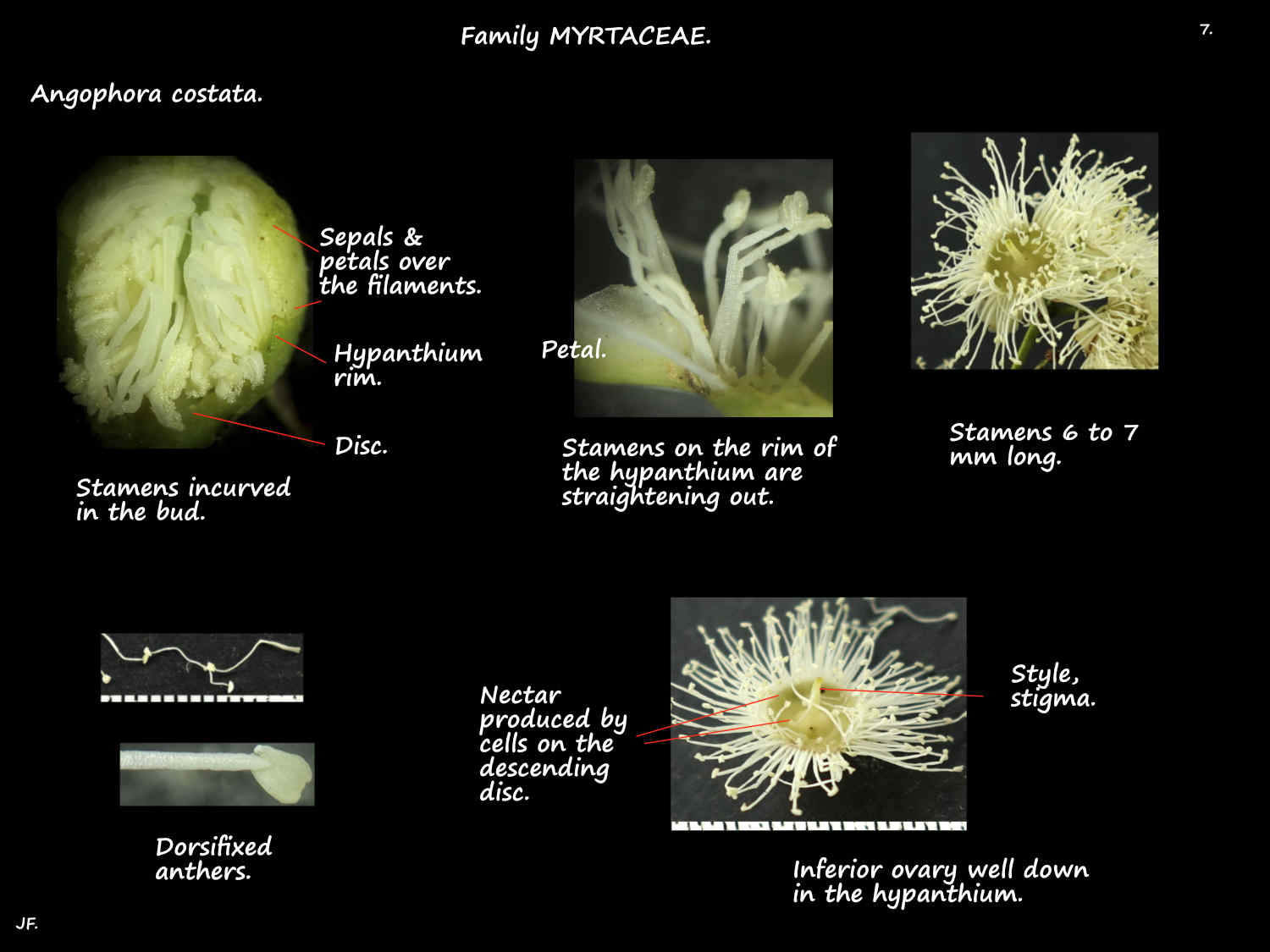
Inside the petals are whorls of cream to white stamen filaments.
The numerous filaments are curved inwards in the bud.
The longest filaments are around 7 mm long.
Dorsifixed anthers have 2 pollen sacs with a gland on the connective between them.
The sacs open through separate longitudinal slits.
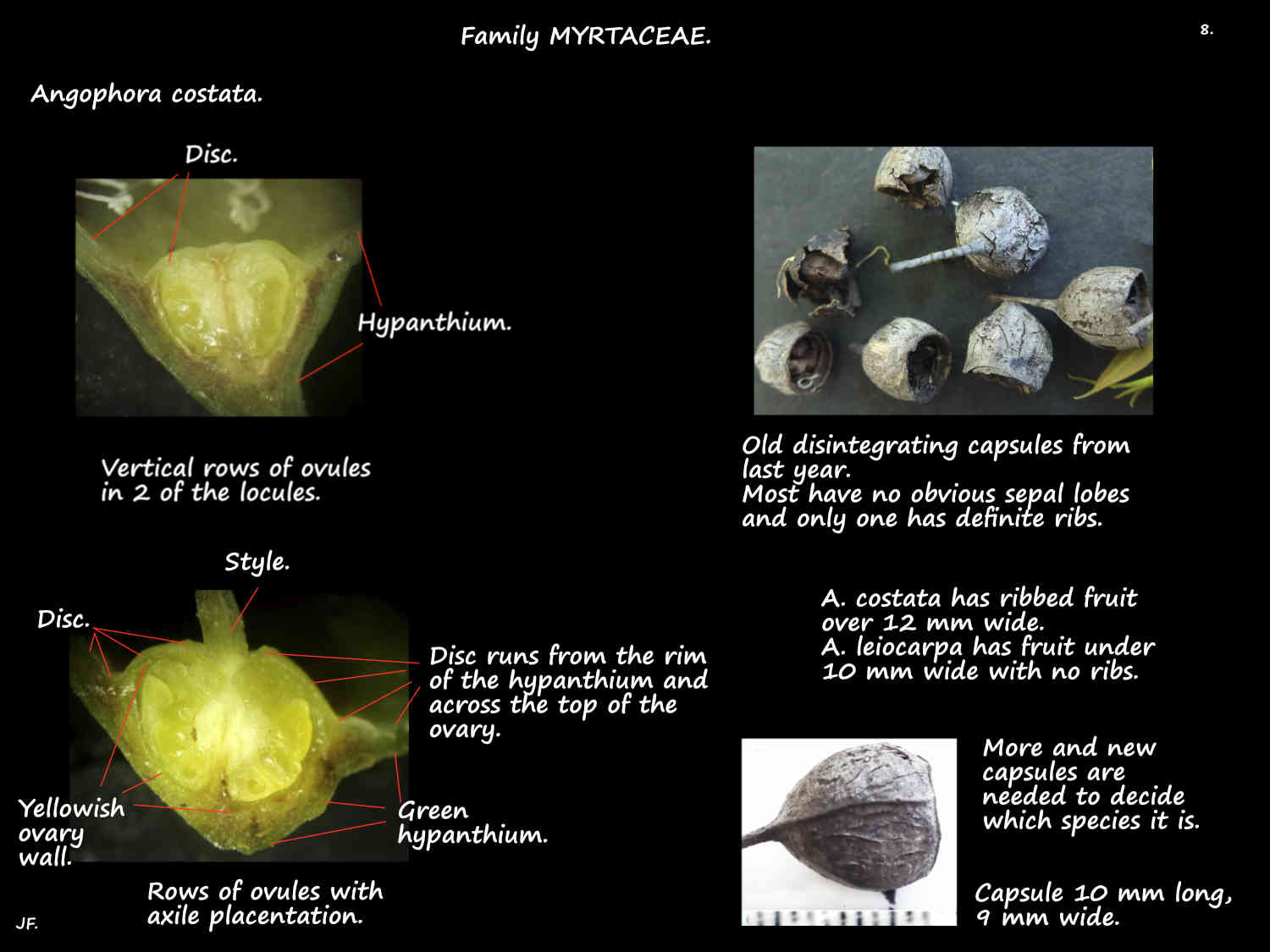
The inferior ovary typically has 3 or 4 locules each with 3 to 5 vertical rows of ovules.
The single style, with a small stigma projects just past the hypanthium.
Ovoid, cylindrical or barrel-shaped capsules have a thin woody wall.
They are 1 to 2 cm long and 1 to 1.5 cm wide.
The 3 or 4 valves are deep in the capsule with the disc descending to them.
Most of the capsules have tiny teeth from the sepal lobes.
There are faint to prominent (or no) ribs running down from the teeth.
Some capsules are smooth while others have dense hairs.
The flattened red-brown seeds are around 6 or 7 mm long.
Subspecies are described based on the pedicel length and capsule features.
The capsules are less woody than in other species.
Capsules have no, or very faint ribs and no hairs.
A. costata is generally regarded as the only smooth-barked species.
Angophora costata subsp. leiocarpa is common in South East Queensland.
Now classified by some as a species, A. leiocarpa, it has smaller fruit with no ribs.
J.F.