Family Malvaceae s.l. > Subfamily Dombeyoideae.
Dombeya is now part of the loosely defined (s.l.) Malvaceae family.
Dombeyoideae has around 14 genera most from the old Sterculiaceae and Tiliaceae families.
196 of the around 380 species in Dombeyoideae are Dombeyas with most from Madagascar.
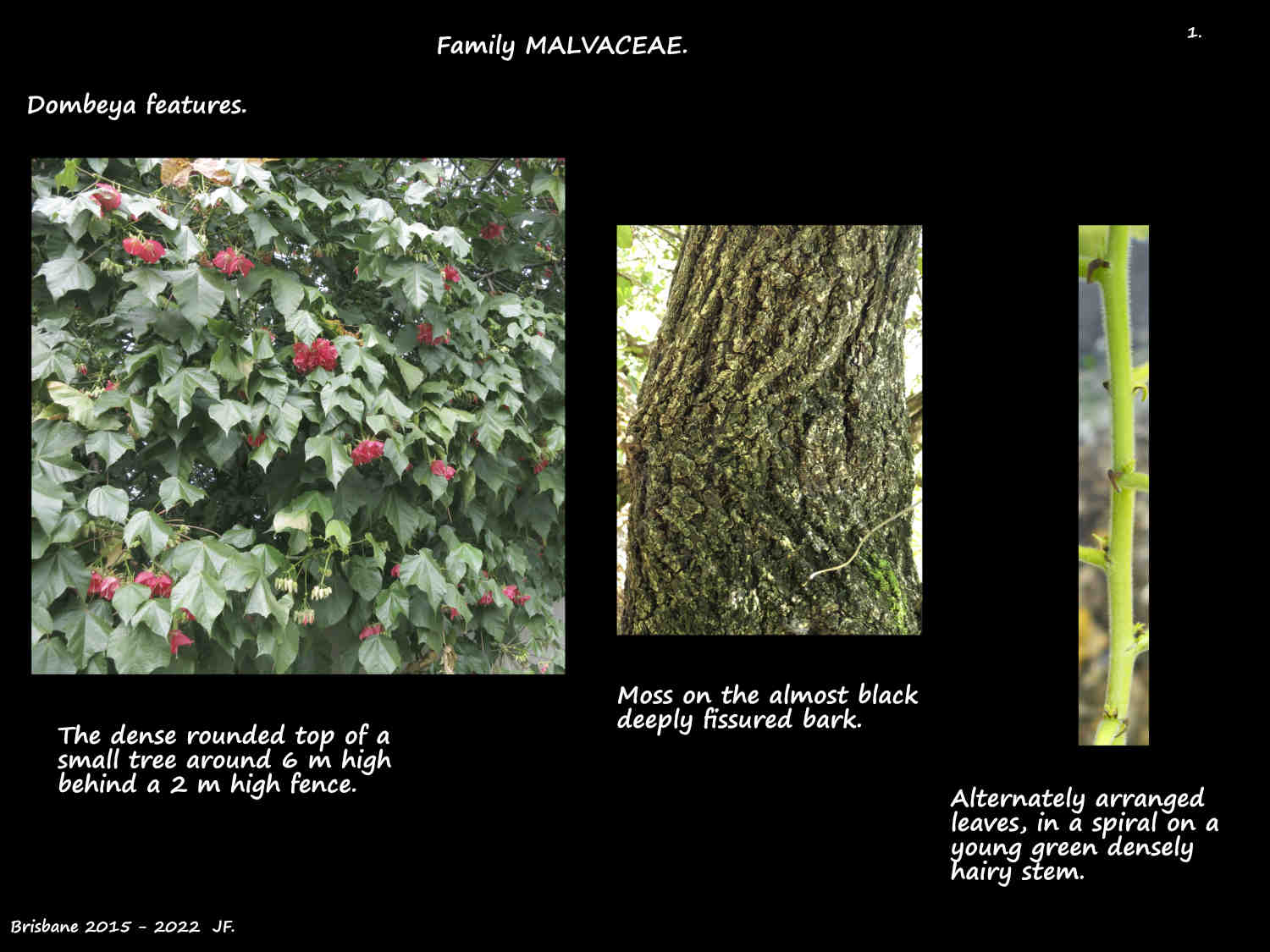
They are evergreen or deciduous shrubs from 1 to around 4 m high or trees 7 to 15 or 16 m.
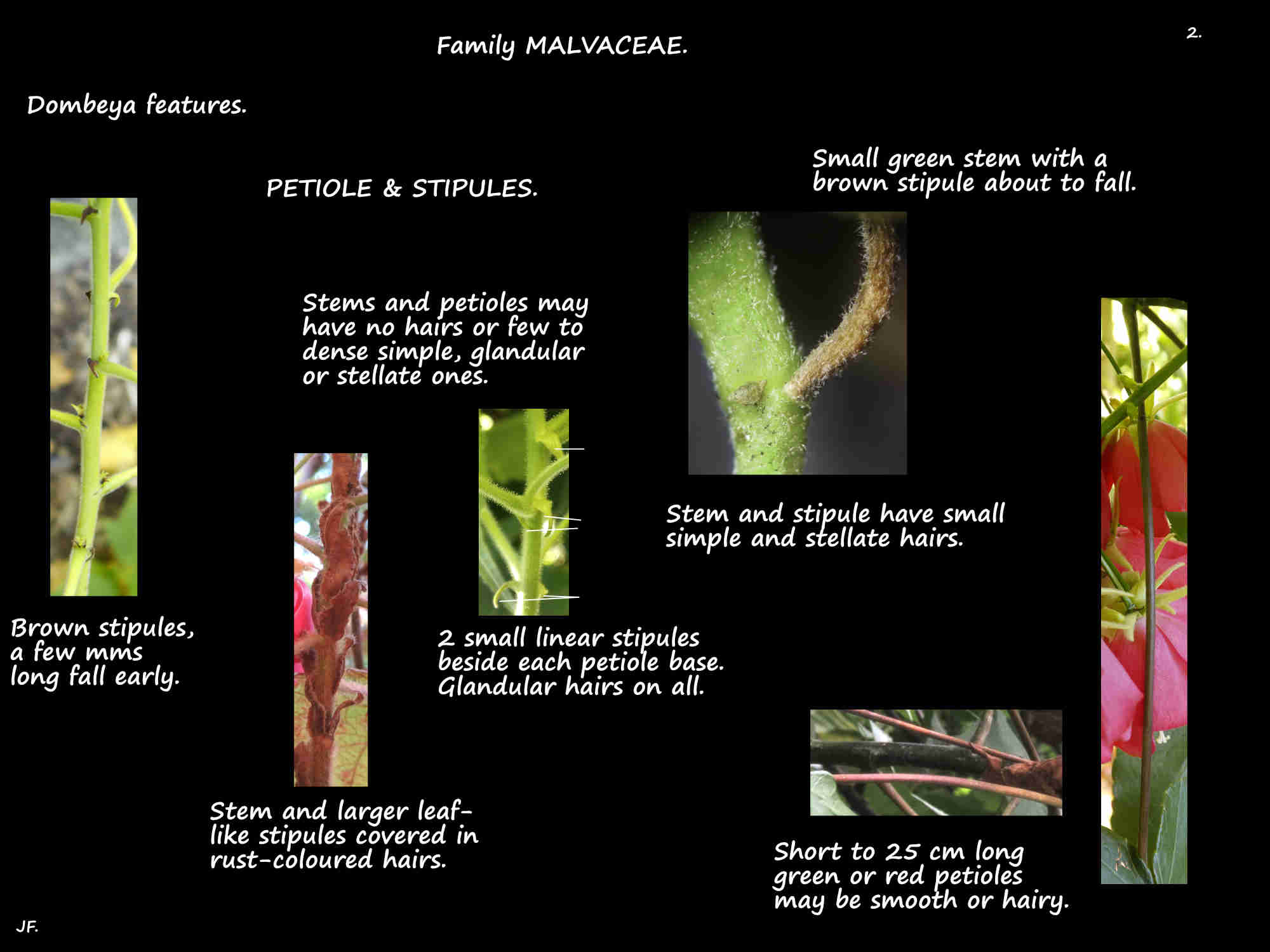
Stems may have no hairs or a few to dense ones that may or man not persist.
The clear, pale brown or rust-coloured hairs can be simple, simple with glands, stellate or a mix of these.
The alternately arranged leaves are on a petiole from 2.5 to 15 or 25 cm long.
The linear to leaf-like stipules, 2 to 15 mm long usually fall early.
Petioles and stipules can have few to dense simple, glandular or stellate hairs.
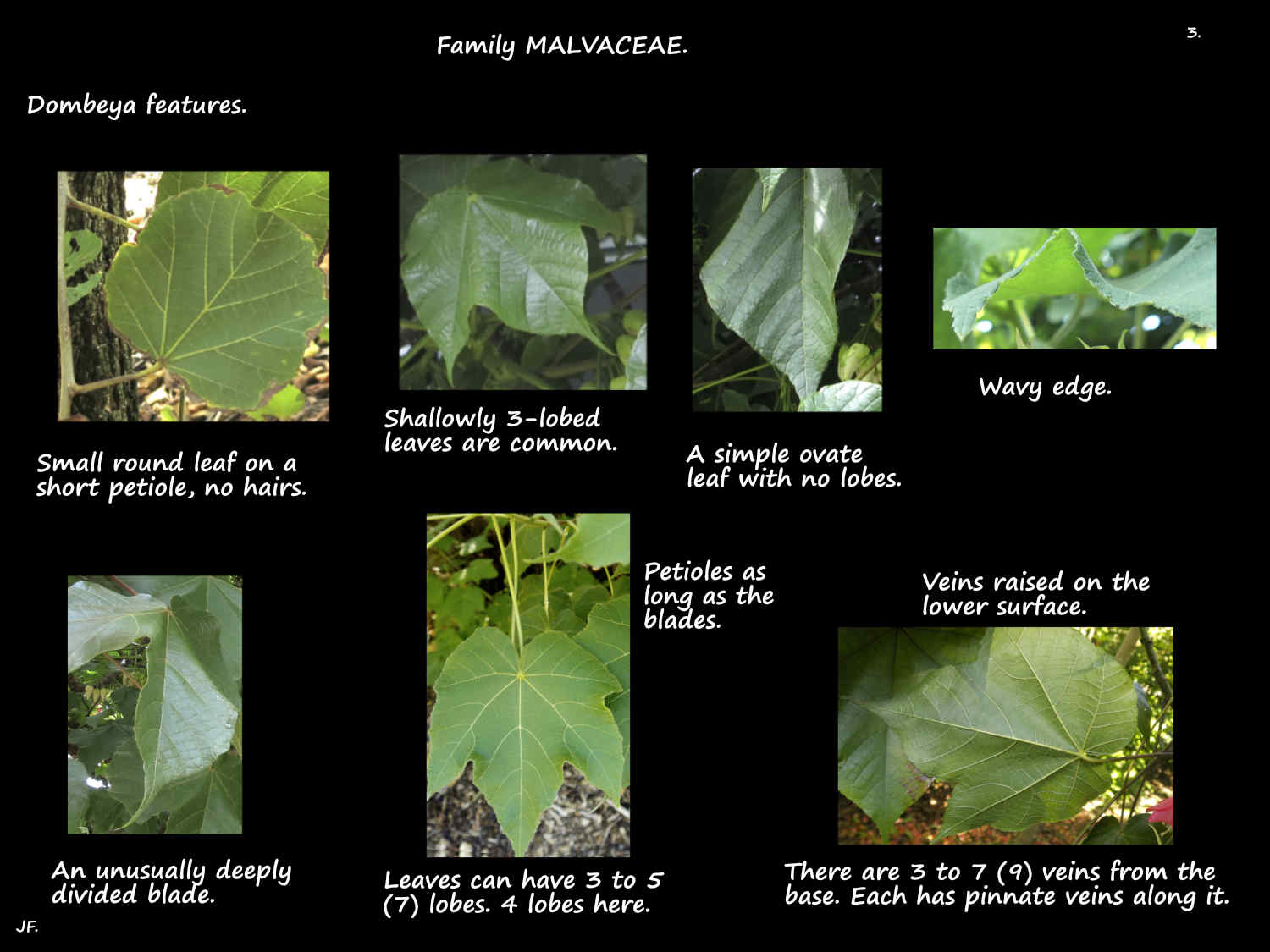
The widely ovate to round leaves frequently have 3 to 5 (2 to 7) shallow to deep lobes.
Blades are from around 6 to 25 cm long and 10 to 20 cm wide.
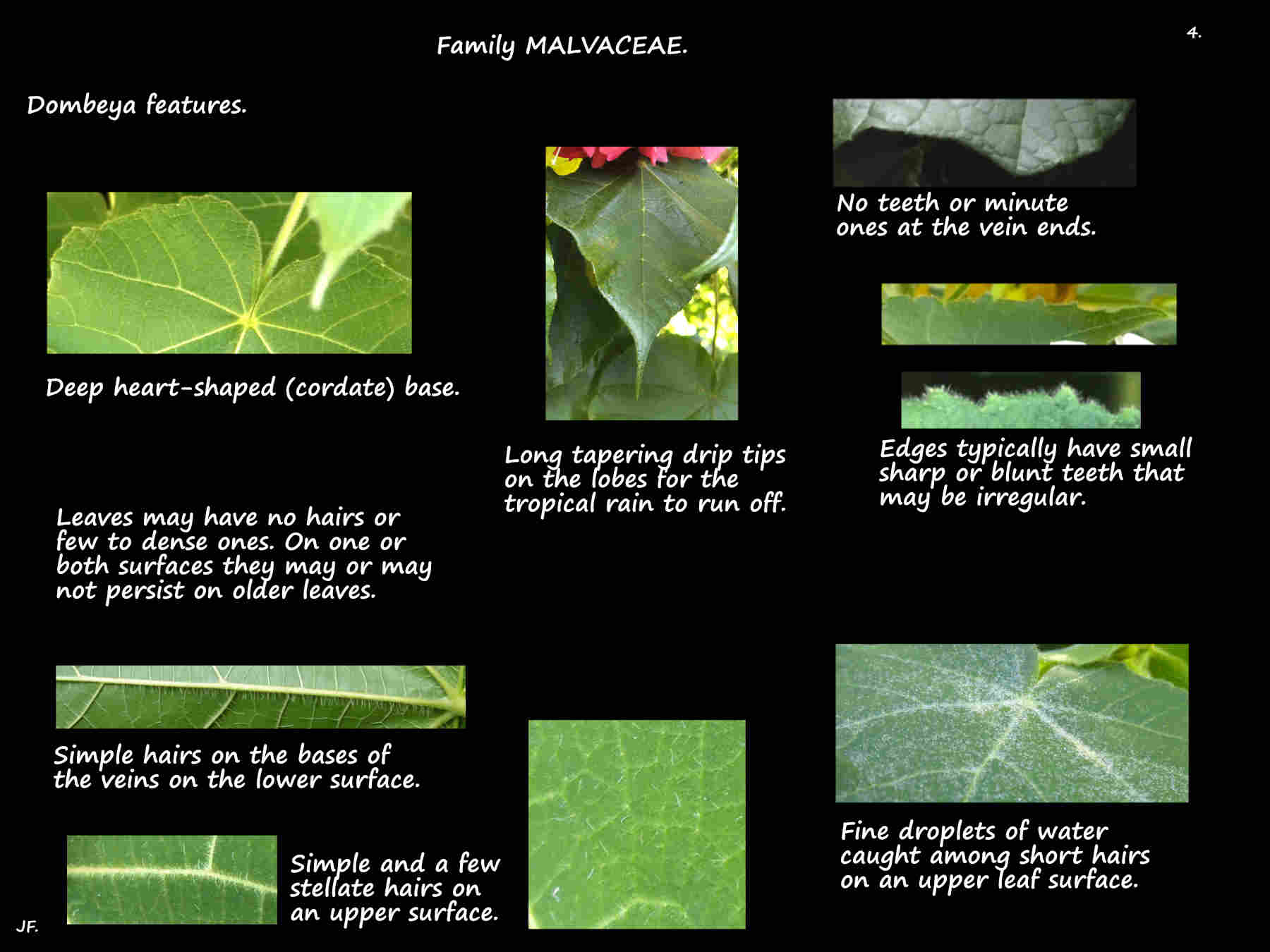
Bases are a shallow to deep heart-shape and the tips a long tapering point.
The wavy edge usually has small regular or irregular sharp or blunt teeth.
The 3, 5 or 7 palmate veins (nerves) from the base are raised on the lower surface.
Blades may have no hairs or a few to dense ones on both surfaces or mostly on the lower.
All over or just along the basal veins, hairs can be simple, stellate or a mixture of both.
With dense hairs the surfaces can feel soft and velvety.
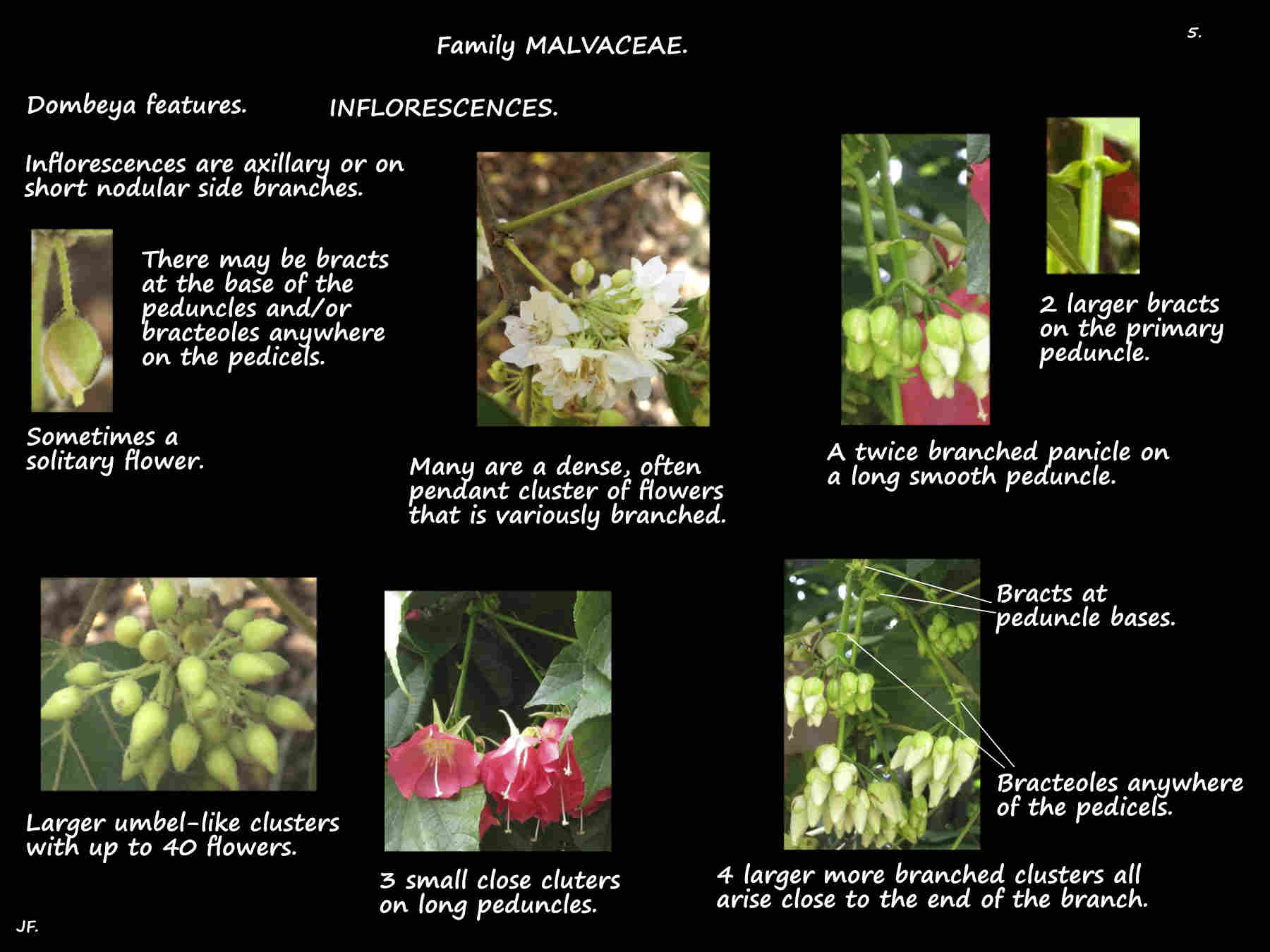
Axillary inflorescences are in the axils of leaves or scale-like leaves.
They may also arise from very short side shoots often close together and near the branch ends.
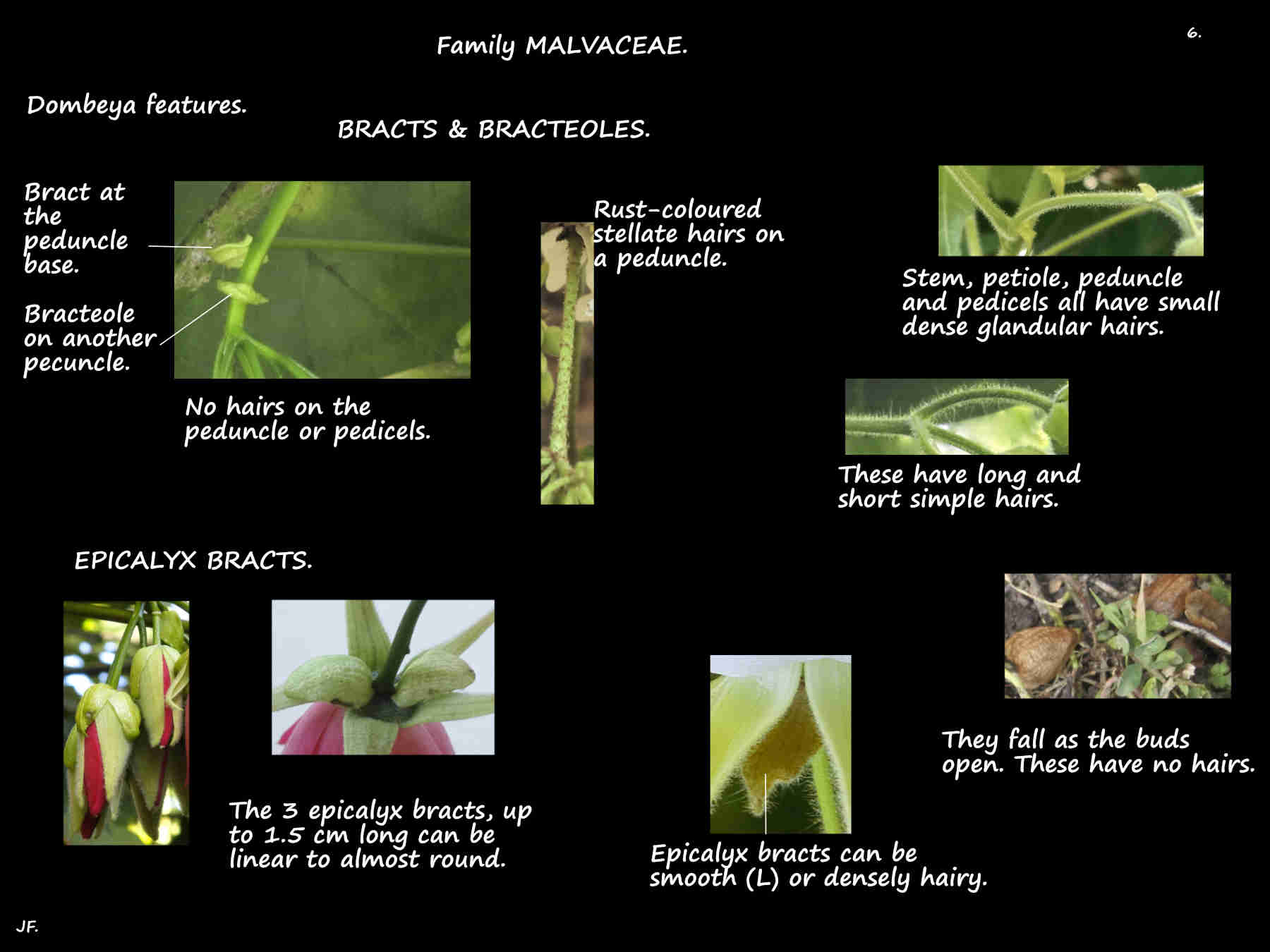
Peduncles a few mms to around 15 cm long can be smooth or have few to many small soft woolly hairs.
The basic inflorescence unit is a cyme or is cyme-like with the first flower on the tip of the axis.
Unable to grow longer the axis puts out side branches below the flowers.
Each side branch has a flower at the tip and the process repeats itself.
Branching patterns vary with inflorescences described as a panicle, bundle, umbel-like, cluster or a head.
They can be a single flower, a few or up to 40 and from 5 to 40 cm wide.
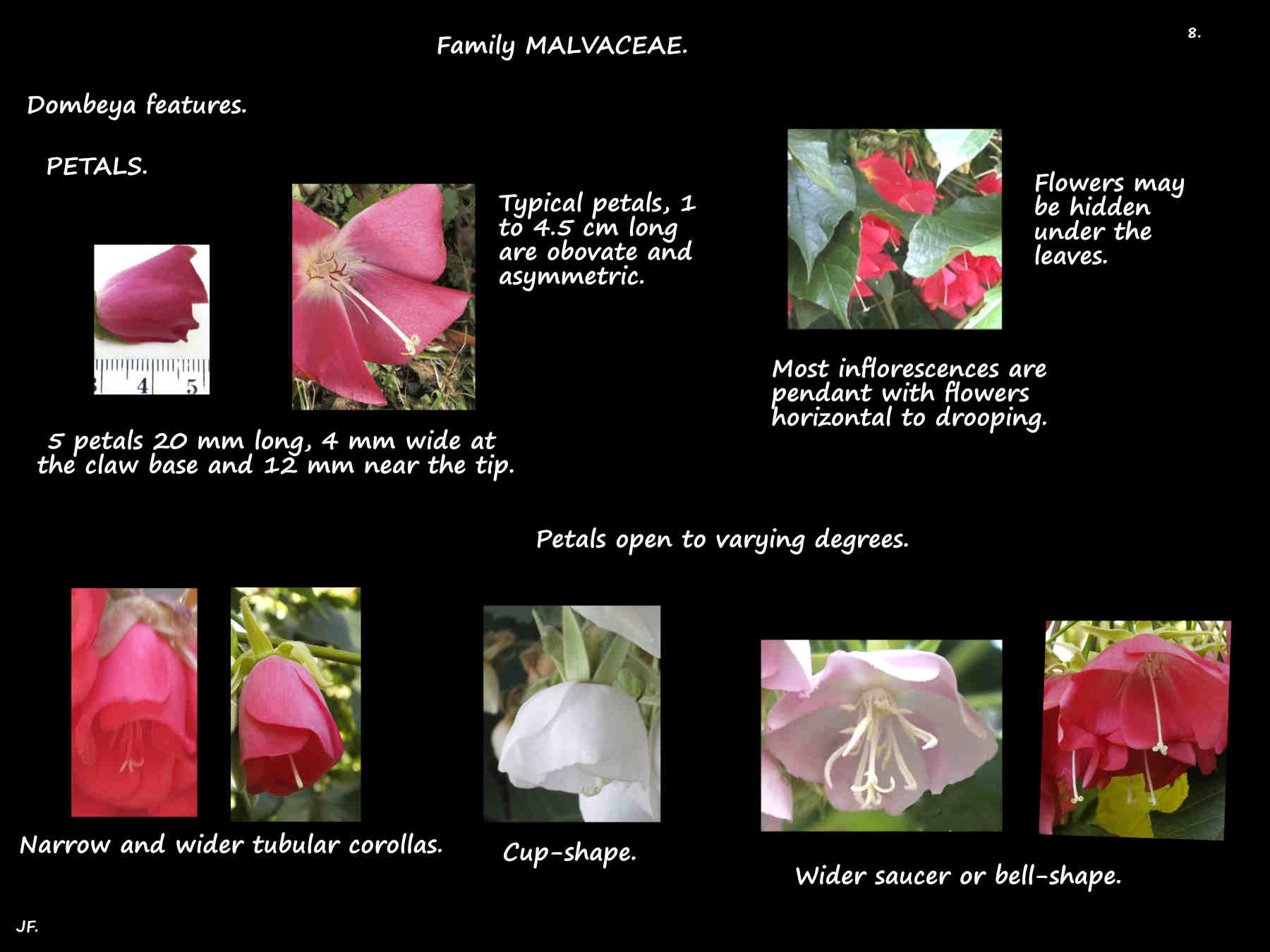
The often drooping clusters may appear before the leaves or be partly hidden by them.
The thin smooth or hairy pedicels are from 0.5 to 4.5 cm long.
Bracts at the peduncle base and bracteoles anywhere on the pedicels may be present or absent.
The epicalyx (involucre) immediately under or just below the calyx has 3 deciduous bracts.
Bracts, a few mms to 1.5 cm long can be linear, ovate, elliptic to almost round.
They may be of different sizes, inserted at slightly different levels and have no, few or dense hairs.
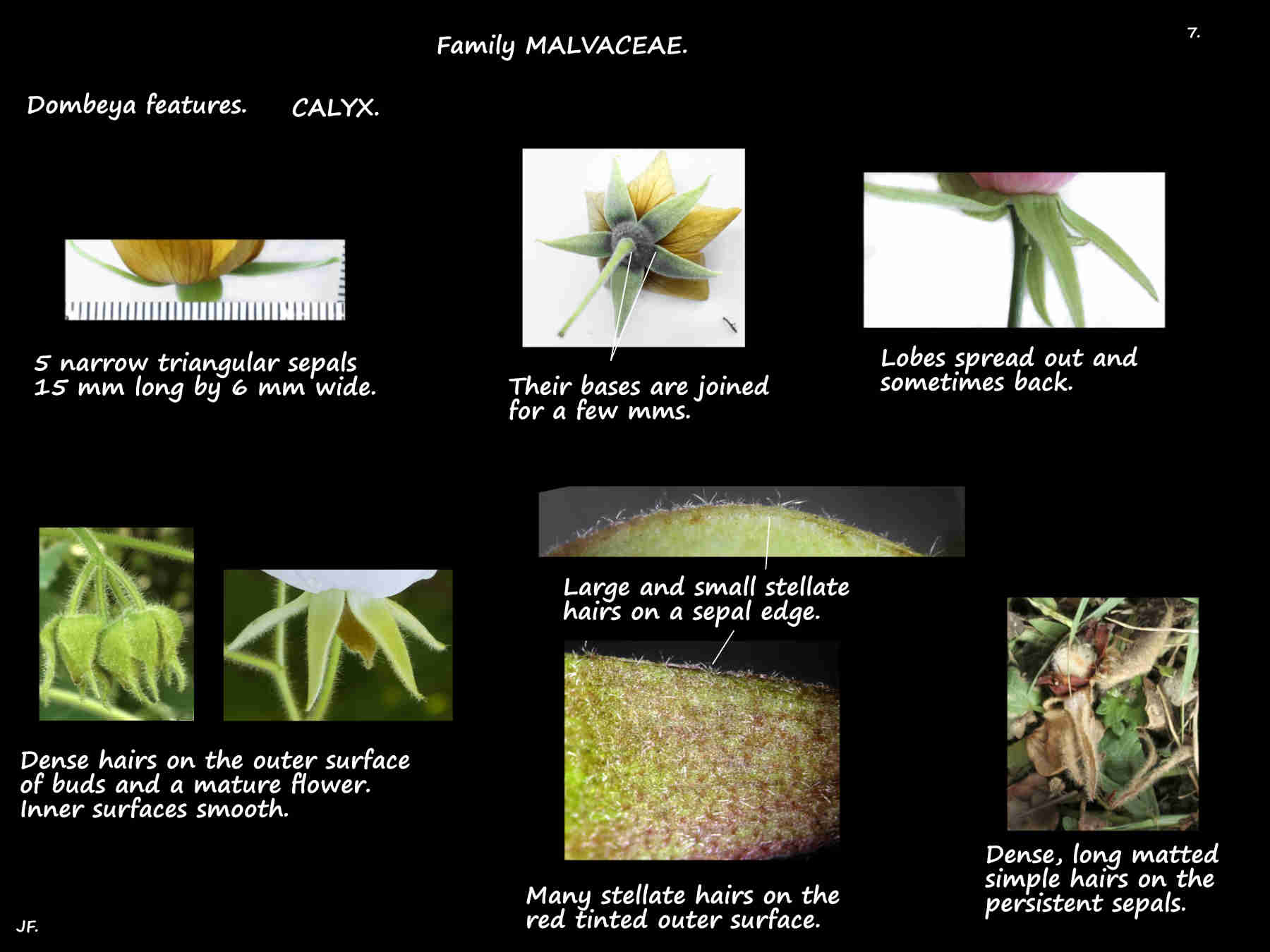
The short basal calyx tube has 5 triangular sepal lobes from 0.5 to 2 cm long and 2 to 5 mm wide at the base.
The outer surface of the green or pinkish lobes has simple and/or stellate hairs that can be dense.
There is nectar producing tissue at the base of the sepals.
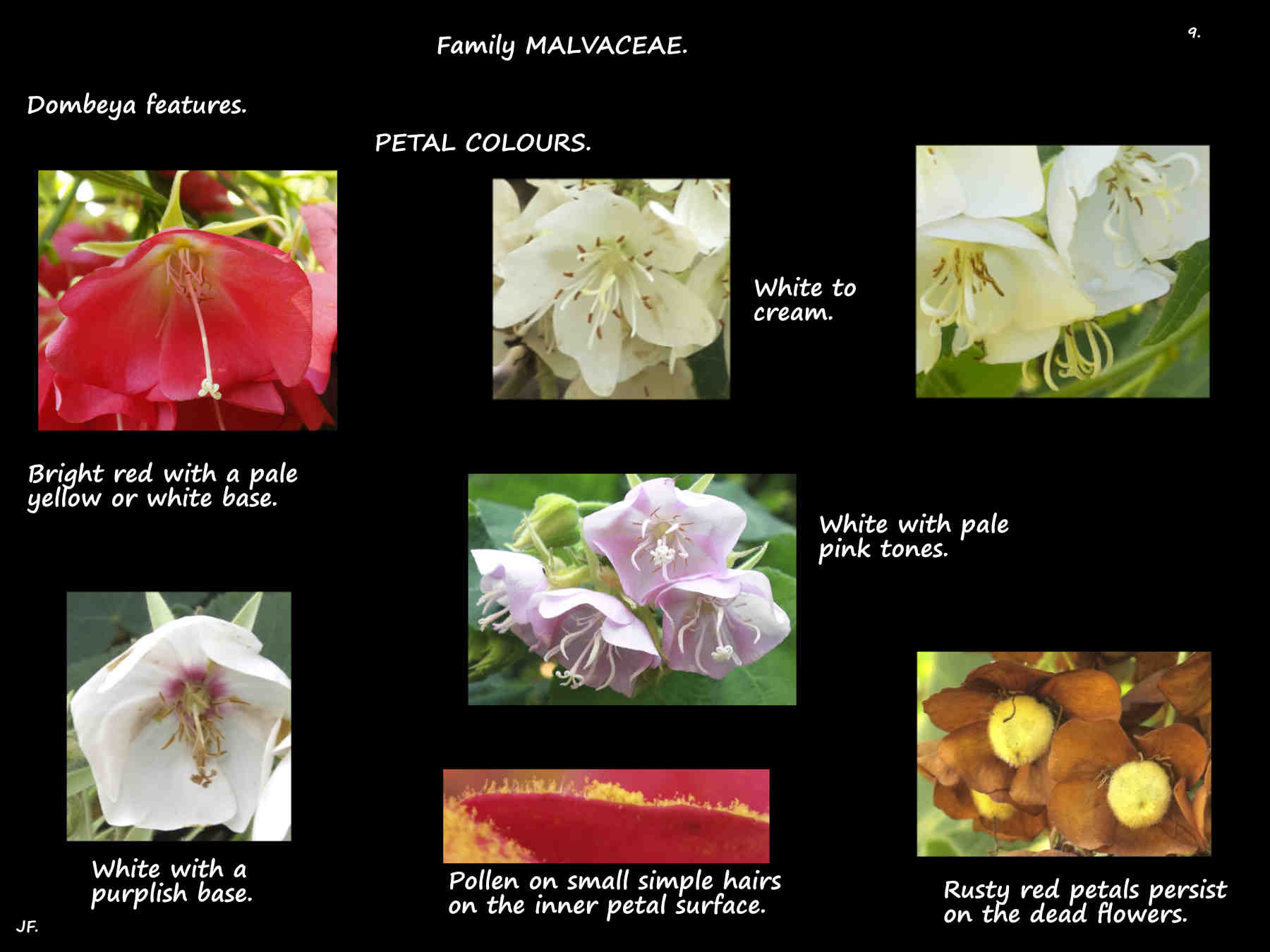
The 5 free petals form a bell, cup, tubular or saucer-shaped corolla.
Some are only 1 cm long with others up to 4.5 cm long and 3 cm wide near the tip.
On a narrow claw base the petals are often asymmetrically obovate (ovate to elliptic).
The white, cream, pink or red petals may have a reddish-purple base and simple hairs.
Most species have petals that turn reddish-brown and papery.
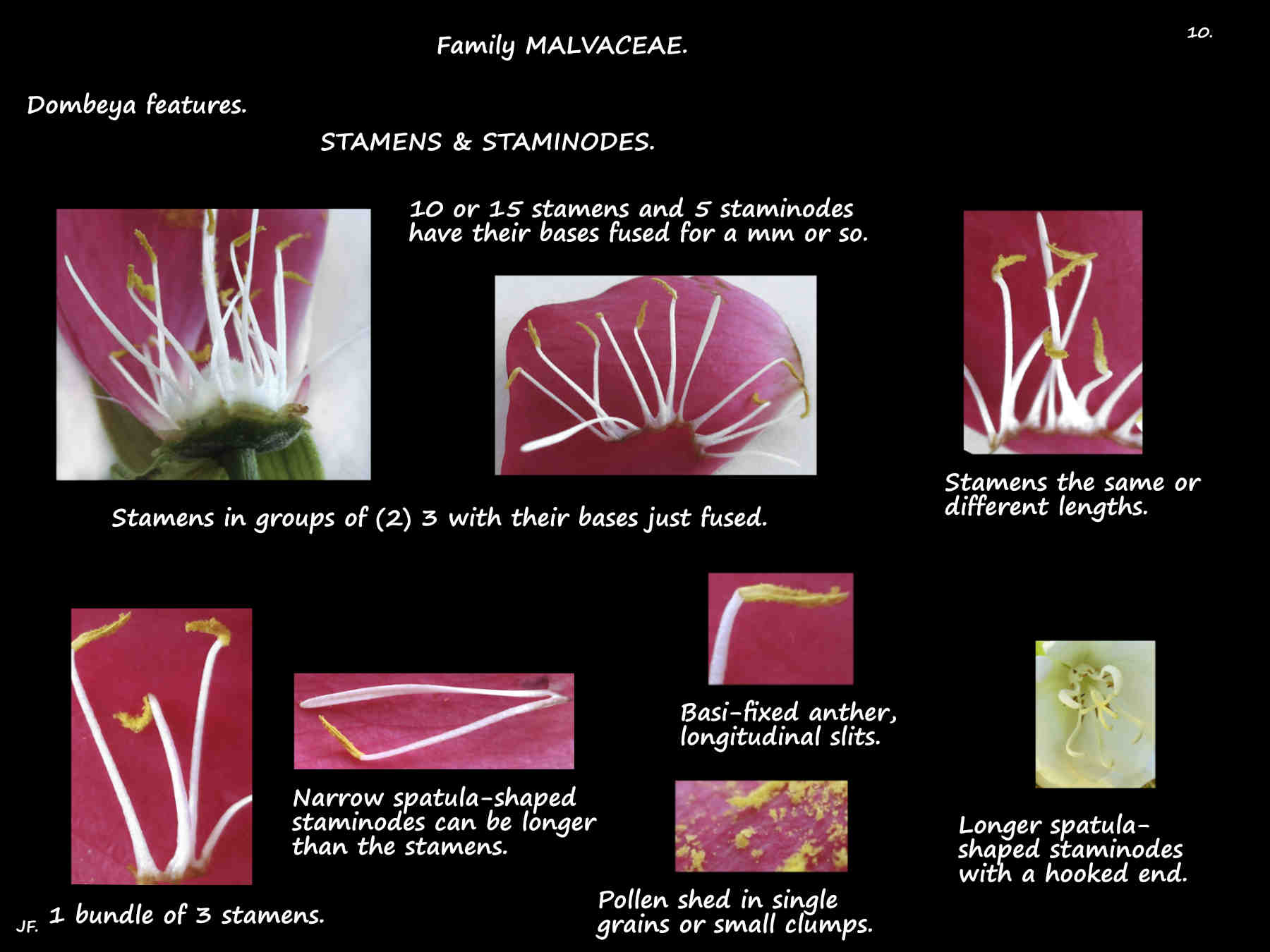
The 10 to 15 fertile stamens and 5 infertile staminodes are up to 1 or 1.5 cm long.
The bases of all are fused into a staminal tube 1 to a few mms long.
Bases of the free stamen filaments are fused in pairs or 3’s to give 5 bundles.
The oblong basifixed anthers open through longitudinal slits.
The slightly longer or shorter staminodes can be linear or spatula-shaped.
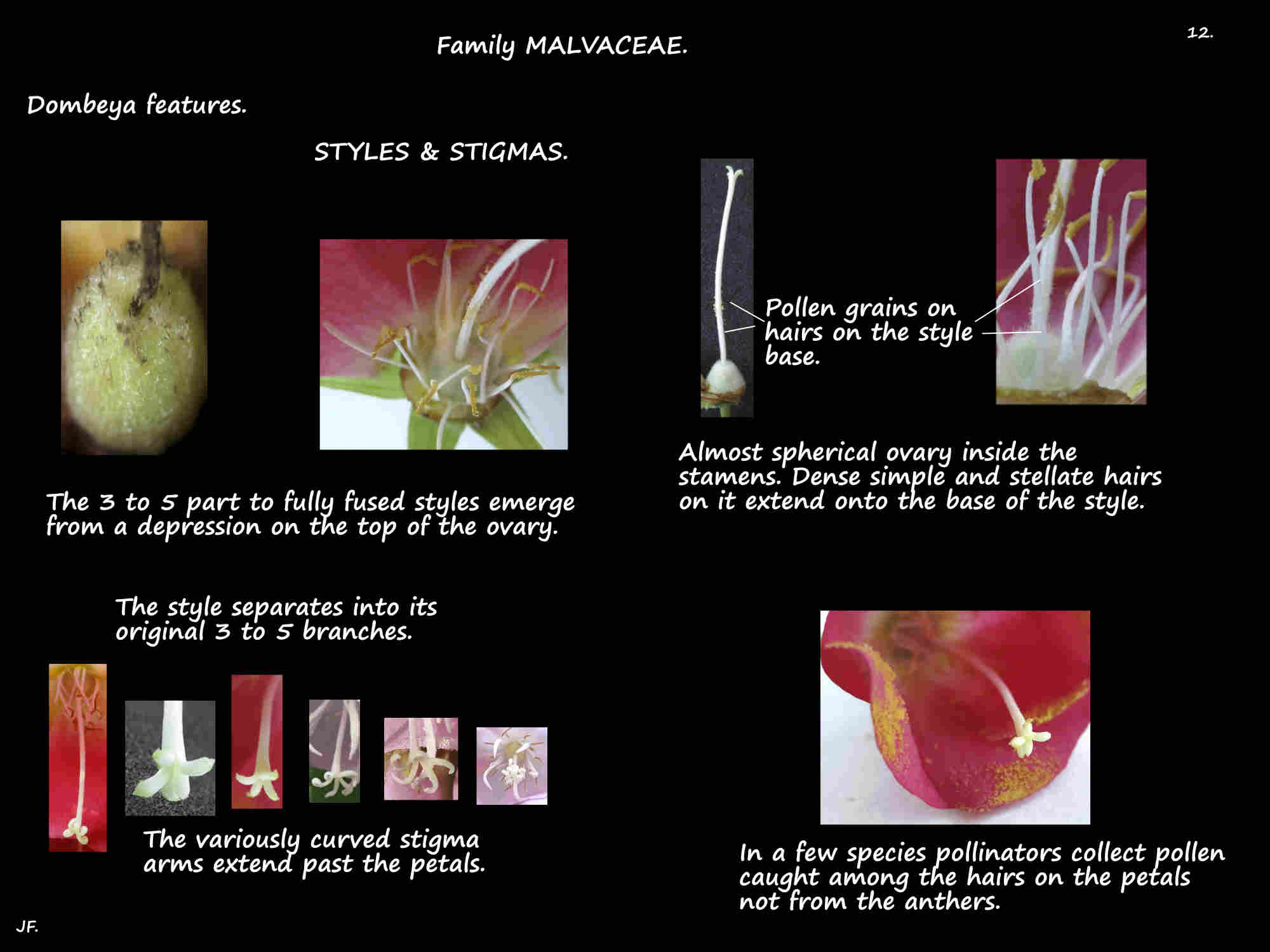
Pollinators mainly get pollen from the anthers (primary presentation).
Secondary pollen presentation in Dombeyas can be from the staminodes or petals.
An example is D. tiliaceae which has hairs on the staminodes that hold a lot of pollen.
In D. cacuminum secondary presentation from the petals is prominent.
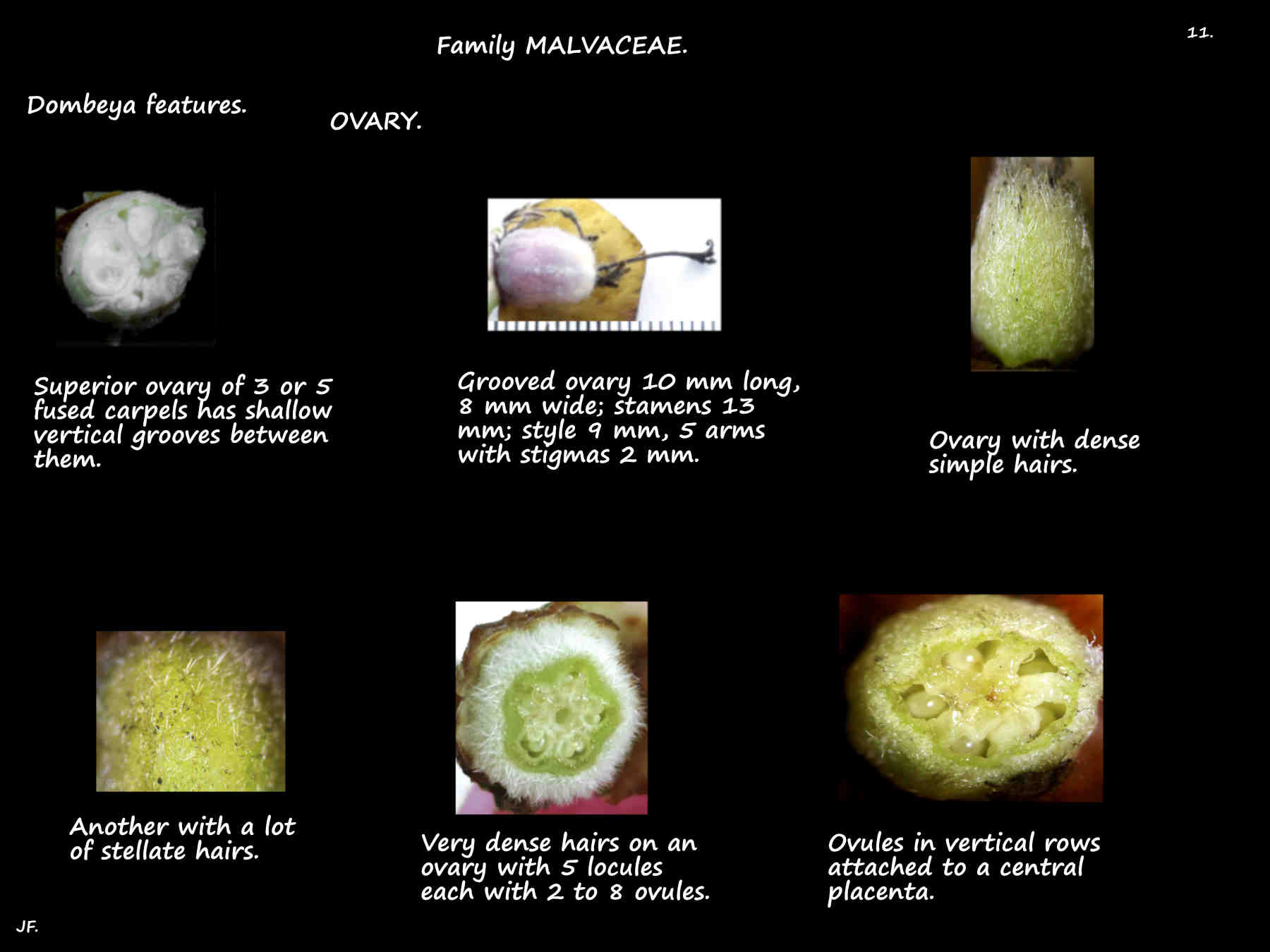
The roughly ovoid superior ovary, a few mms long and covered in dense simple or stellate hairs has 3 or 5 locules.
Each locule has up to 8 ovules attached to a central placenta (axile placentation).
The 3 or 5 partly or completely fused styles, up to 3.5 cm long may have hairs at the base.
At the top the 3 or 5 short branches holding the anthers curve back.
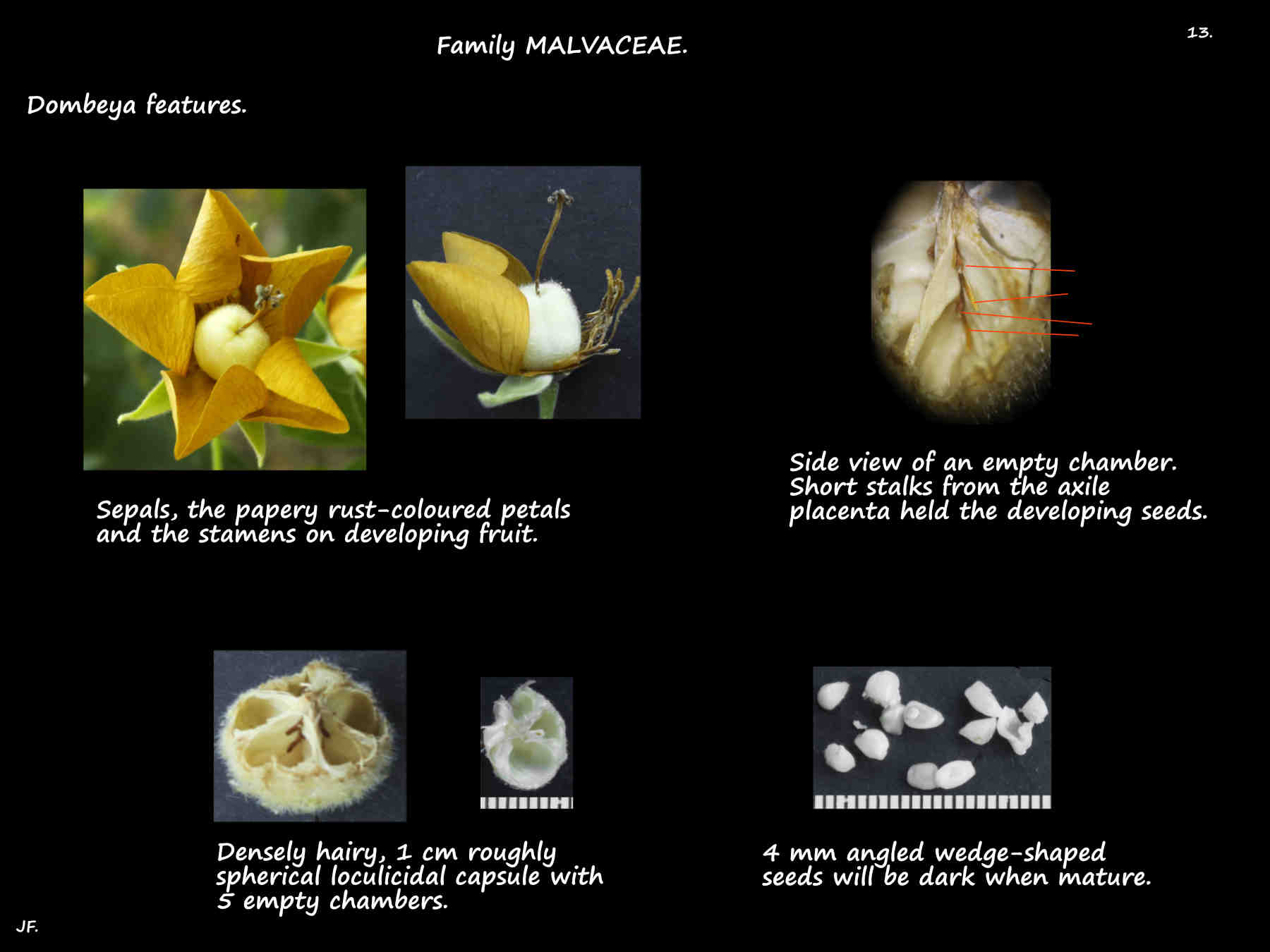
Fruit are a round or ovoid loculicidal capsule that becomes dry and hard.
Up to around 1 cm long it has dense short simple and stellate hairs.
Each of the 3 to 5 chambers splits down the centre to release the seed/s.
The brown to black seeds, a few mms long are angled or kidney-shaped.
J.F.