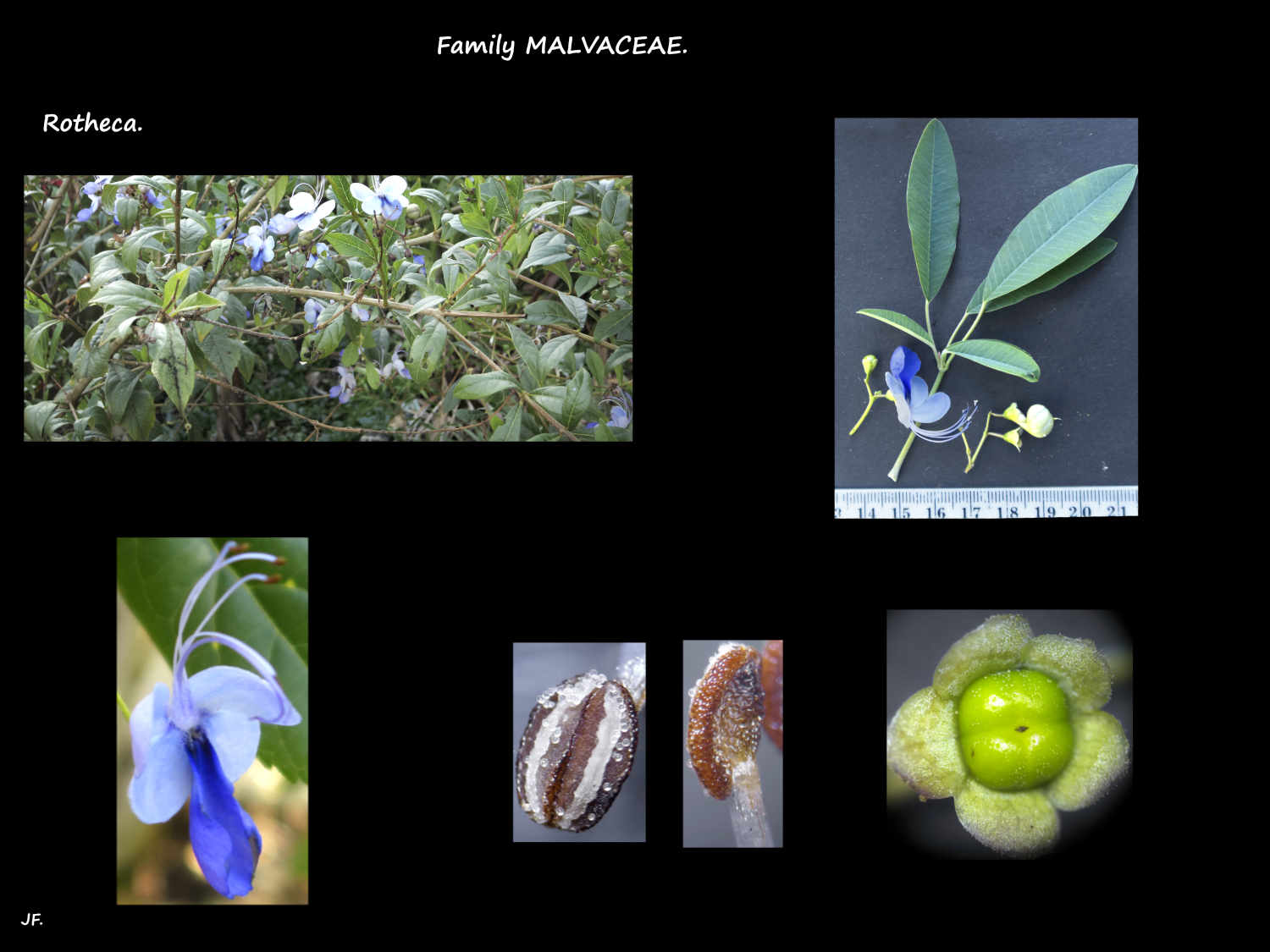
Previously in Verbenaceae most now put the (26 – 30) 37 species in Family Lamiaceae.
They are native to tropical and sub-tropical areas of South Africa and Asia.
There are perennial herbs, and shrubs or sub-shrubs with a woody underground stem or rhizome.
Branches can be erect, arching or lie along the ground with the tips erect.
There are a few woody vines (lianas) and small trees.
Small stems are usually 4-angled and new twigs often have dense hairs.
Leaves are typically opposite and decussate (in 4 ranks) but some are in whorls of 3 or 4.
The simple leaves have a short or no petiole and an elliptic to ovate or obovate blade.
The wavy edges can be smooth or have small sharp or blunt teeth or be slightly lobed.
The lower surface is paler and both surfaces may have simple pale hairs.
Inflorescences are terminal and/or axillary on short side branches.
There may be bracts at the peduncle base and bracteoles on the pedicels.
The basic unit is a spike with flowers, on a pedicel opening from the top first (a cyme).
The cymes are variously arranged in loose to dense, usually drooping clusters.
Flowers not resupinate (rotated).
The calyx is bell or cup-shaped to almost spherical.
The 5 (4, 6) round or pointed lobes are up to half its length.
Sometimes the rim of the calyx is almost flat.
The often purple or red lobes can be similar or slightly different in size.
The calyx may persist on the fruit and may enlarge with it.
The corolla has a short straight or curved tube that may be wider in one section.
There are 5 spreading lobes in 1 or 2 lips.
Flowers can be almost radially symmetric with the 2 lobes in the upper lip similar to the 3 in the lower.
Others corollas are bilaterally symmetric with all 5 lobes in a lower lip.
Here there are 2 posterior lobes and 2 slightly larger lateral lobes.
The anterior (lower) lobe is usually larger, a deeper colour and may be concave.
Colours are mainly deep to pale blue, almost white, purple and rarely yellow.
The 4 stamens are inserted onto the base the corolla-tube.
They are of equal length or in 2 slightly unequal pairs.
The straight or curved filaments hold the basifixed anthers well past the corolla.
The nectary disc at the base of the ovary may be very small or well developed.
The superior ovary, from 2 fused carpels is partly divided into 4 locules.
Each locule has 1 ovule but not all may develop into seeds.
The ovary is spherical but as ovules develop it may become irregularly lobed.
There may be some simple or glandular hairs on the ovary.
The slender style holds the 2 unequal, linear stigma lobes well past the stamens and corolla.
Fruit are a spherical to obovoid drupe-like schizocarp with up to 4 lobes.
Each lobe has a thin fleshy layer around the hard-coated seed.
At maturity the capsule splits into up to 4 sections or mericarps each with 1 seed.
The calyx may remain and enlarge around the fruit.
J.F.