

Family Acanthaceae > Subfamily Acanthoideae > Tribe Justicieae.
Loosely classified, Plants of the World Online includes around 130 species.
More strictly defined, Australian sources such as Mabberley and PlantNet recognise around 50 species.
The presence of a retinaculum to eject seeds defines the strictly defined group.
There have been many re-classifications over the years.
Genus names encountered include Eranthemum, Justicia and Ruspolia.
Plants are from tropical areas around the world.
Australia has 3 species including Pseuderanthemum seticalyx and P. variabile.
Most species are herbs or small shrubs, rarely woody vines or small trees.
There may be hairs on the stems and other parts.
Some are cultivated as as ornamentals.
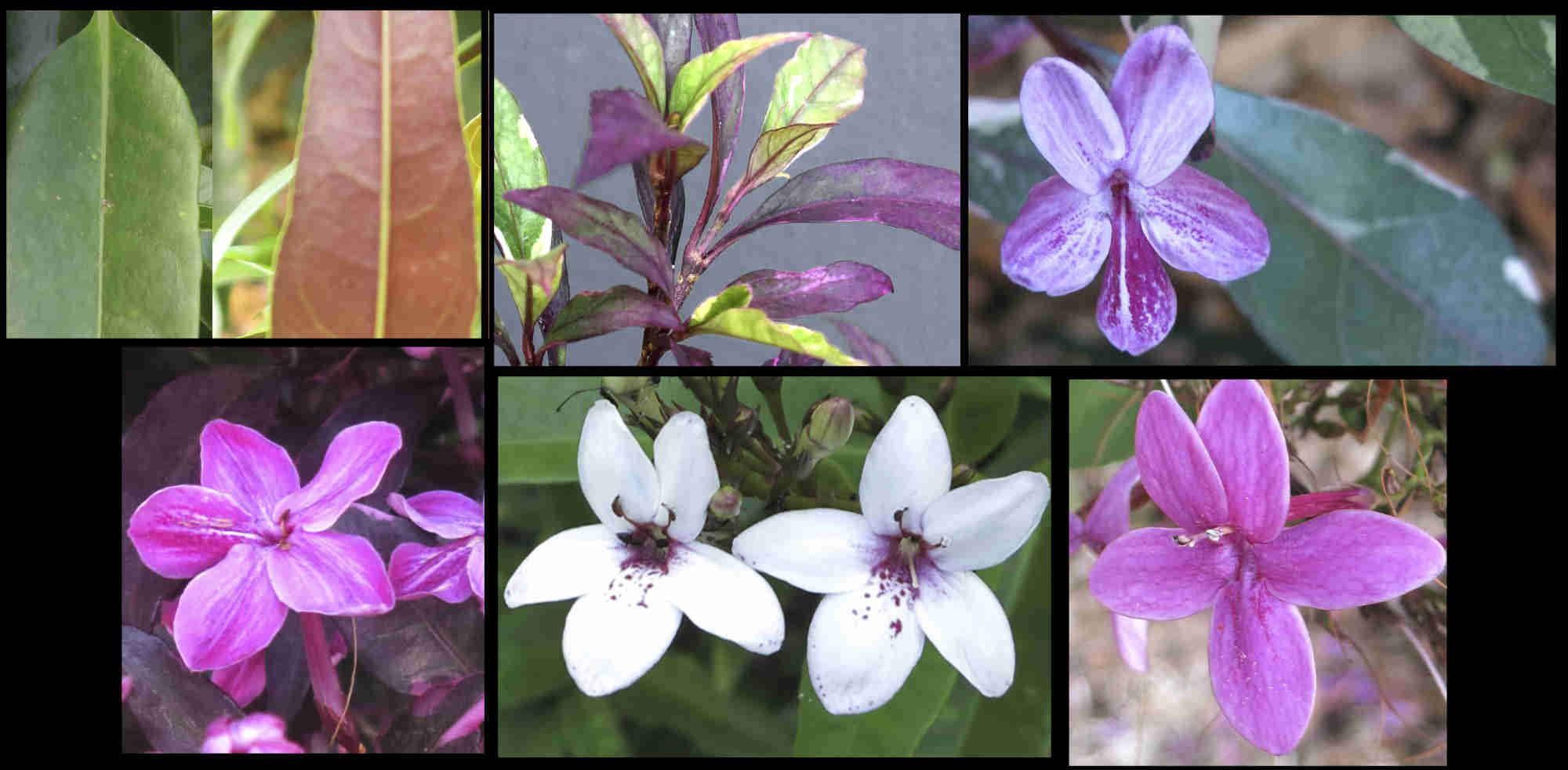
Oppositely arranged leaves are often in 4 ranks (decussate).
Most are on a petiole but some are directly attached.
Blades are a wide or narrow ovate, elliptic or lance shape.
Edges are almost always entire and may be wavy.
Cystoliths (small elevated collections of calcium) are usually visible on both sides.
Inflorescences are terminal or axillary solitary or clustered flowers.
They are variously arranged in spikes or panicles (branched).
There is a small bract at the base of peduncle/s and paired bracteoles on the pedicels.
The calyx consists of a short tube and (4) 5 long narrow lobes.
Lobes, of the same or different lengths may have some hairs.
The corolla tube has a narrow base that widens slightly near the top.
The 5 widely spreading lobes are separate or in 2 lips.
The 2 posterior (upper) lobes may be slightly smaller than the 3 anterior (lower) ones.
White, pink, mauve, purple or bluish petals often have darker spots on one or more lobes.
The 2 stamens are attached near the top of the corolla tube.
Anthers, with 2 equal or unequal pollen sacs lie in or just outside the tube.
There may be 2 infertile staminodes in the top of the tube.
The 2 locules of the superior ovary each have 2 ovules.
The style, with a bi-lobed stigma lies in the corolla tube or extends past it.
The roughly round or angled capsular fruit are on a long stalk.
Seeds are thrown out by a retinaculum.
J.F.

