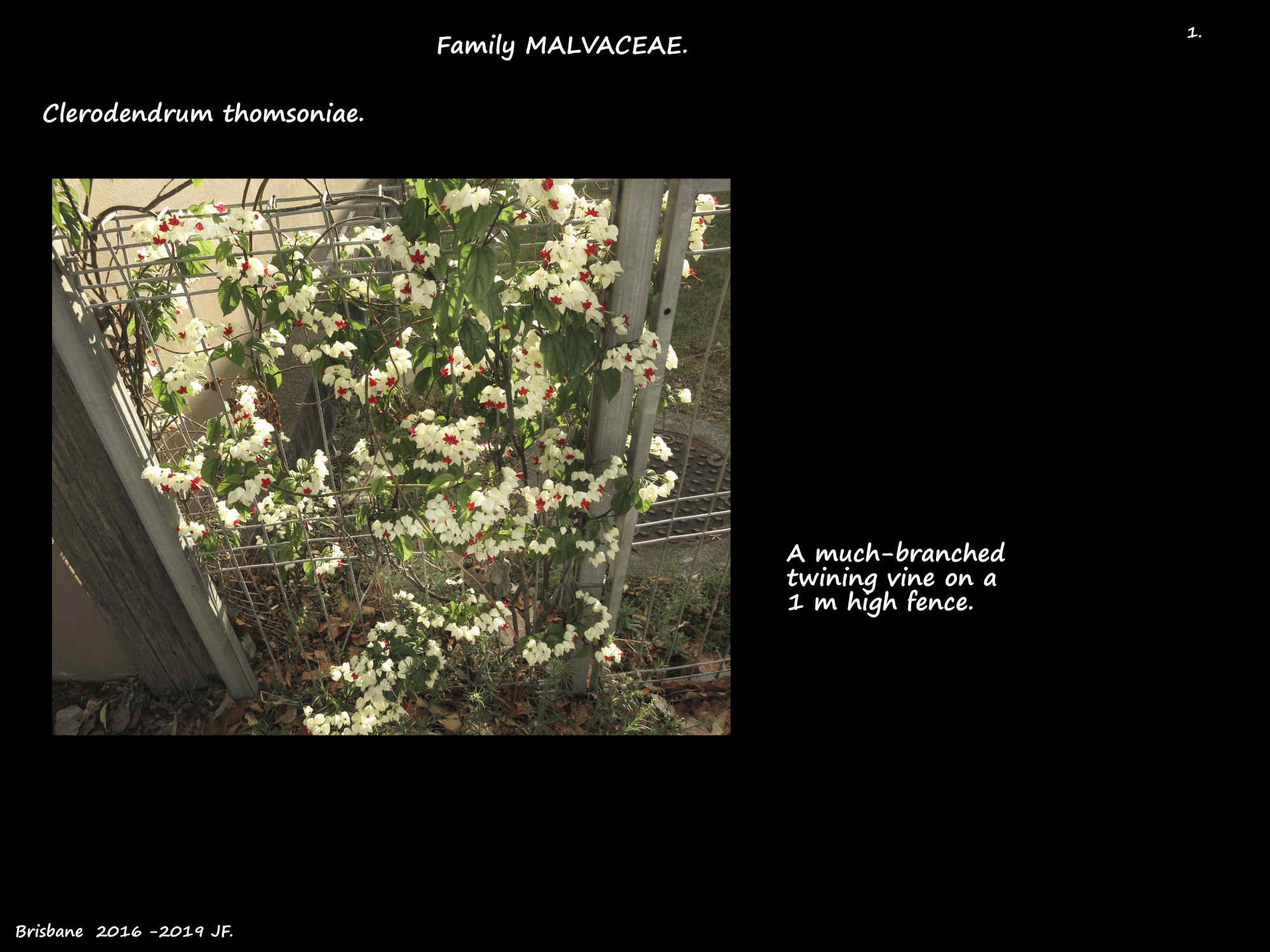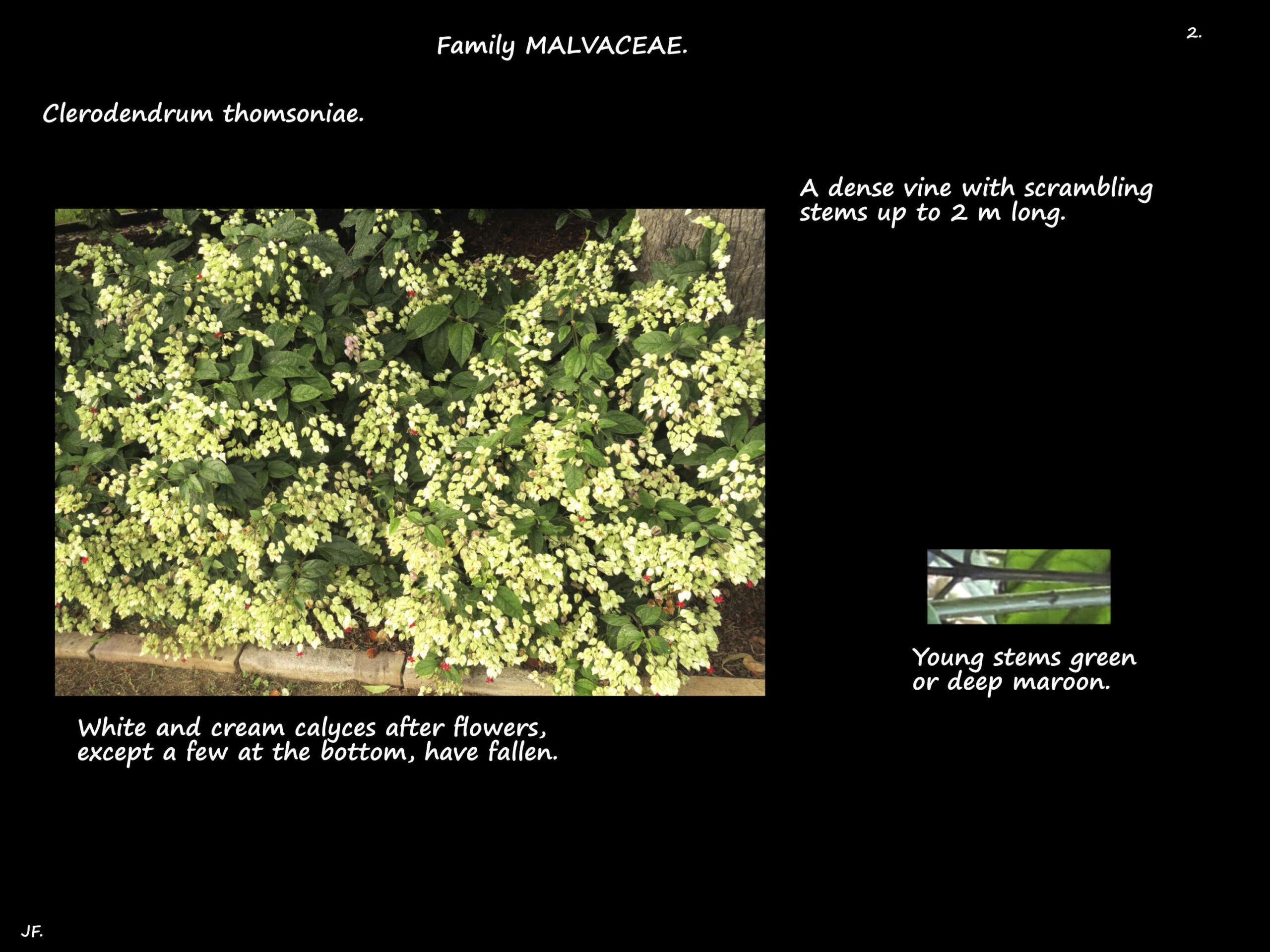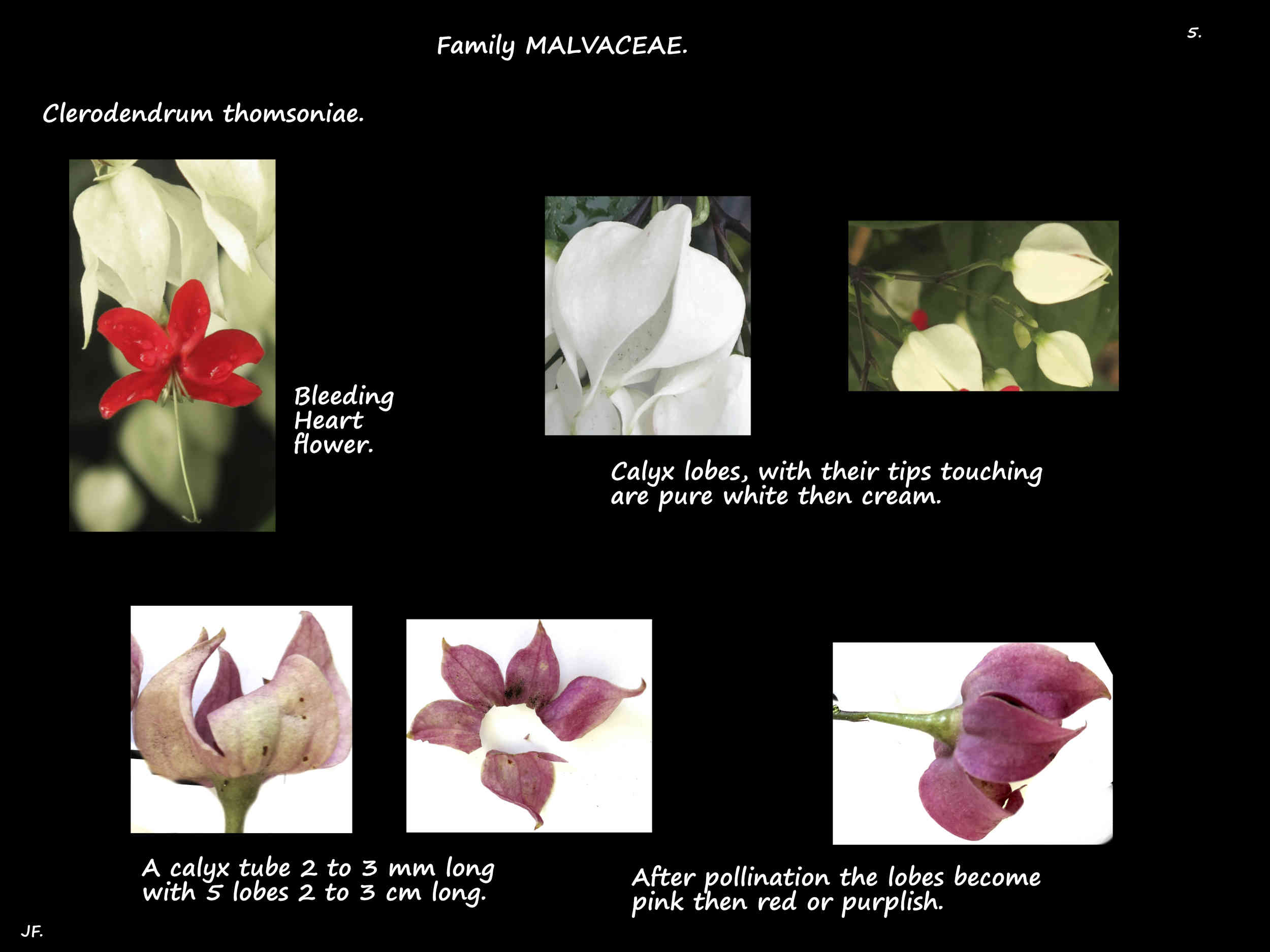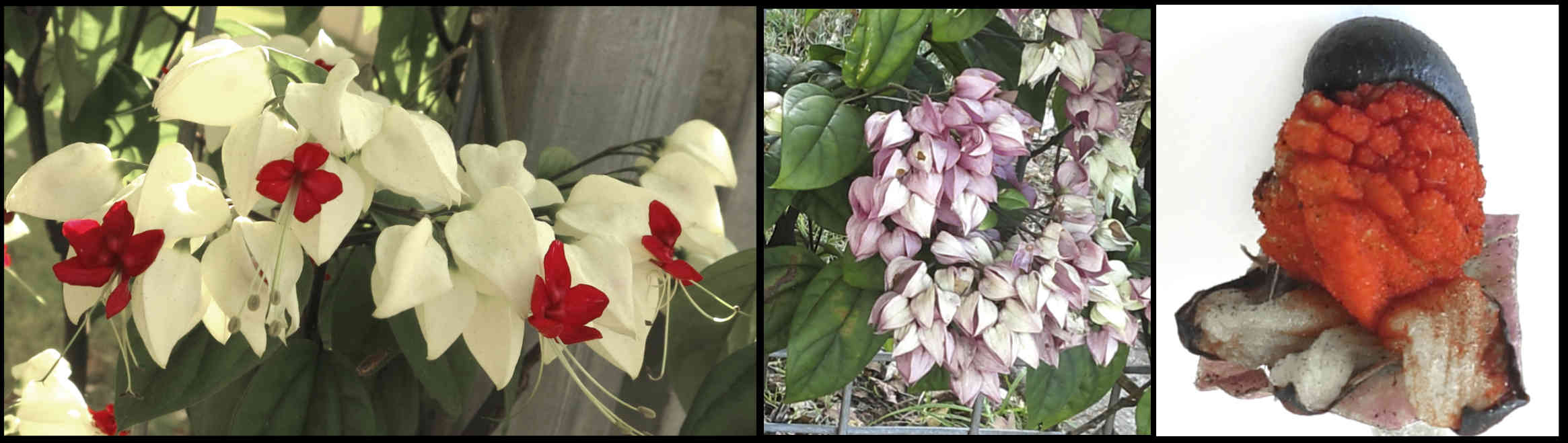
The Bleeding Heart Vine, from tropical W. Africa is cultivated in Queensland.
Synonyms are Clerodendrum thomsoniae var. balfourii, Clerodendrum balfourii and Clerodendrum delectum.
Rarely seen as a low shrub 1 to 2 m high they are usually a vine.
They climb by scrambling over other vegetation or by twining.
Young slender 4 to slightly 5-angled stems are green or purplish.
Old grey woody stems can be up to around 8 m long.
Leaf scars, often large, are round and flat and there are lenticels (small nodules).
Young stems have tiny fine hairs.
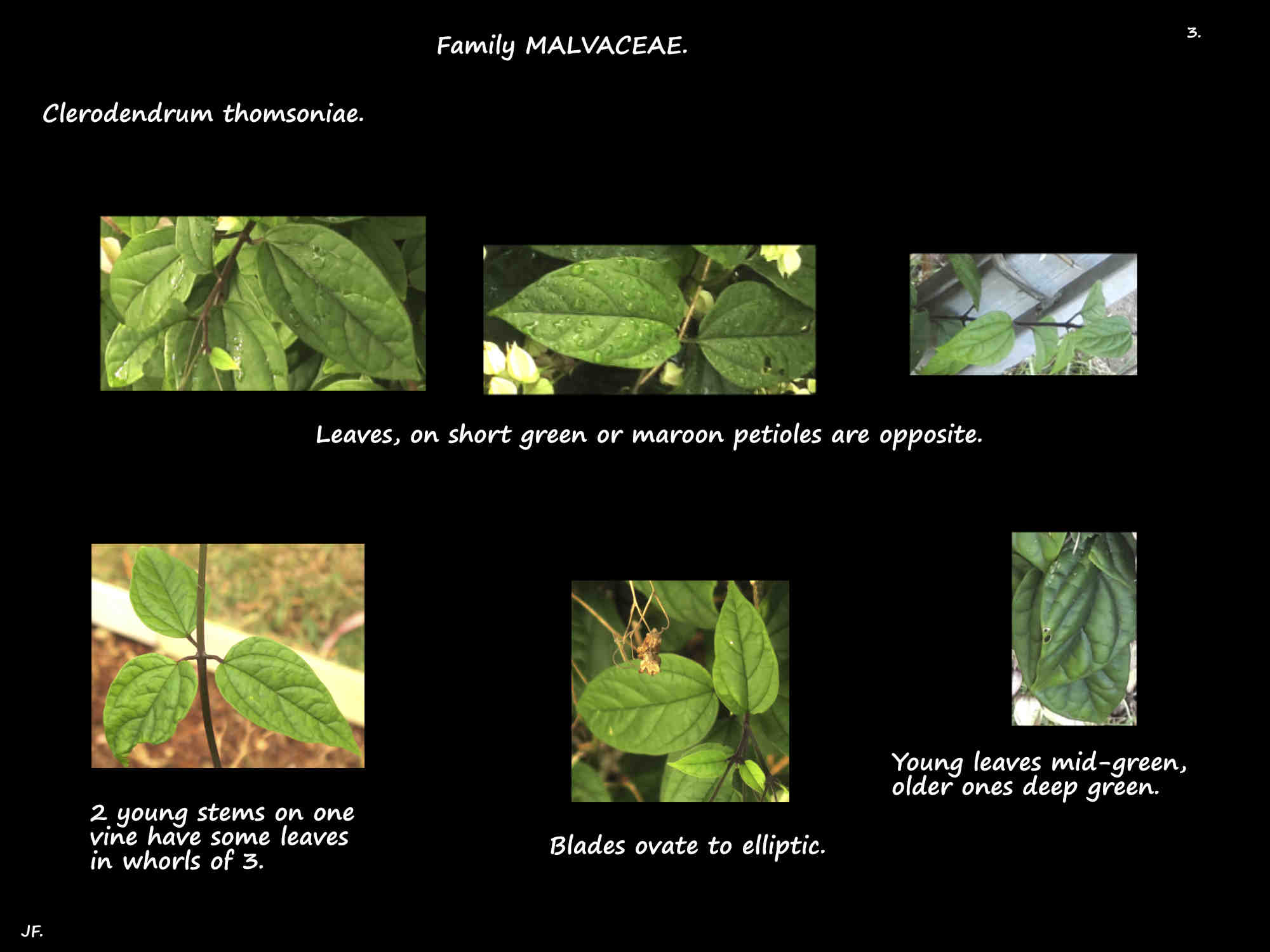
Simple, opposite evergreen leaves have petioles up to 3.5 cm long.
Blades are up to around 18 cm long and 8 or 10 cm wide.
They are ovate to elliptic with a short pointed tip and a round or wedge-shaped base.
The edge, with tiny hairs (cilia) is smooth or slightly lobed.
Both surfaces may have no hairs or only some on the veins on the lower surface.
Leaves have a dark green upper surface and are paler below.
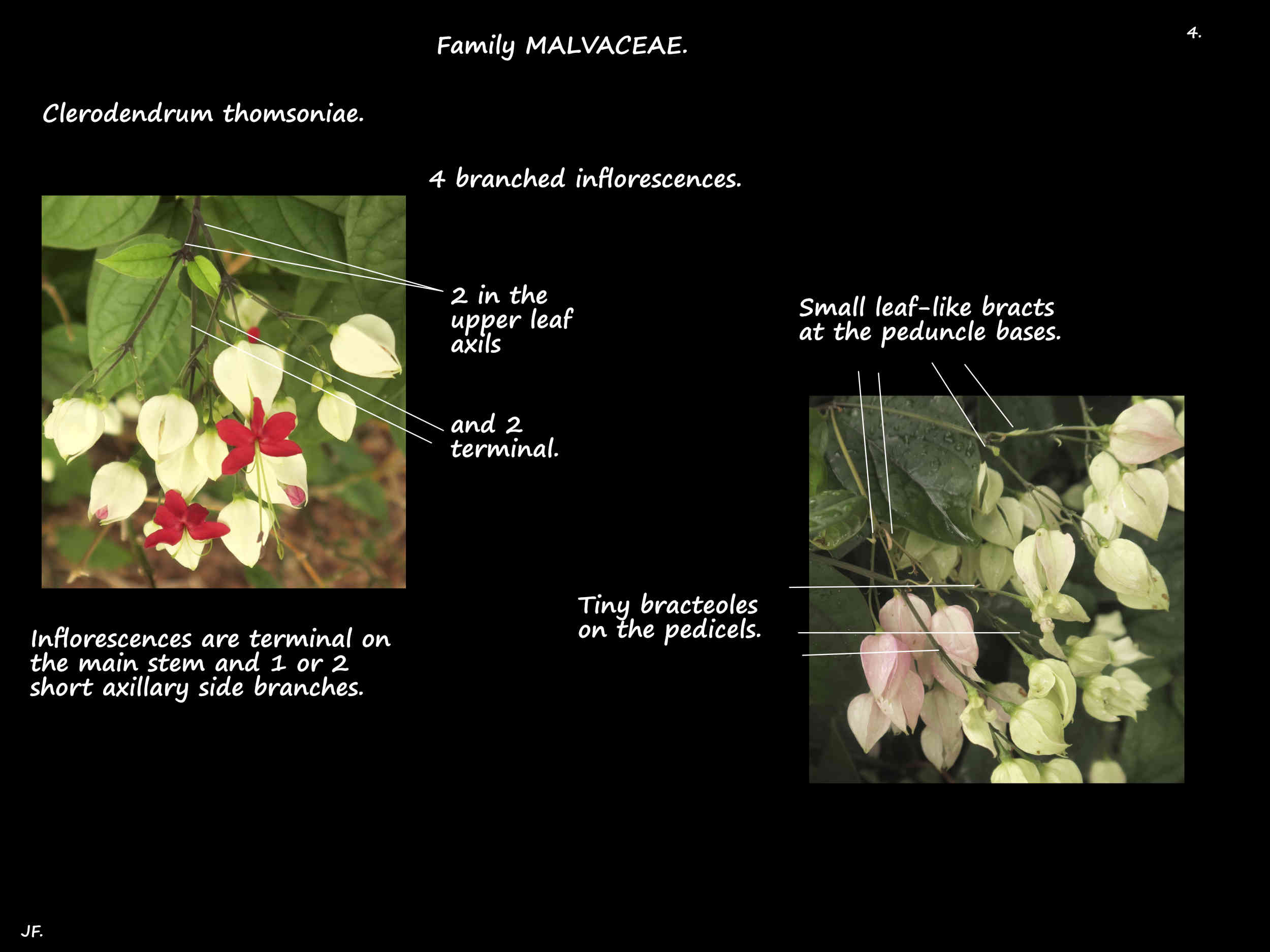
Partly pendulous inflorescences are terminal on the main stem and on short axillary side branches near the stem ends.
The branched clusters are up to 10 (15) cm long and 5 to 10 or 15 cm wide.
The primary peduncle, up to around 6 cm long has a narrow bract 1 to 2 cm long.
Bracts may be slightly leaf-like but most are not.
Each inflorescence branch has a few flowers on a pedicel with bracteoles.
Pedicels on the lower flowers are longer than those on the upper ones forming a roughly flat-topped corymb.
All these parts have tiny hairs.
The calyx tube, a few mms long has 5 lobes 2 to 3 cm long and 1 cm wide.
The wide ovate lobes have short pointed tips that touch but are not joined.
There are tiny hairs on the calyx tube and the edges of the lobes.
Initially pure white the lobes change to pale cream then yellow then pink or purplish-red.
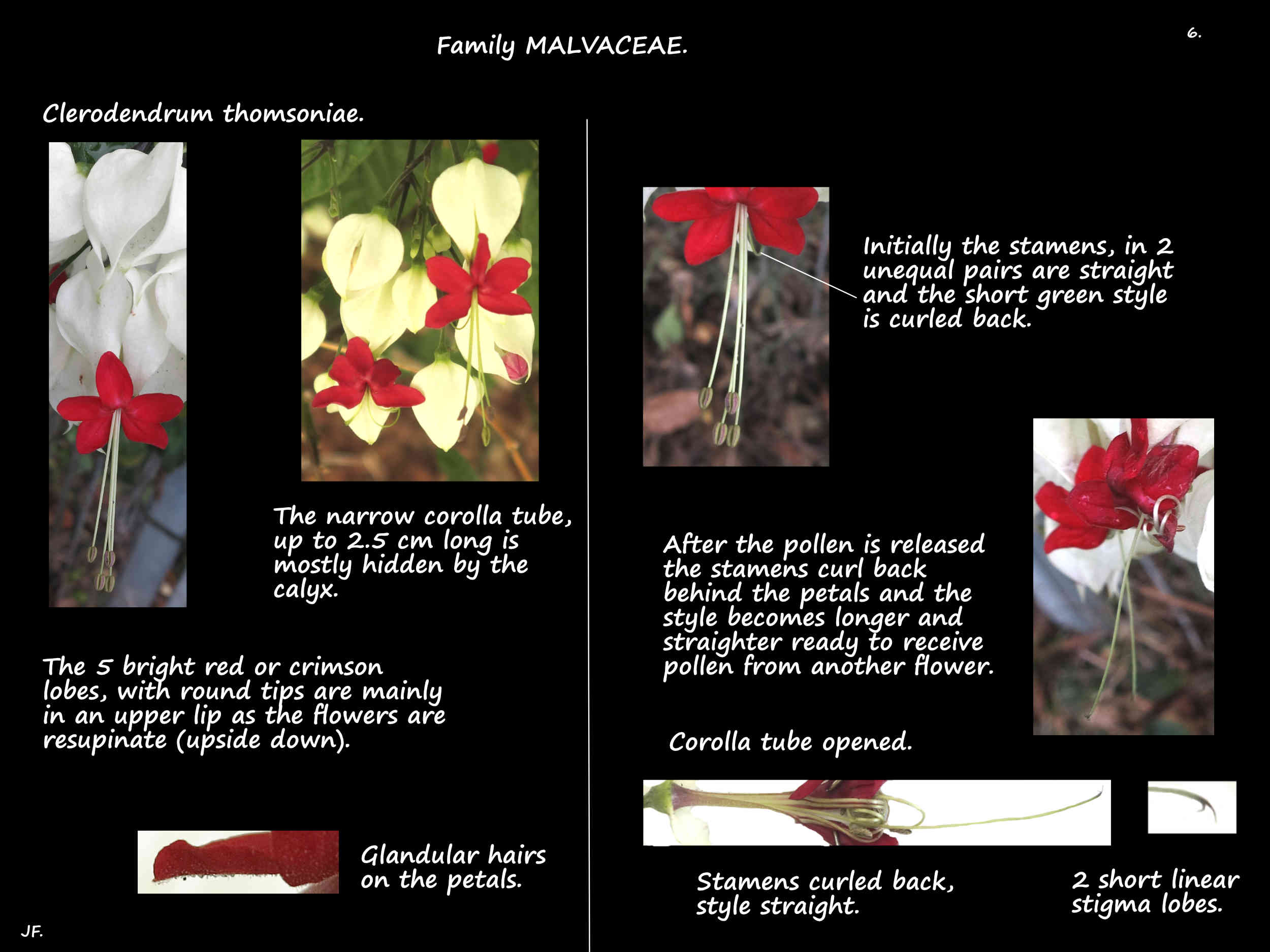
The narrow corolla tube, around 2.5 cm long is, or is almost hidden by the calyx.
The 5 lobes spread sideways or curl back.
Up to 1 cm long they are oblong with a rounded tip.
The corolla has glandular hairs on the outer surface and tiny hairs inside.
It is bright to dark red or crimson.
The 4 stamens, with green filaments are in 2 pairs of slightly unequal length.
Initially almost straight they extend up to 2 cm past the corolla.
After the pollen is shed they curl up behind the petal lobes.
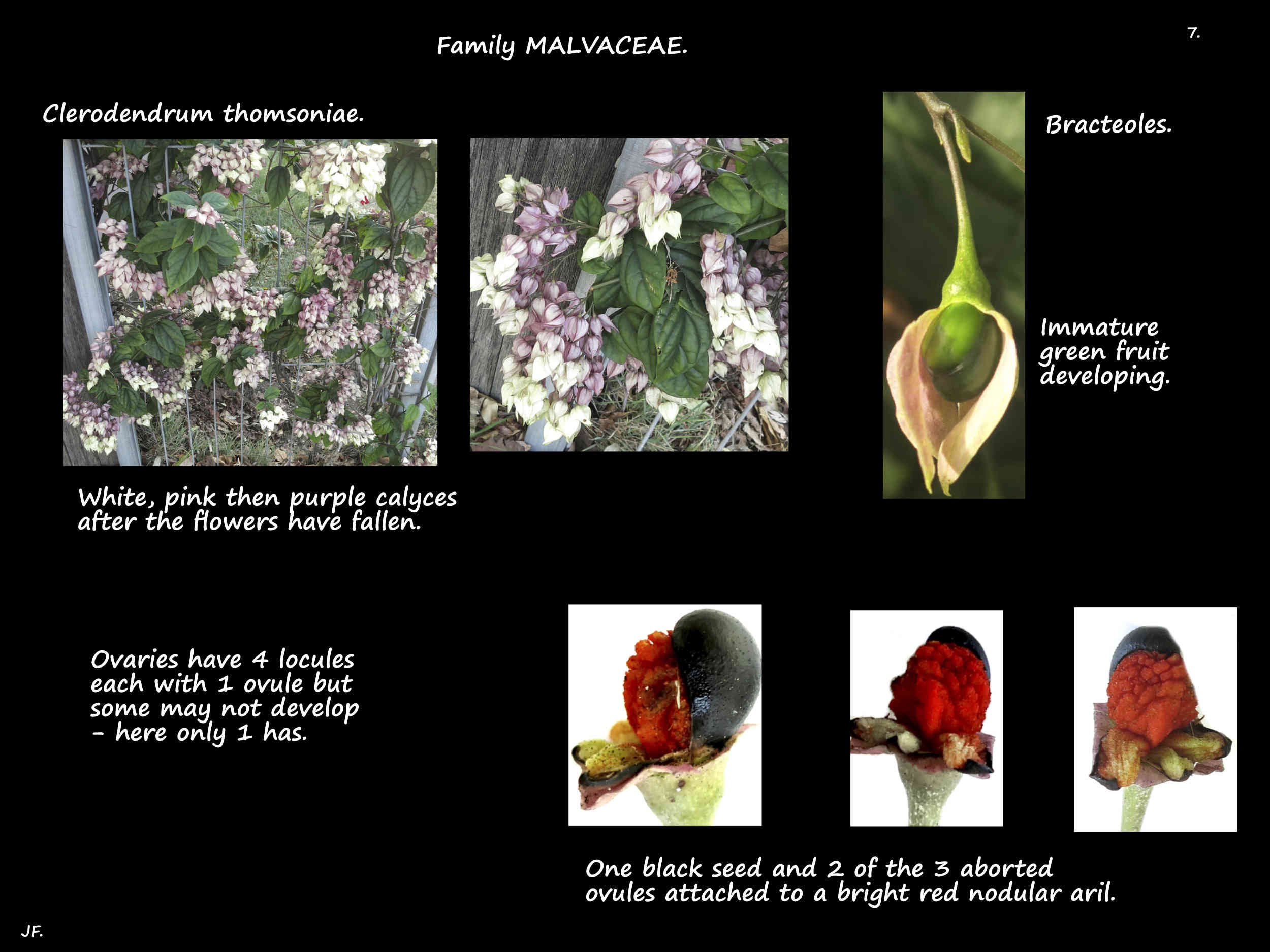
The ovary has 4 locules each with 1 ovule.
The style, with 2 short stigma lobes is around the same length as the stamens.
Fruit are a shiny roughly spherical, 1 to 1.5 cm drupe-like capsule.
They are surrounded by the now pink, red or purplish calyx.
When mature the green then black or reddish-black capsule splits into its 4 mericarps each with 1 seed.
The 4 oblong seeds have a lobular bright red aril (a fleshy swelling where they are attached).
J.F.