Family Myrtaceae > Subfamily Myrtoideae > Tribe Metrosidereae.
Metrosideros are separated from the other Myrtaceae genera by having opposite leaves, almost always red stamens and dry capsules.
Plants of the World Online (Kew) lists 58 species and Mabberley has over 60.
New Caledonia has 21 species, New Zealand 12 and New Guinea 7.
Australia has 2 naturalised species.
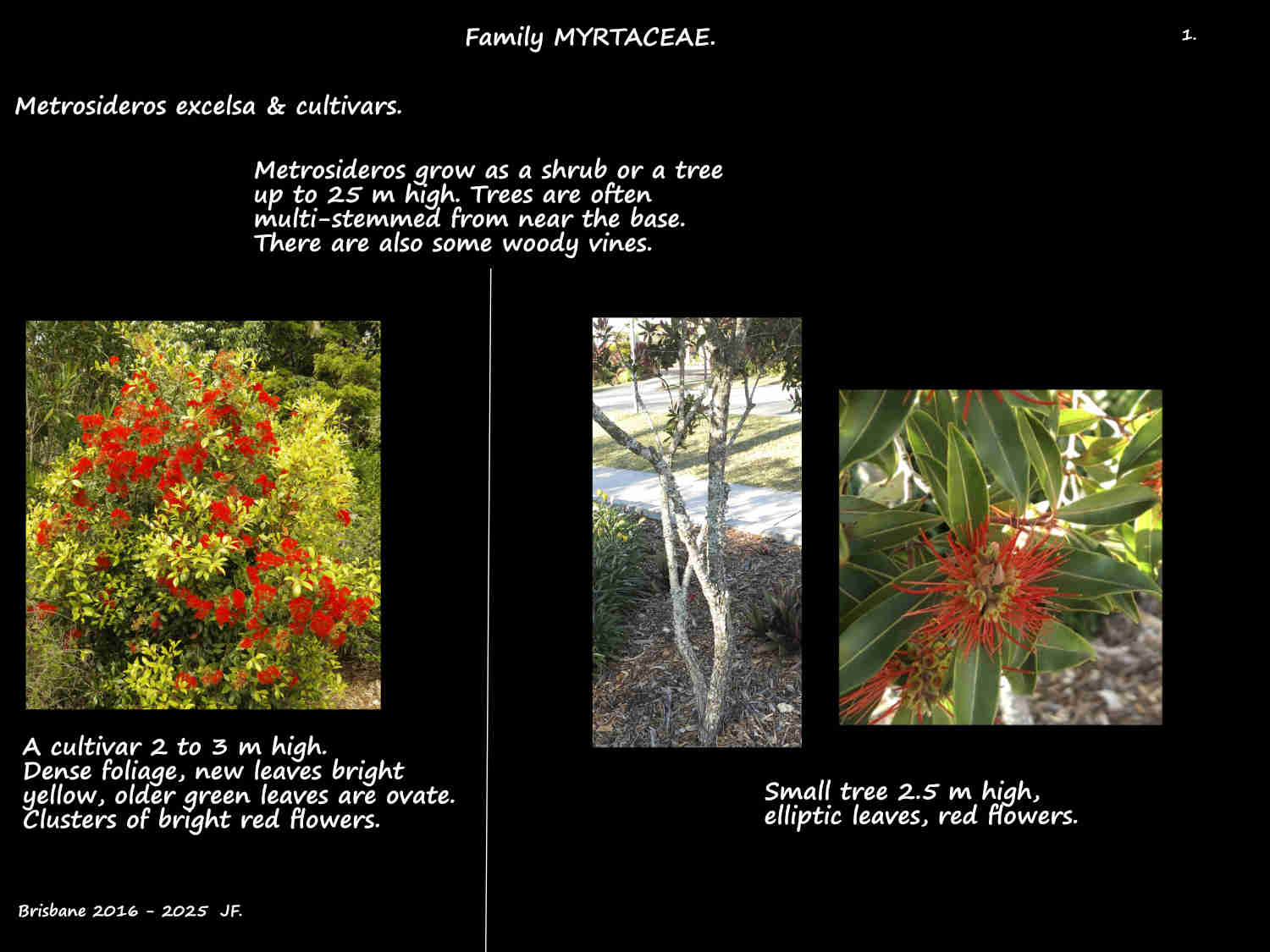
A number of introduced species, and cultivars are commonly seen in gardens in Brisbane.
Species available include M. carminea, M. polymorpha, M. kermadecensis and M. umbellata.
Metrosideros excelsa is available and most of the around 60 cultivars have it as a parent.
There are some multi-stemmed shrubs and small trees up to 8 or 10 m high.
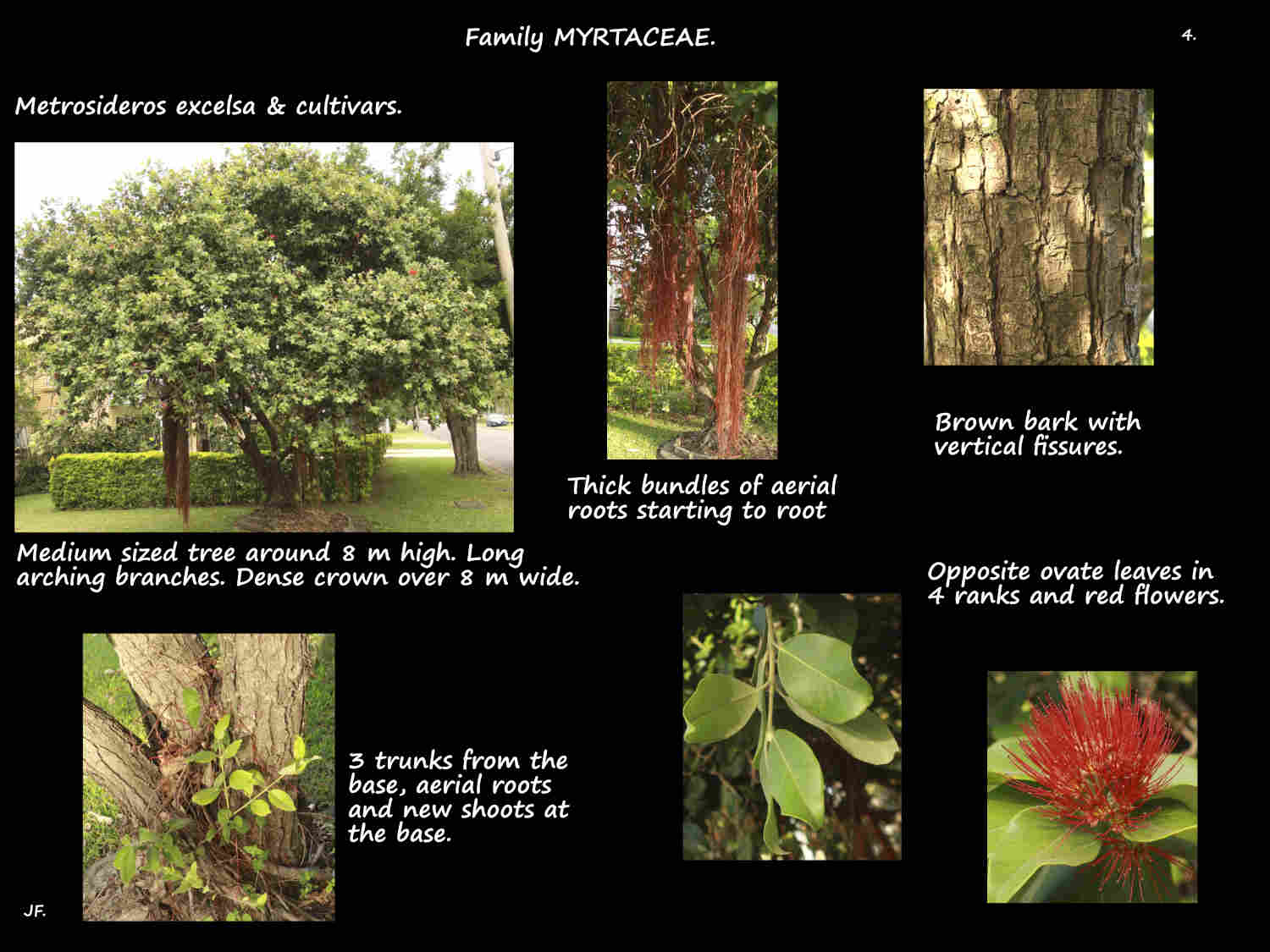
Larger trees are up to 20 or 25 m high and there are a few woody vines (lianes).
Large trees can have a trunk diameter up to 2 m.
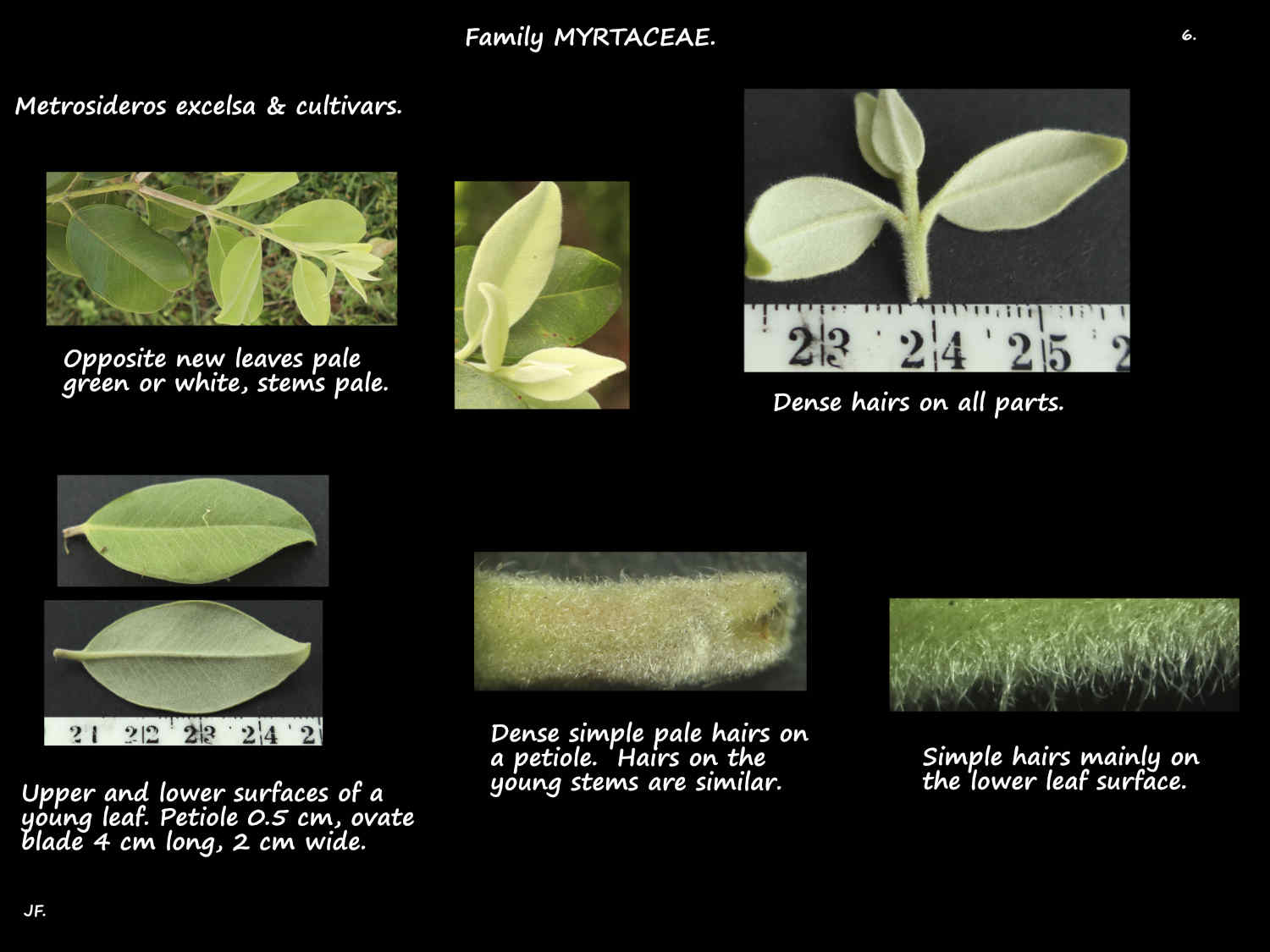
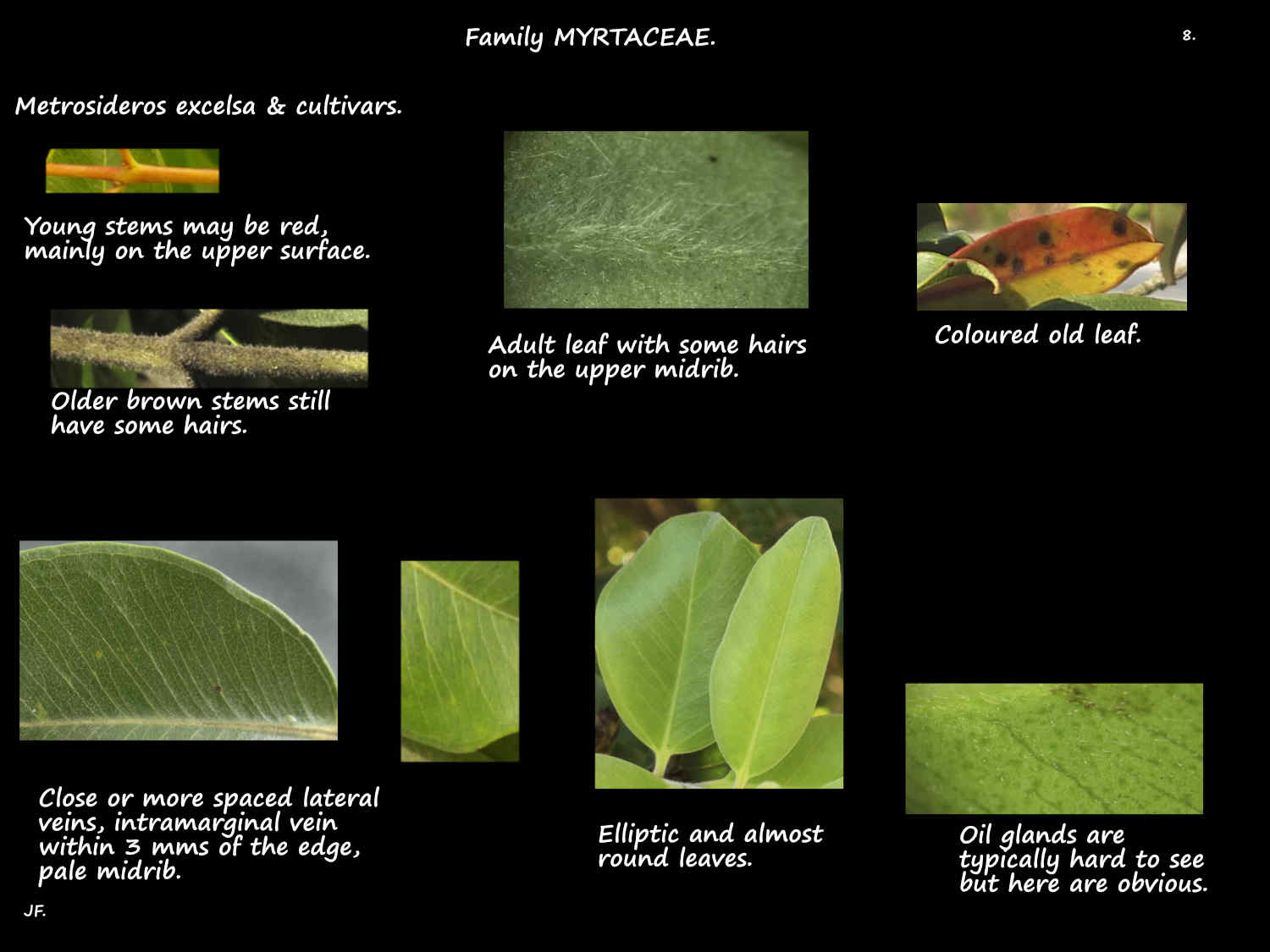
The bark is thick and new stems, sometimes angled have some white hairs.
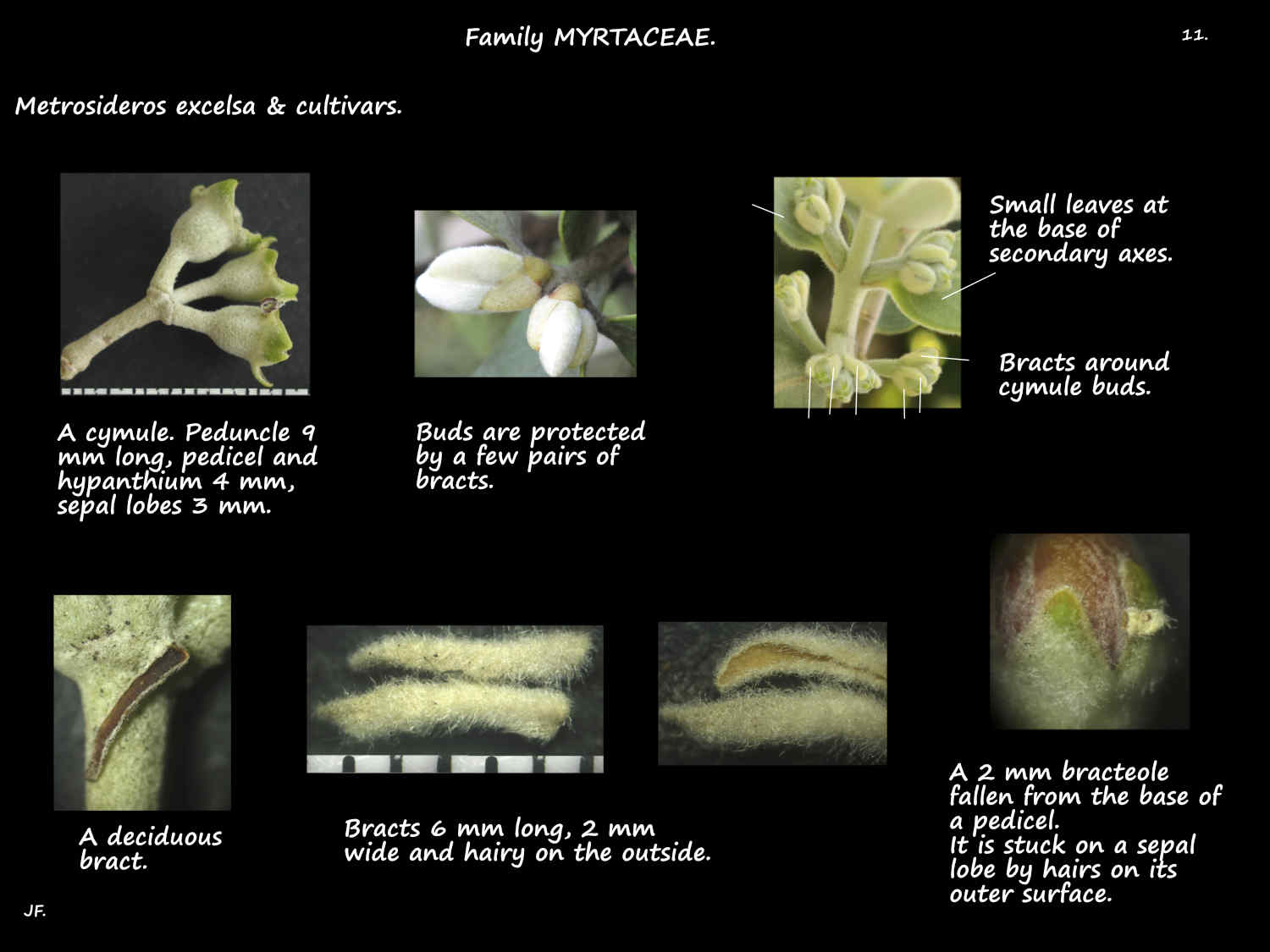
Vegetative buds may have protective scales up to 1.5 cm long.
Some species have red adventitious aerial roots that grow from the trunk or large branches.
These hang down in thick bundles that can root then merge into new trunks.
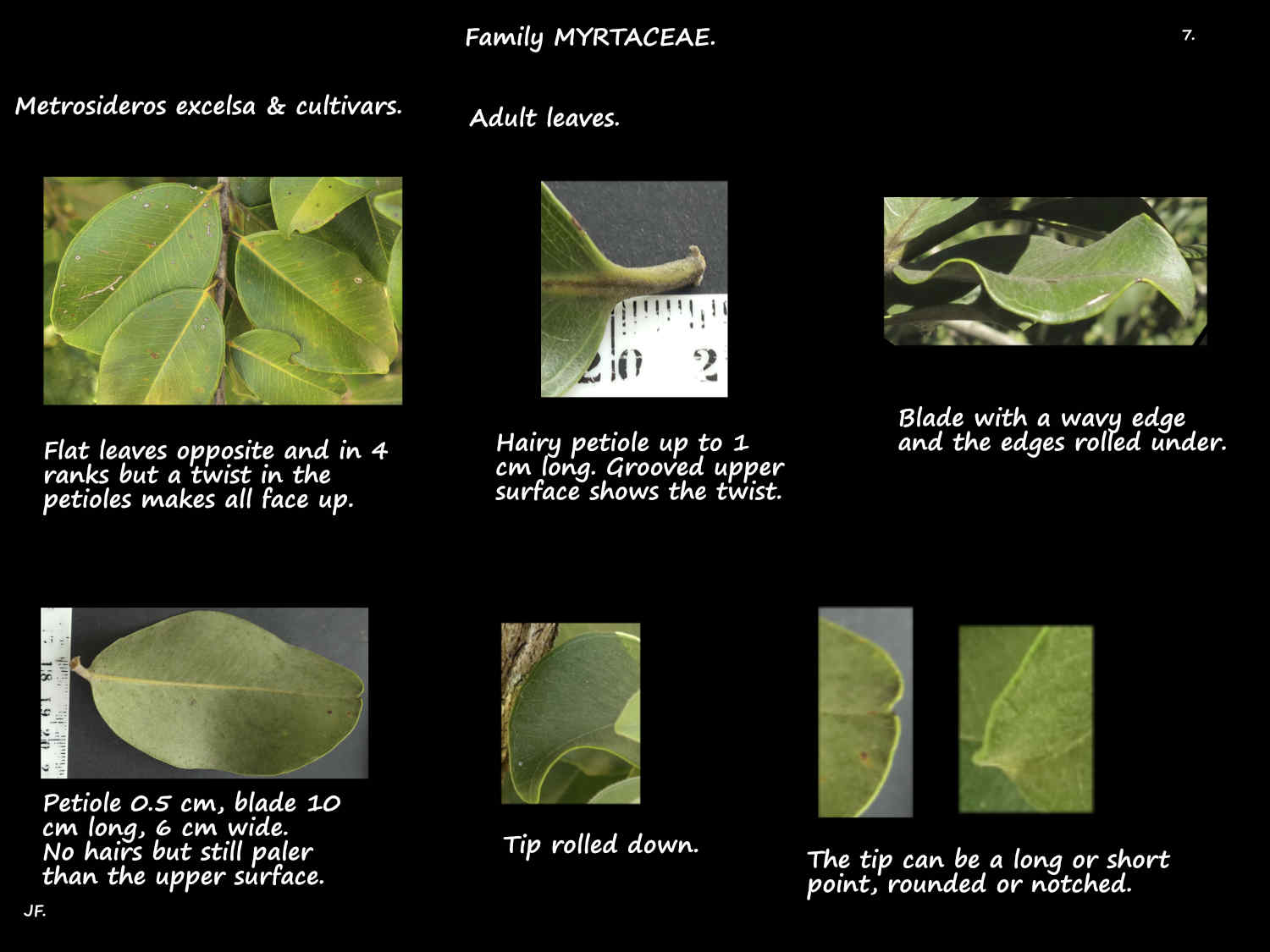
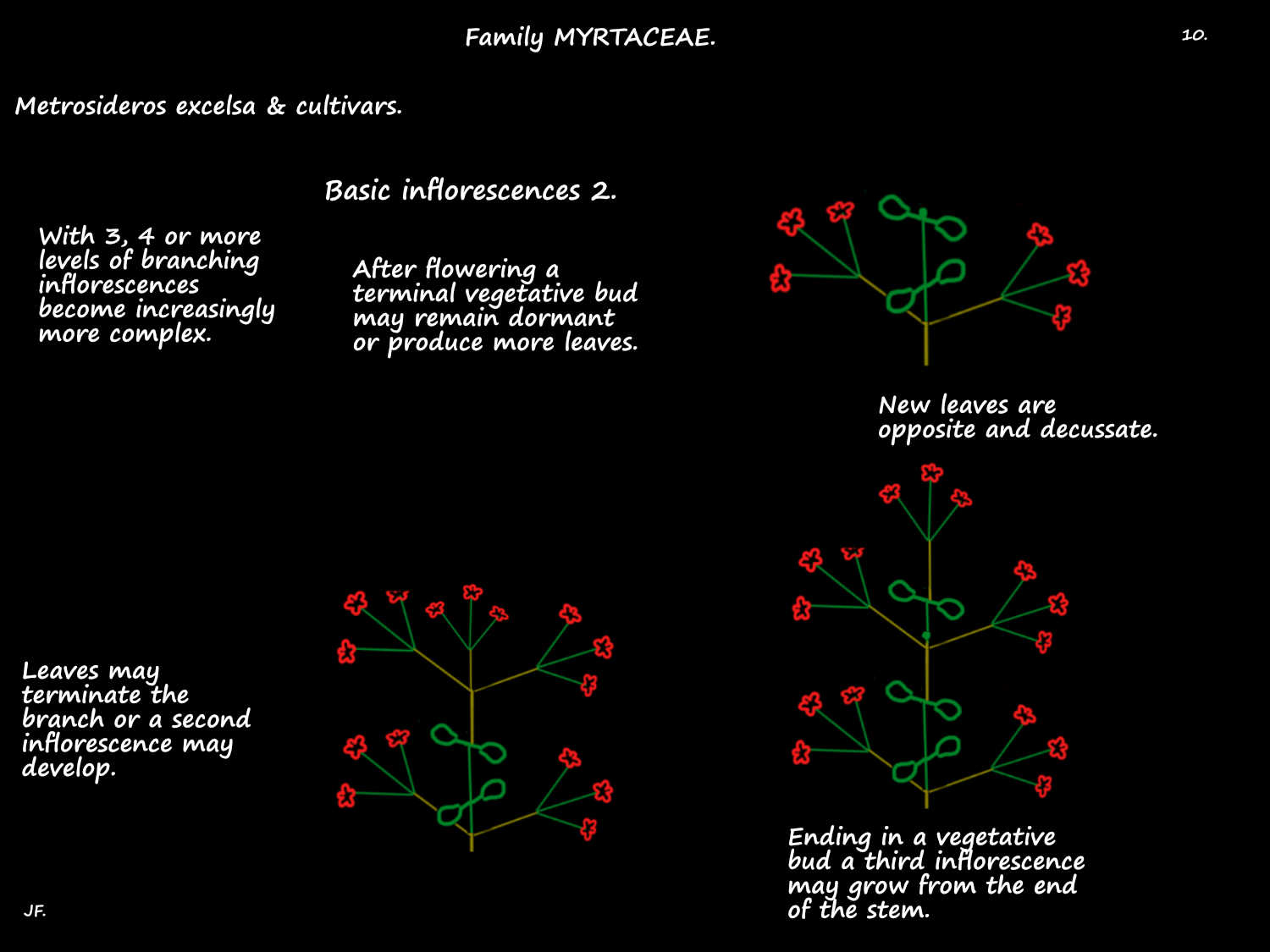
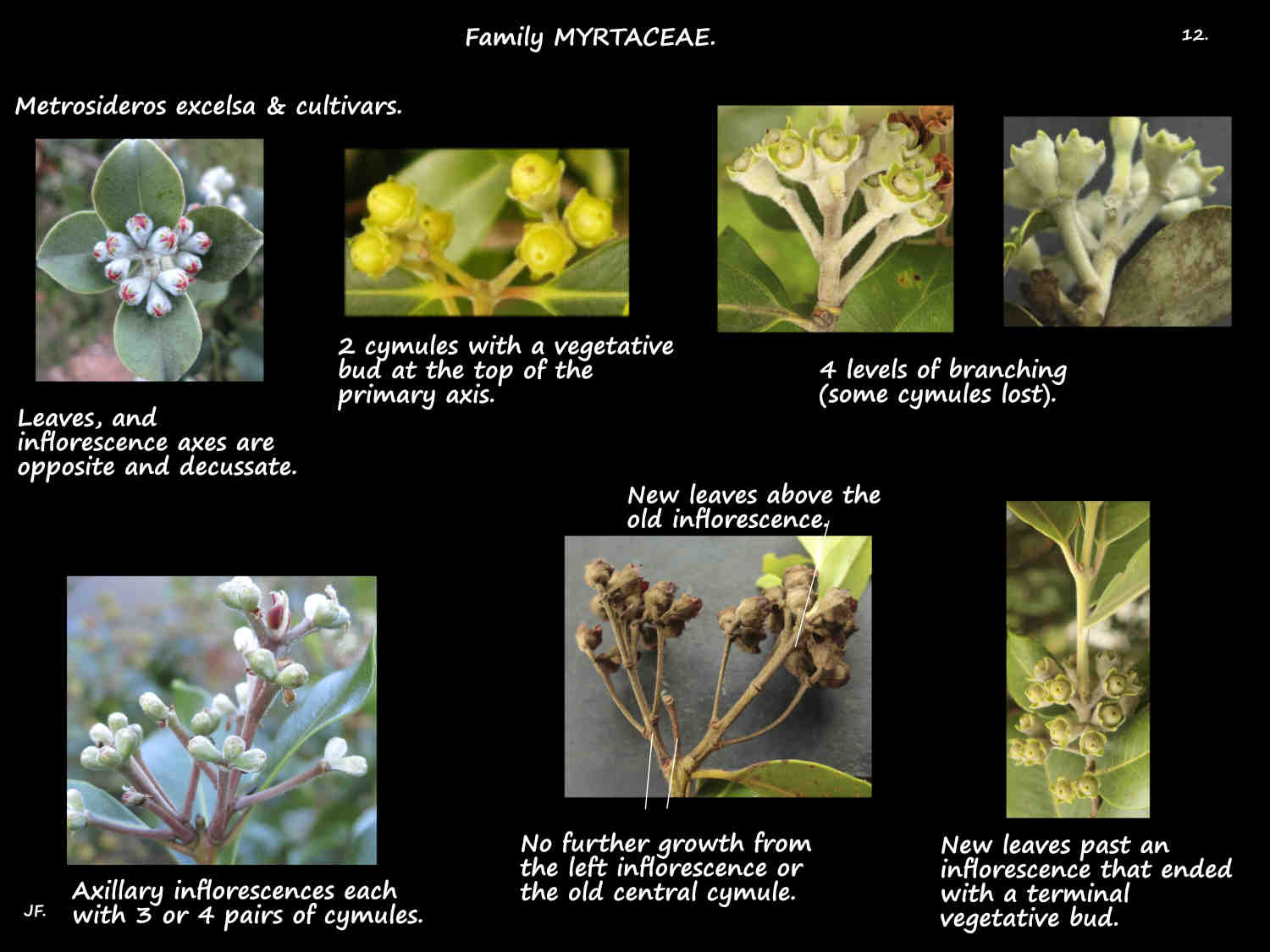
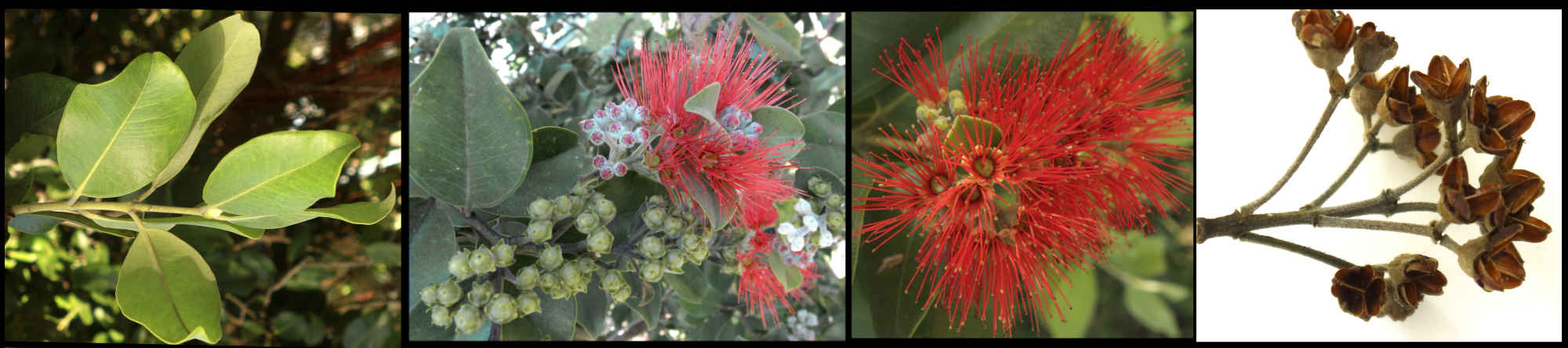
The simple leaves, on a petiole up to 1 cm long are opposite and in 4 ranks (decussate).
Leaves are elliptic, ovate to almost round or occasionally lance-shaped.
They have a pointed, rounded or notched tip and the base is rounded or heart-shaped.
The tough leaves are up to around 10 cm long and 5 cm wide.
The blade edges may be rolled under.
The pinnate veins are up to 3 mm apart and there may be an intramarginal vein.
Fine reticular veins may also be present.
Young leaves may be smooth but often have dense pale hairs especially on the lower surface.
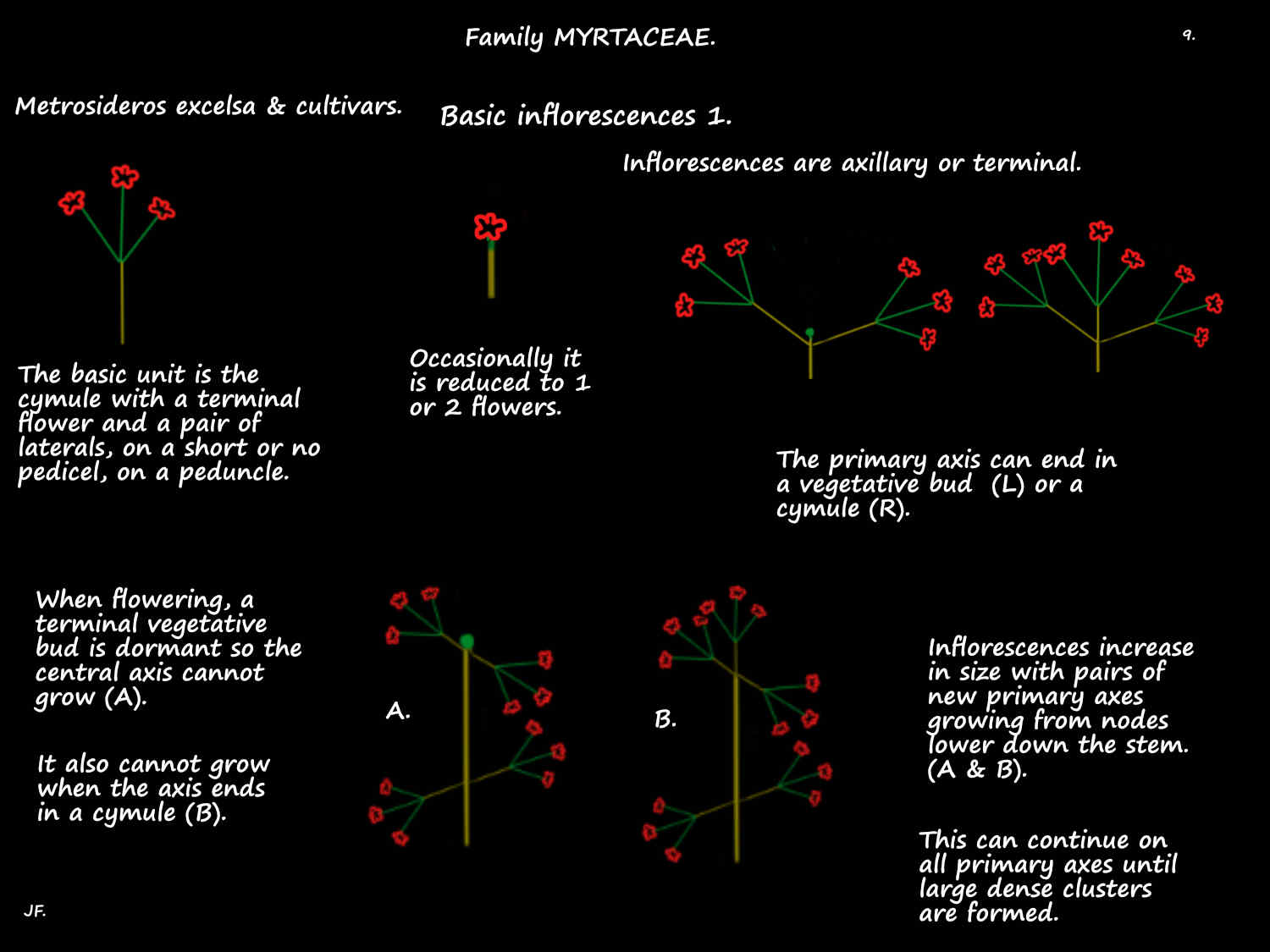
Inflorescences are axillary and/or terminal and occasionally below leaves on woody stems.
On a peduncle the simplest are a single flower.
The basic unit is a cymule which has a central flower with a pair of laterals beside it.
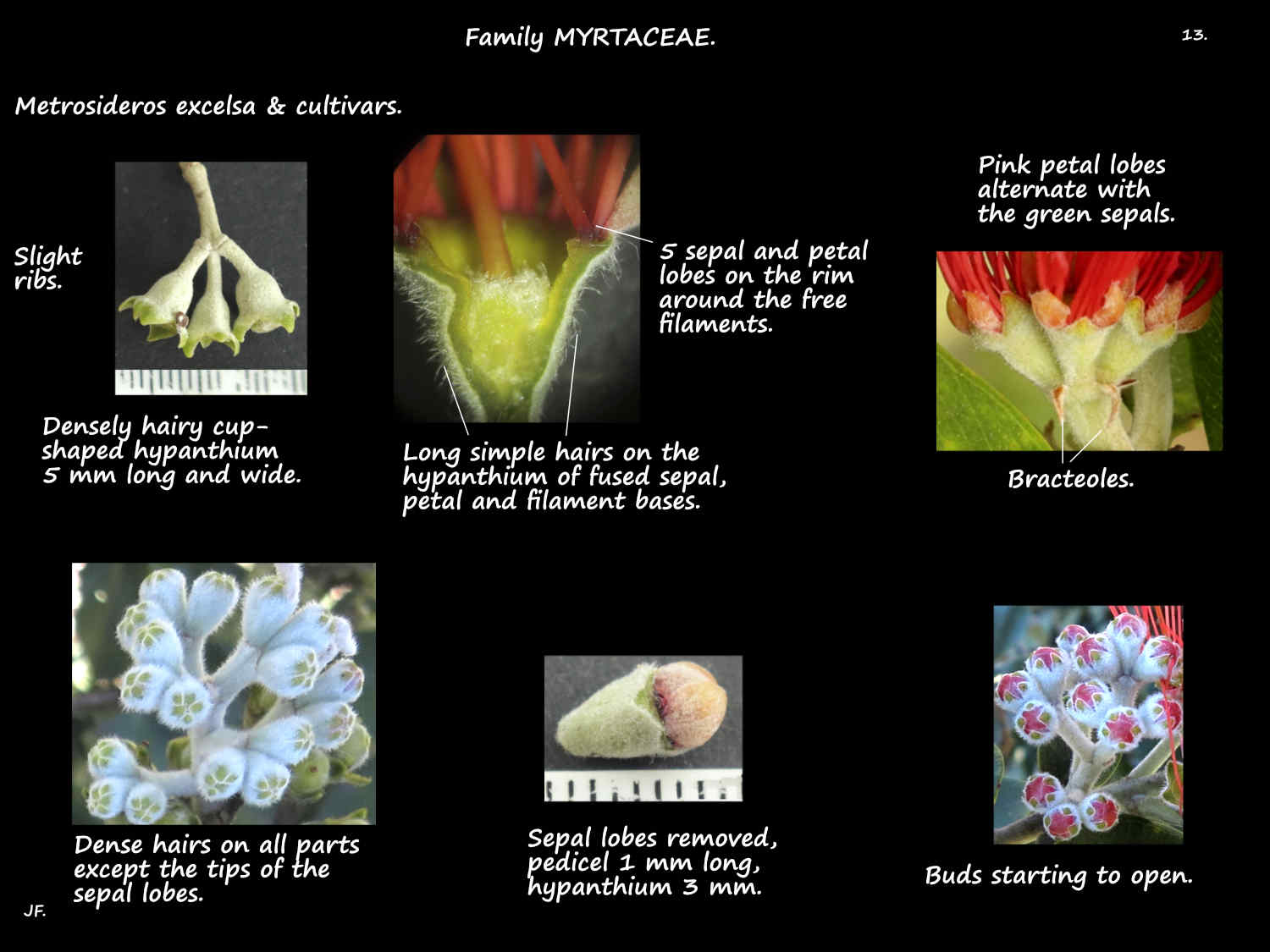
Flowers are on a short or no pedicel.
By adding pairs of cymules in different patterns increasingly complex inflorescences are formed.#
Inflorescences have dense silvery-white hairs on the peduncle and pedicels.
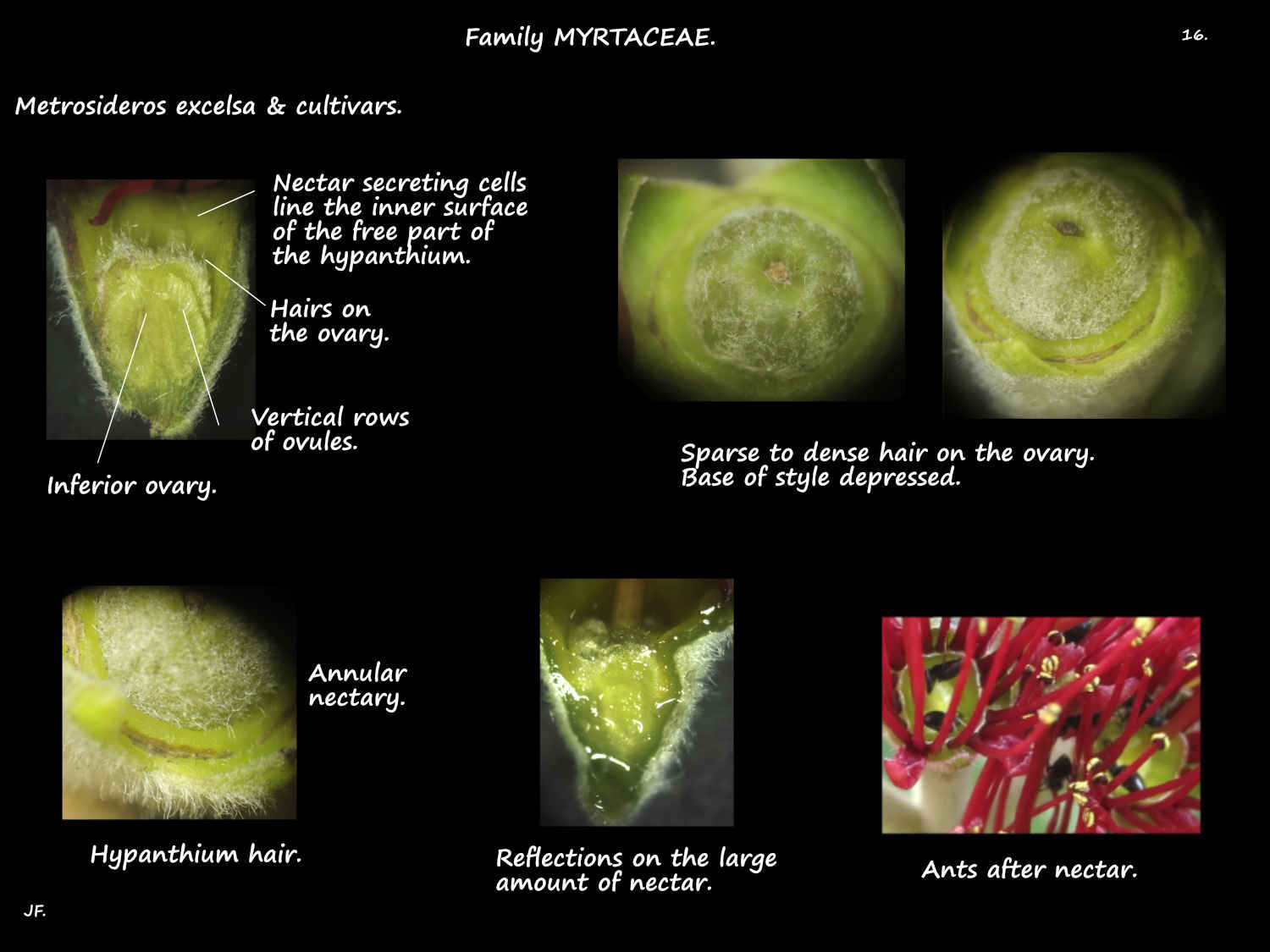
Flowers have a hypanthium, around 5 mm long of fused sepal and petal bases.
Initially it is densely hairy and has 5 ribs but these may disappear.
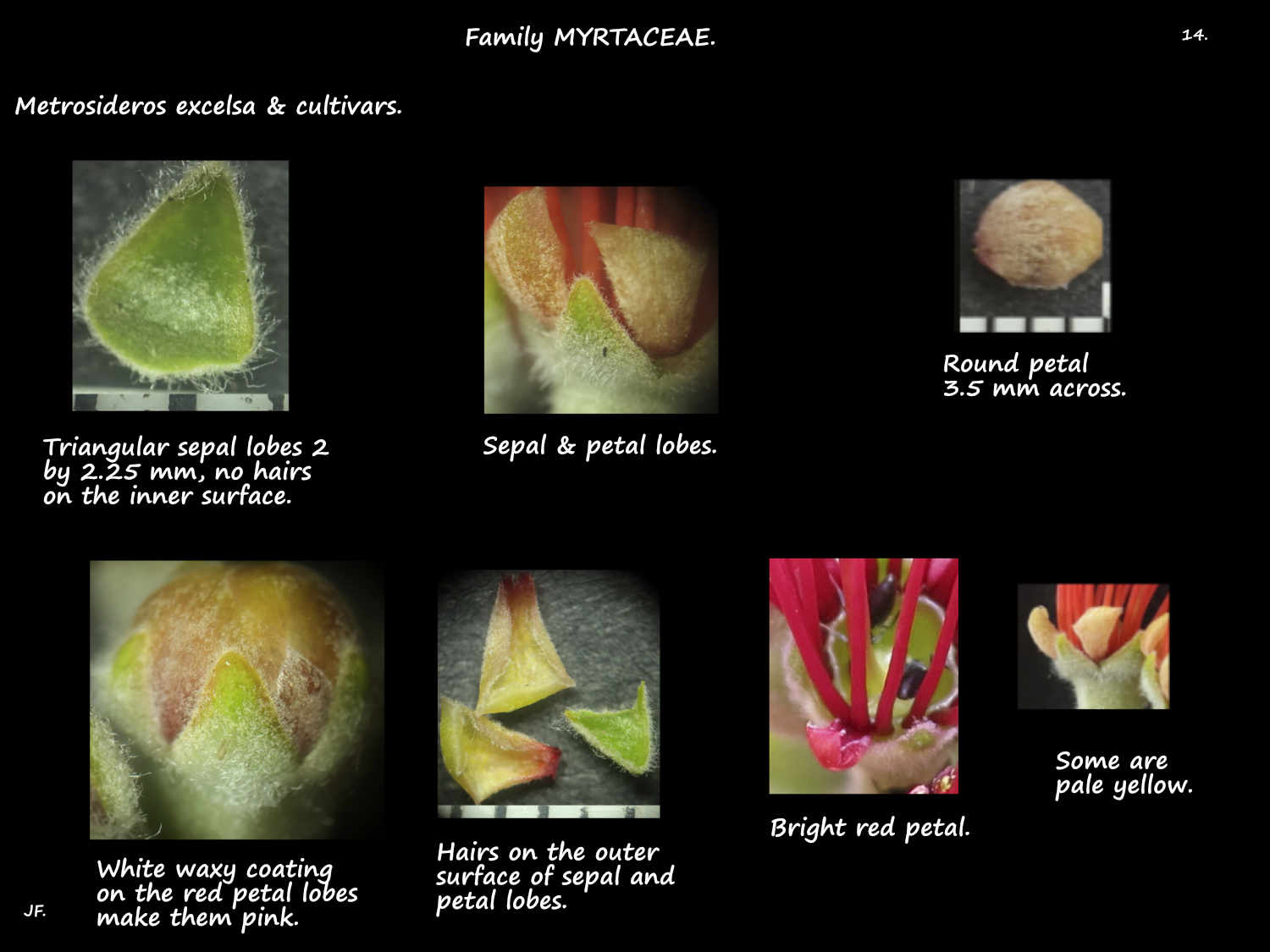
On the rim are 5 free triangular sepal lobes around 3 mm long.
There are long dense hairs on most of the outer surface.
Inside the sepals are 5 free round to obovate petal lobes around 4 mm long.
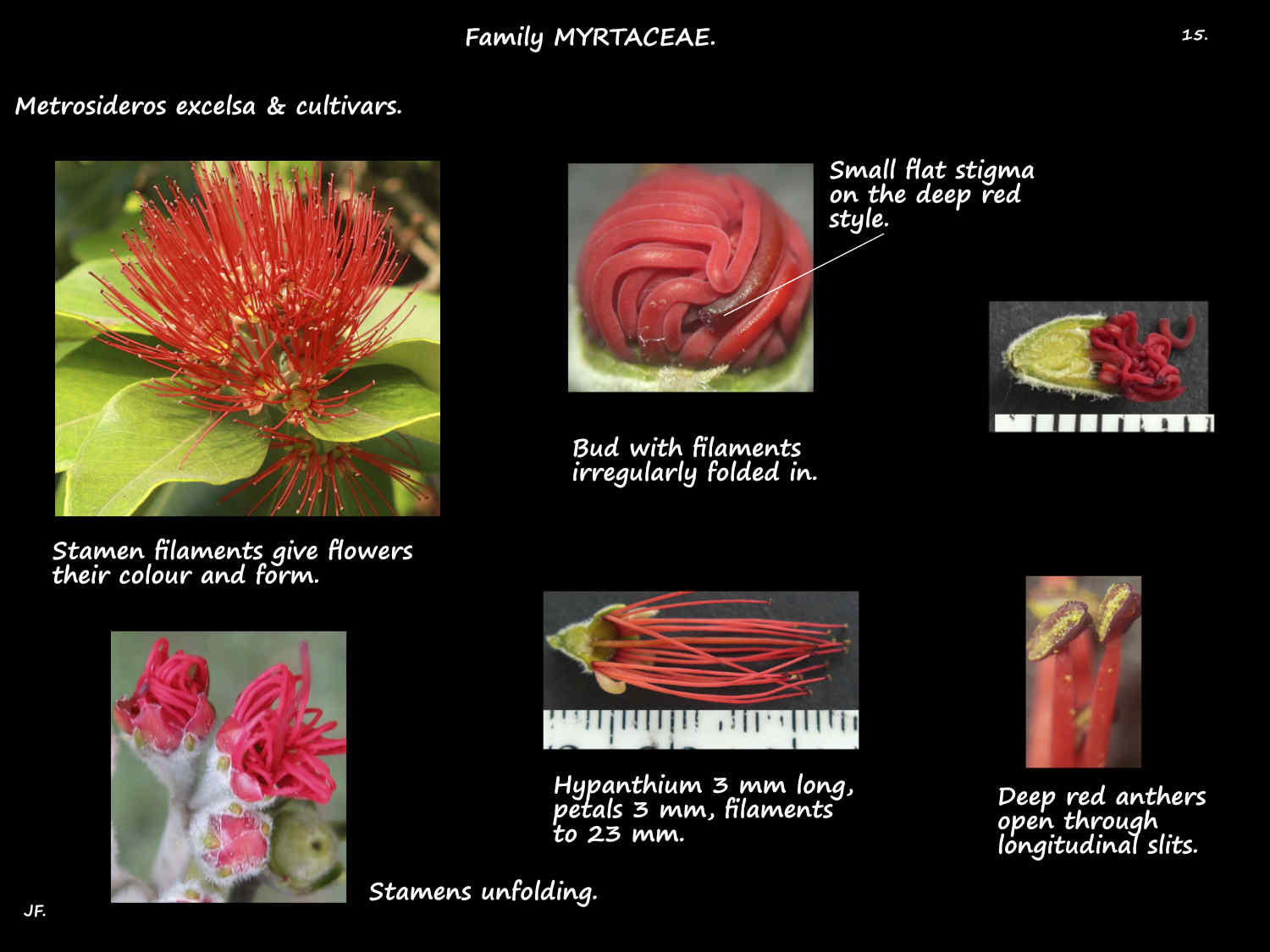
On the hypanthium rim and inside the petals are numerous stamens usually in 1 whorl.
The filaments, around 2 cm long are mostly red and give flowers their colour.
There are forms with pink, yellow, orange or white filaments.
The inferior or part inferior ovary typically has 3 locules.
The numerous ovules have axile placentation.
A single style has a small stigma.
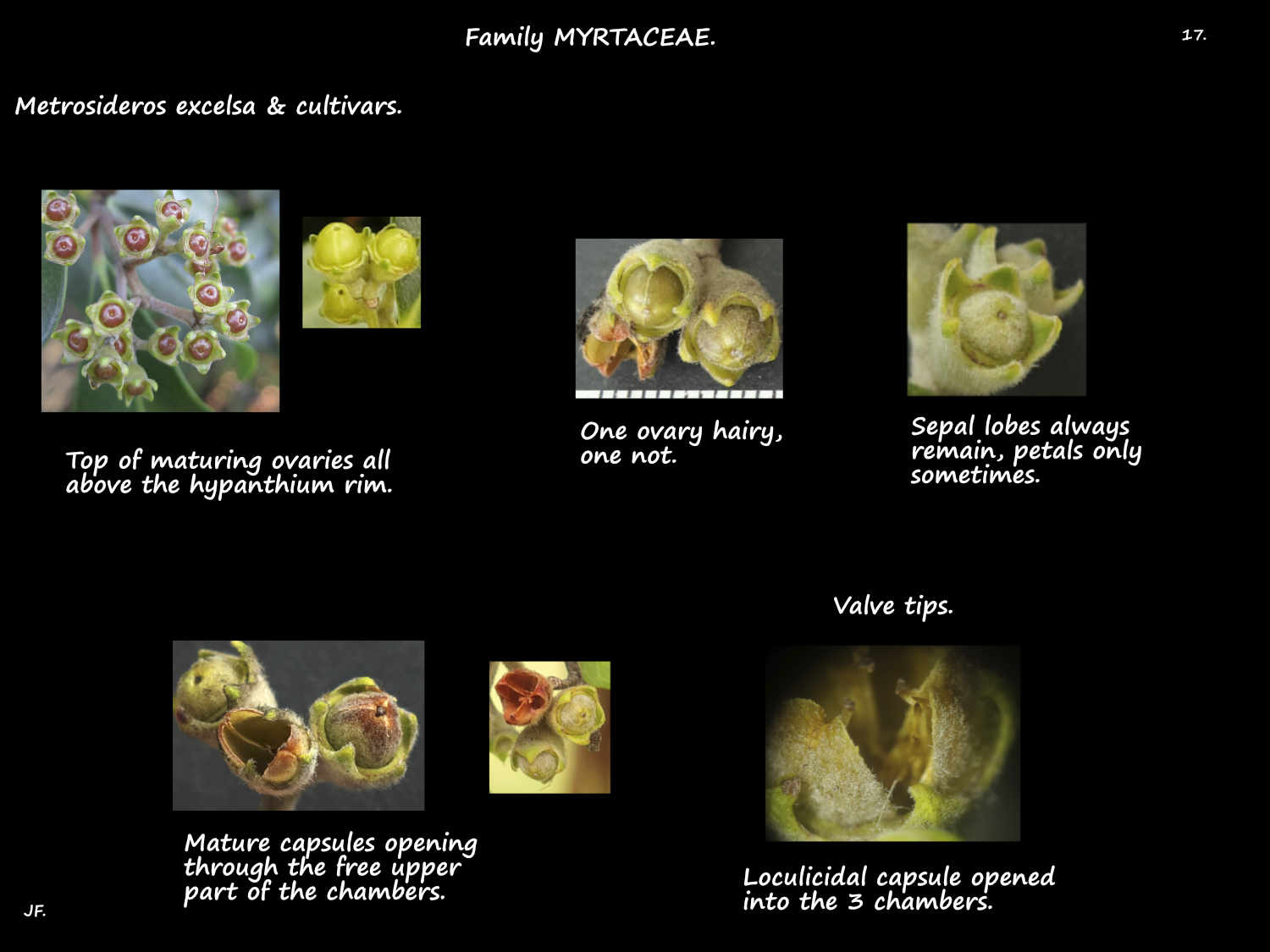
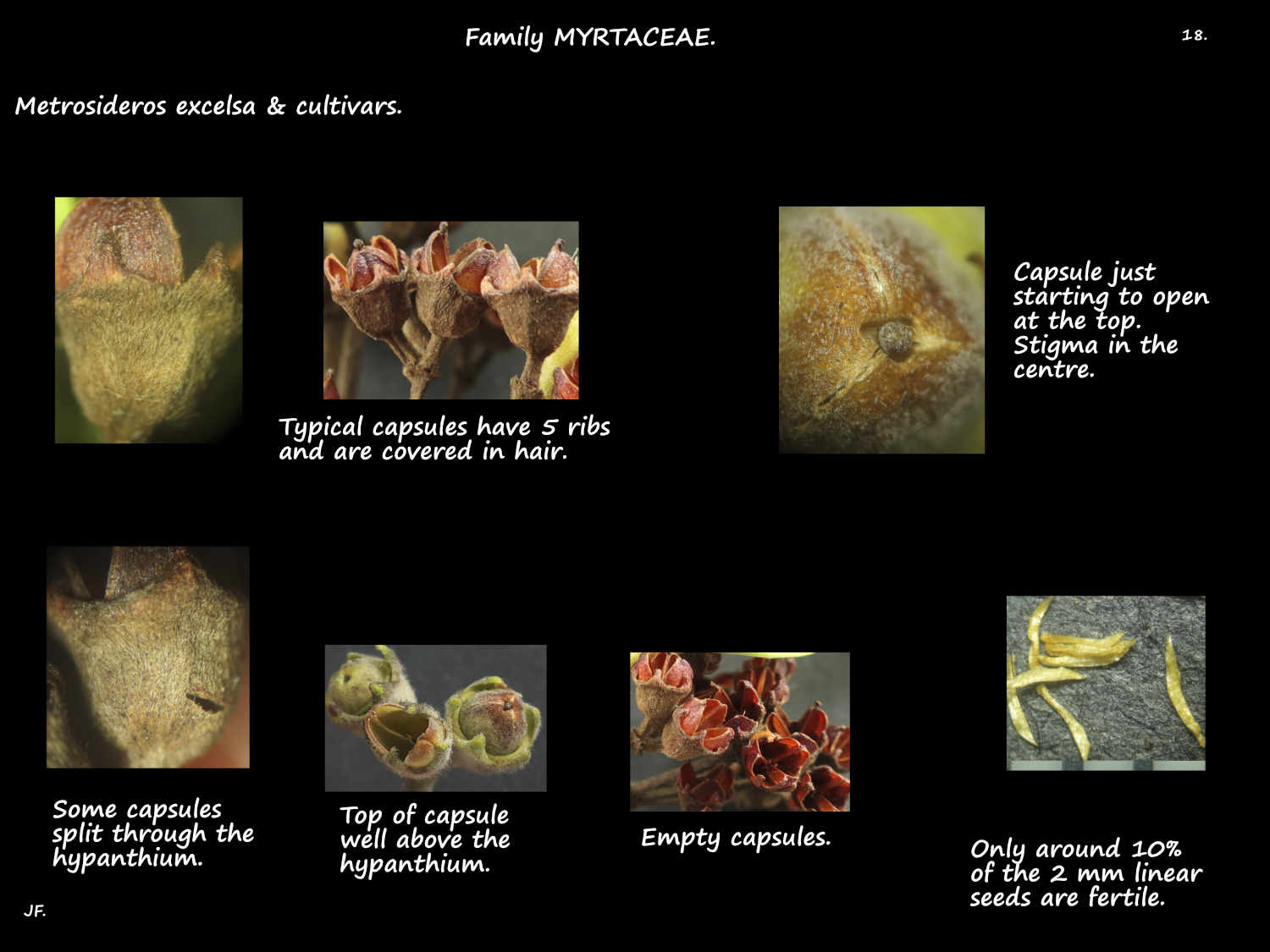
The tough to woody capsules, around 7 mm long have persistent sepal lobes attached.
Capsules open into the chambers (loculicidal).
The top of the capsule valves can be above, level with or below the rim of the hypanthium.
Most of the linear seeds are infertile.
#For more details on some inflorescences see J. W. Dawson (1968)
An analysis of flowers and fruits in New Zealand Metrosideros,
New Zealand Journal of Botany, 6:1, 43-55, DOI: 10.1080/0028825X.1968.10428789
To link to this article: https://doi.org/10.1080/0028825X.1968.10428789.
J.F.