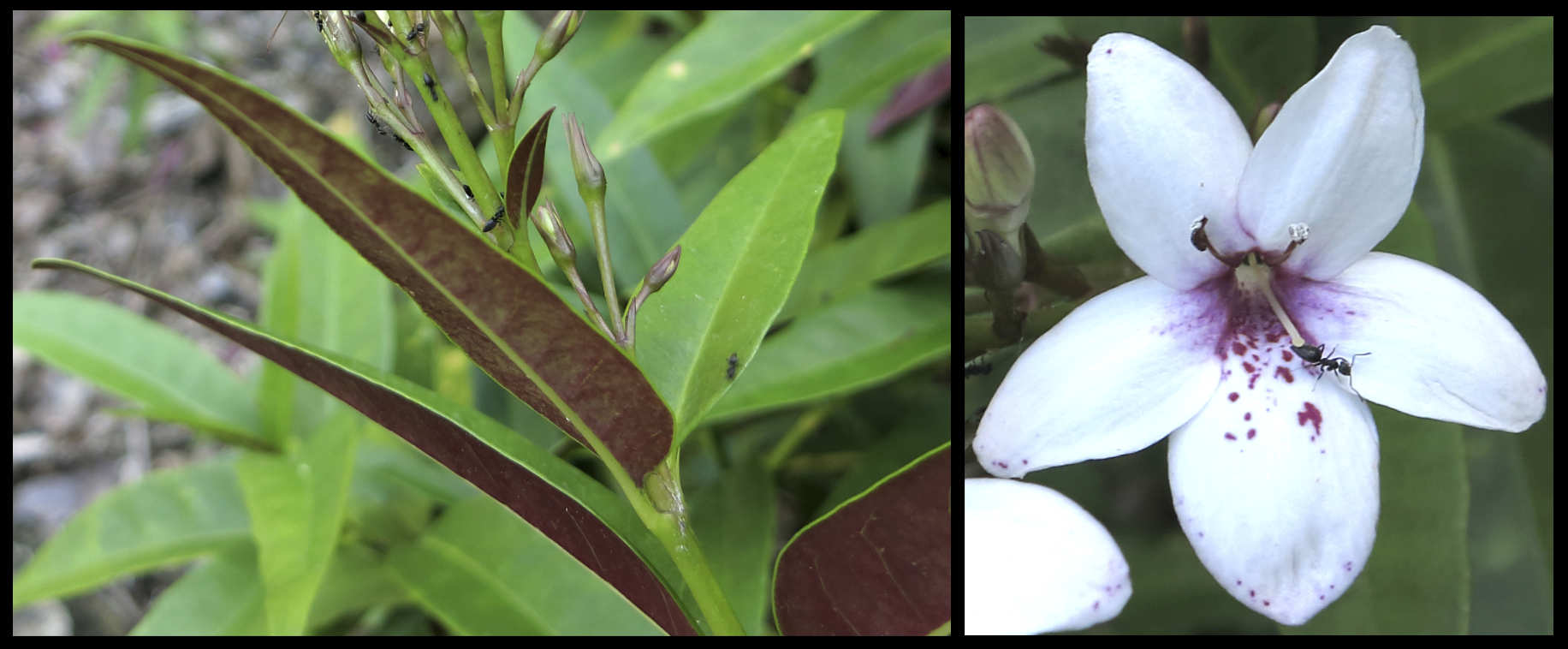
Kew has reclassified Pseuderanthemum atropurpureum as Pseuderanthemum maculatum.
Their 45 synonyms for P. maculatum include P. atropurpureum, P. carruthersii, P. carruthersii var. atropurpureum
and similar species under the Justicia and Eranthemum genera.
It is still known in Australia as P. atropurpureum so I will use this old name.
Cultivars and varieties are fairly common in Brisbane gardens but not the species plant.
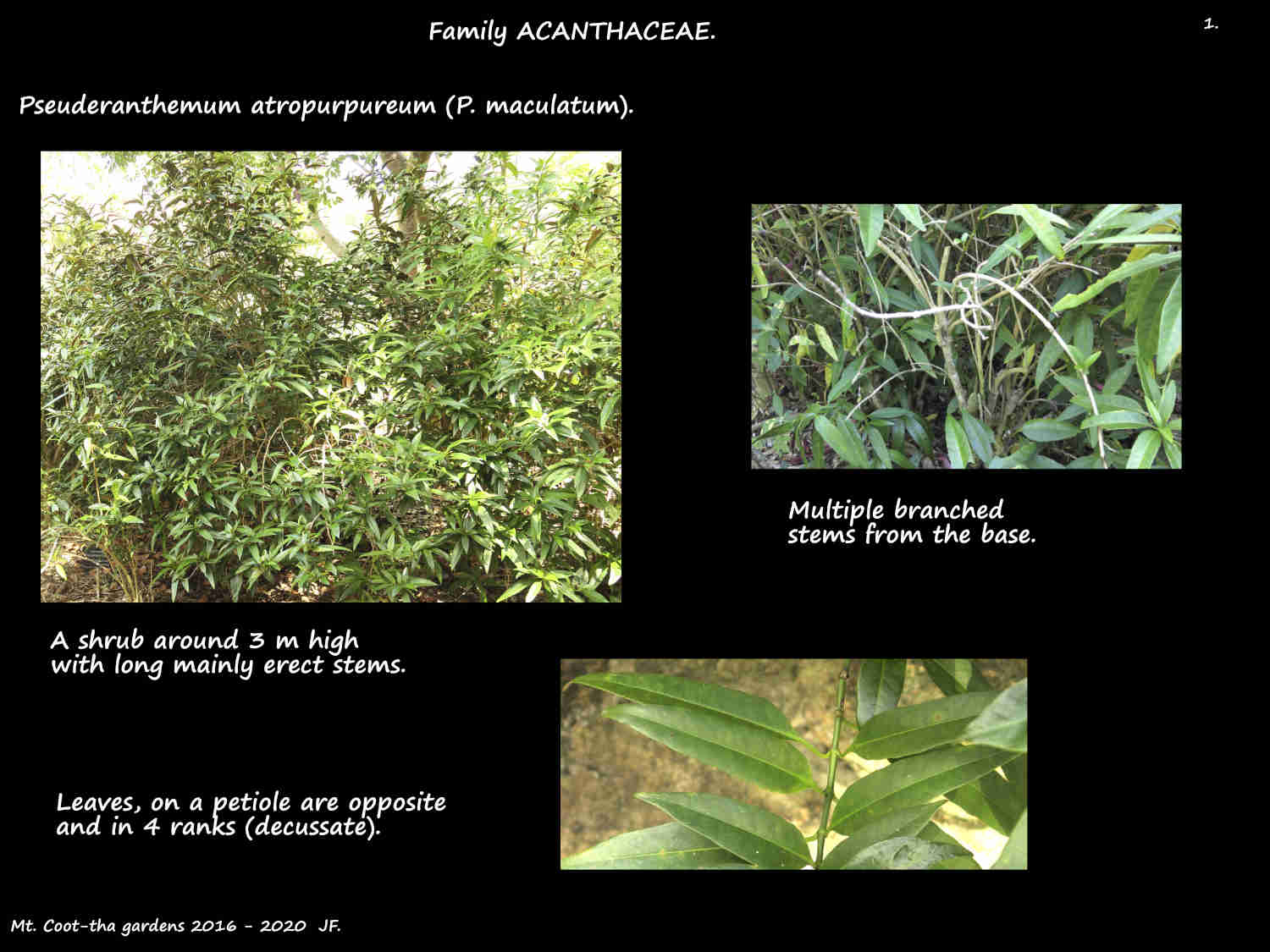
Species plants are erect evergreen shrubs up to 3 or 4 m high with many stems from the base.
Leaves are opposite and decussate (in 4 ranks).
Petioles, up to 2 cm long have a grooved upper surface and slight wings.
At the base of the upper petiole surface is a small clump of tiny hairs.
From this a ring of similar hairs runs around the stem.
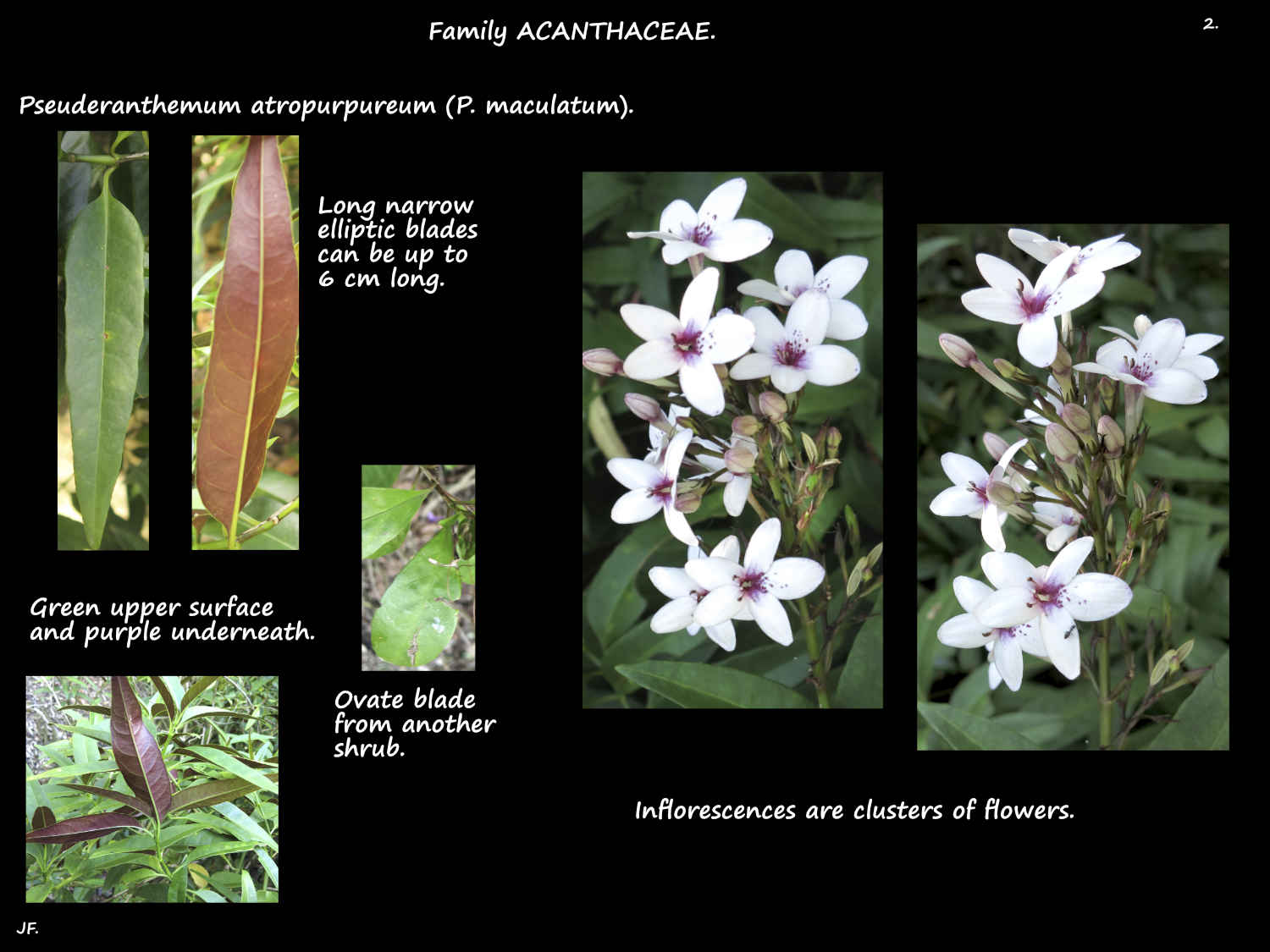
The elliptic or ovate blades can be up to around 10 cm long and 5 to 6 cm wide.
The tip is rounded or slightly pointed and the edge smooth.
Blades have no hairs but there are some cystoliths (small pale nodules).
Leaves are green with a purple lower surface.
Leaf, and petal colours, vary greatly leading to a number of common varieties.
P. atropurpureum var. atropurpureum has leaves mainly in shades of purple.
P. atropurpureum var. variegatum has green leaves with cream.
Most shrubs have a mix of colours with one predominating.
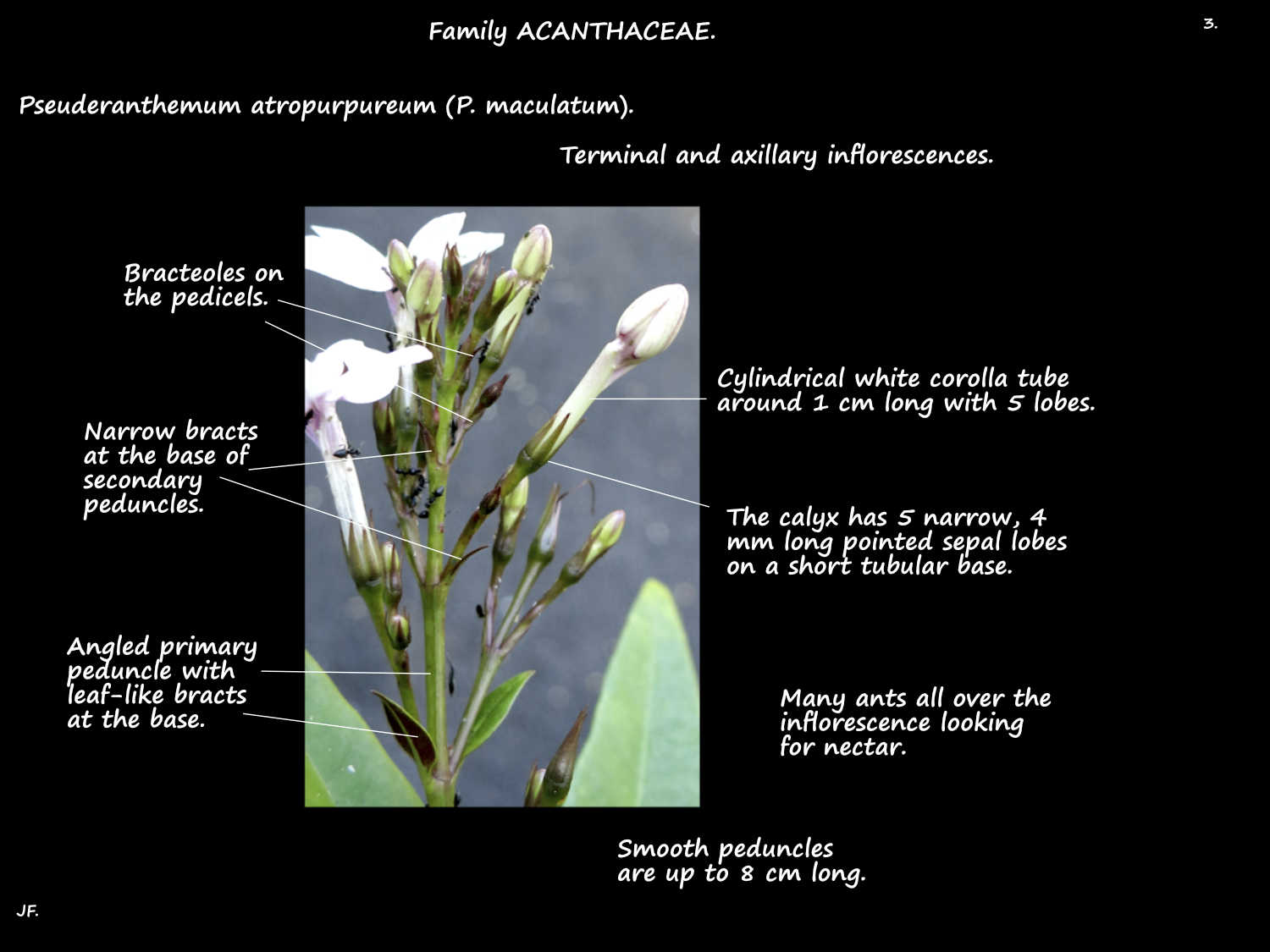
Terminal and axillary inflorescences are branched or unbranched.
They are on a smooth peduncle up to around 8 cm long with small bracts.
Flowers, in opposite pairs are on pedicels a few mms long with tiny bracteoles.
The calyx has a very short basal tube with 5 narrow lobes around 4 mm long.
There are short hairs on the outer surface.
The narrow cylindrical corolla tube is around 1 cm long.
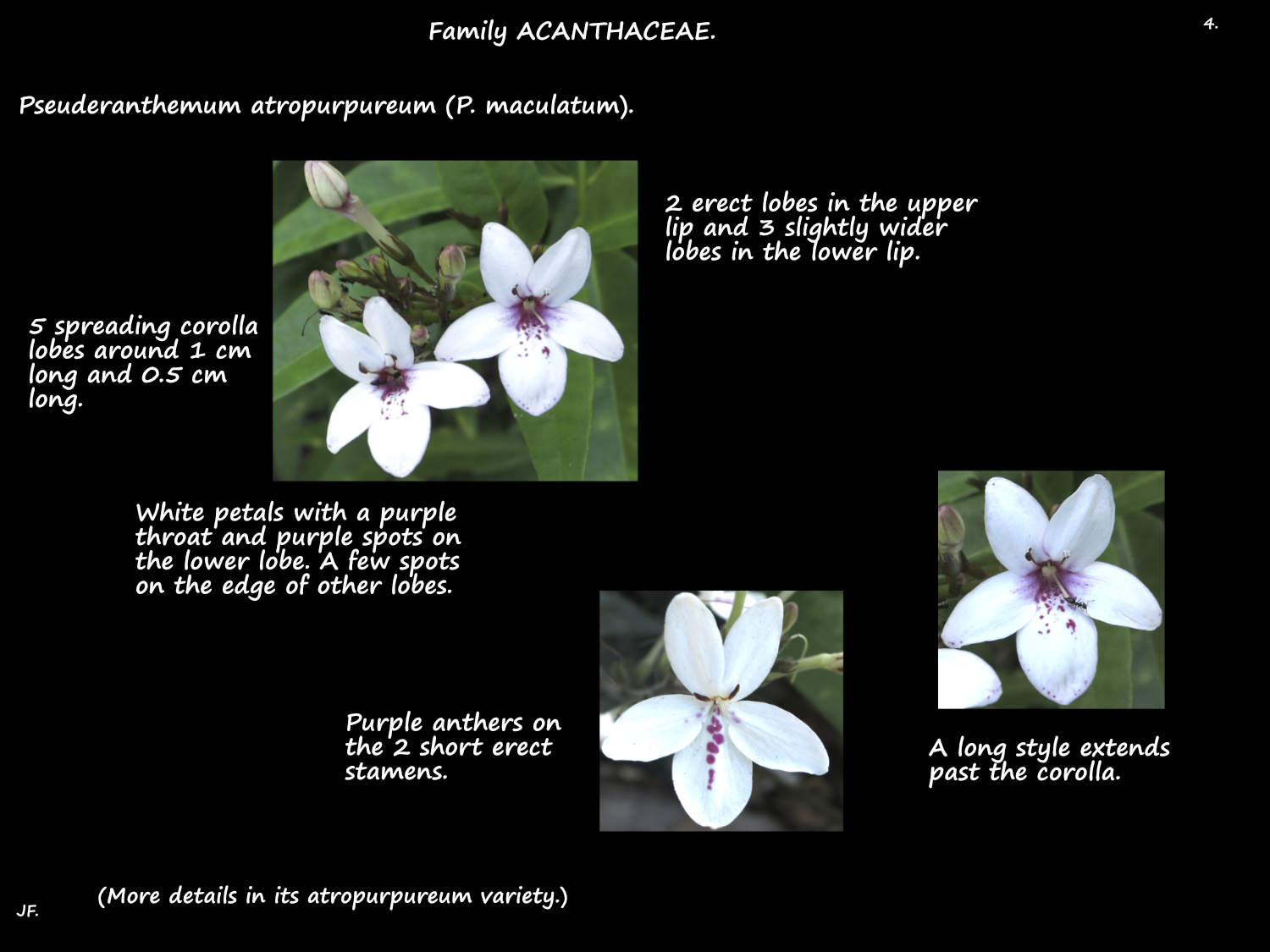
The 5 spreading lobes are in 2 lips with the upper pair being erect.
The lower lip has a pair of lateral lobes and a downward pointing lower lobe.
Petal lobes are around 1 cm long by 0.5 cm wide.
The white ovate to oblong lobes have a purple throat.
There are purple spots mainly at the base of the lower lobe.
There are varieties with different colours.
The 2 stamens are inserted just inside the top of the corolla tube.
They have 2 pollen sacs that lie over the base of the upper lobes.
There are 2 shorter infertile staminodes between the stamens.
The superior ovary, a few mms high has 2 locules each with 2 ovules.
Fruit are capsules with 1 to 4 seeds attached to a retinaculum that forcibly ejects the seeds.
(See the var. atropurpureum pictures for more information.) J.F.